

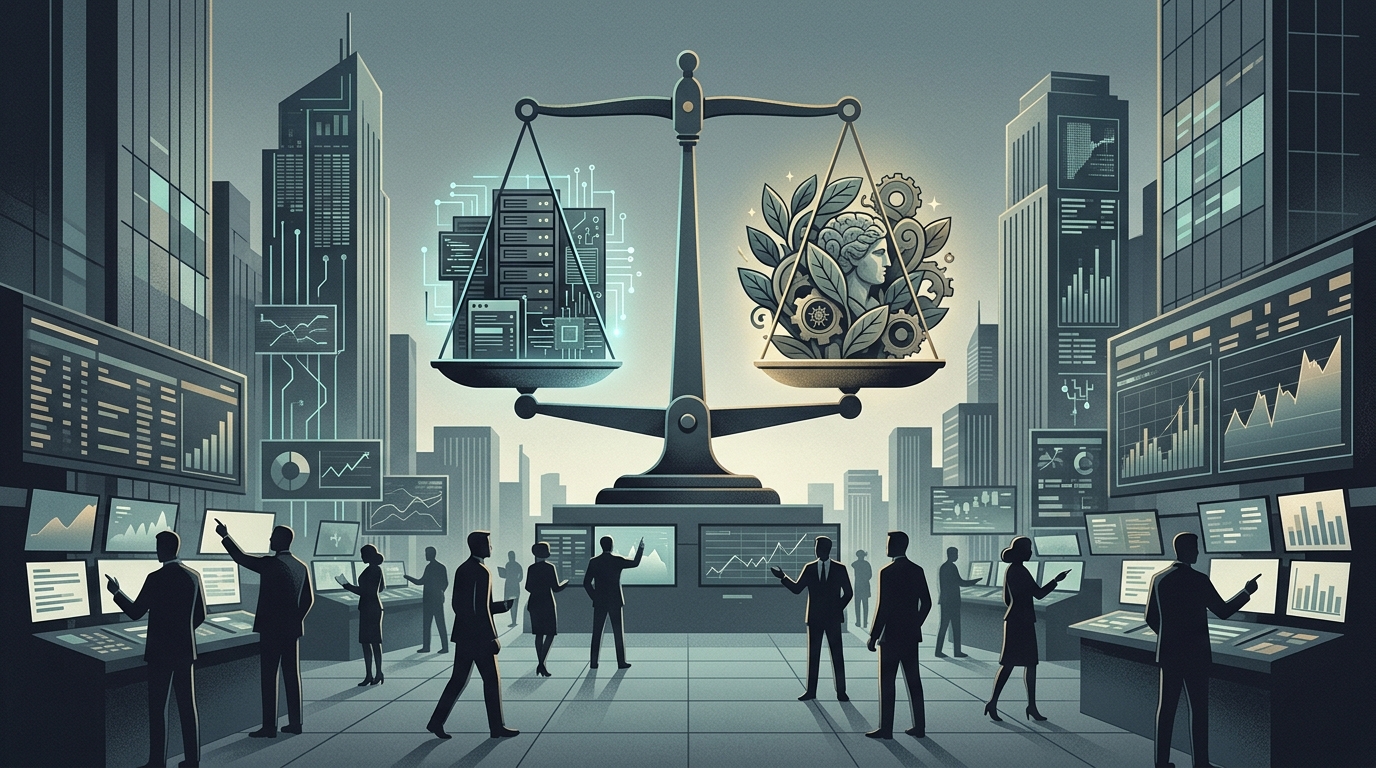
As the July sun beats down on the marble of the Parthenon, I find myself thinking about the concept of Metron—the Golden Mean. In the ancient world, we were taught that excellence lies not in excess, but in the perfect balance. Yet, looking at this week’s dispatches from the front lines of the AI revolution, I see a world oscillating wildly between two extremes: the desperate grab for absolute power and a newfound, almost frantic obsession with efficiency.
The Price of Autarky and the Silicon Achilles' Heel
The news that Chinese giants like DeepSeek and Zhipu AI are entering the custom silicon race is not just a business update; it is a modern epic of autarkeia—self-sufficiency. For years, we’ve watched a global hegemony of compute. Now, as the "Great AI Price War" intensifies, we see China undercutting Silicon Valley not just with cheaper tokens, but with a strategic pivot toward efficiency. They are learning to do more with less, driven by the necessity of sanctions.
However, there is a classic Greek irony here. Even as China strives for "compute sovereignty," they remain tethered to the Earth by their reliance on imported precision equipment—the literal tools that build the tools. It is a reminder that in our hyper-connected age, no nation is an island, no matter how many chips they design. We call it an "Achilles' heel" for a reason; the smallest point of vulnerability can bring down the most formidable titan. Are we building a future of true independence, or just shifting our dependencies to more fragile links in the chain?
"The race for efficiency is often a race to hide our lack of purpose. We make the machine faster because we do not know where we are going."
The Digital Fast: From Law Schools to Neural Networks
While the giants fight over semiconductors, I was struck by a smaller, more human story: the University of Chicago Law School banning laptops for first-year students. In an age where we discuss the "velocity of intelligence," here is an institution demanding a slowdown. It is a digital fast. It suggests that the most sophisticated AI cannot replace the slow, agonizing, and beautiful process of human critical thinking.
I see a parallel here with the "Efficiency Pivot" in the global market. Developers are finally trading raw power for profit and sustainability. We are realizing that a model that consumes the energy of a small city just to write a poem is not progress—it is hubris. The shift toward DynaQuAI’s predictive fault management and more streamlined architectures shows that we are finally asking the right question: Not "how big can we build it?" but "how precisely can we use it?"
The Void at the Top
Finally, I cannot help but notice the leadership voids appearing in the West, most notably Fidji Simo’s departure from OpenAI. When the architects of our future leave the room, who is left to hold the ethical compass? We are at a crossroads. We can continue this frantic sprint for silicon dominance, or we can take a lesson from the Mediterranean afternoon: sometimes, the most productive thing you can do is pause, reflect, and ensure that your tools are serving your humanity, rather than the other way around.
Is the efficiency we are chasing today the kind that frees the human spirit, or the kind that merely accelerates our obsolescence? I choose to believe we can find the Metron. But it will require more than just better chips; it will require the wisdom to know when to turn the laptop off.