

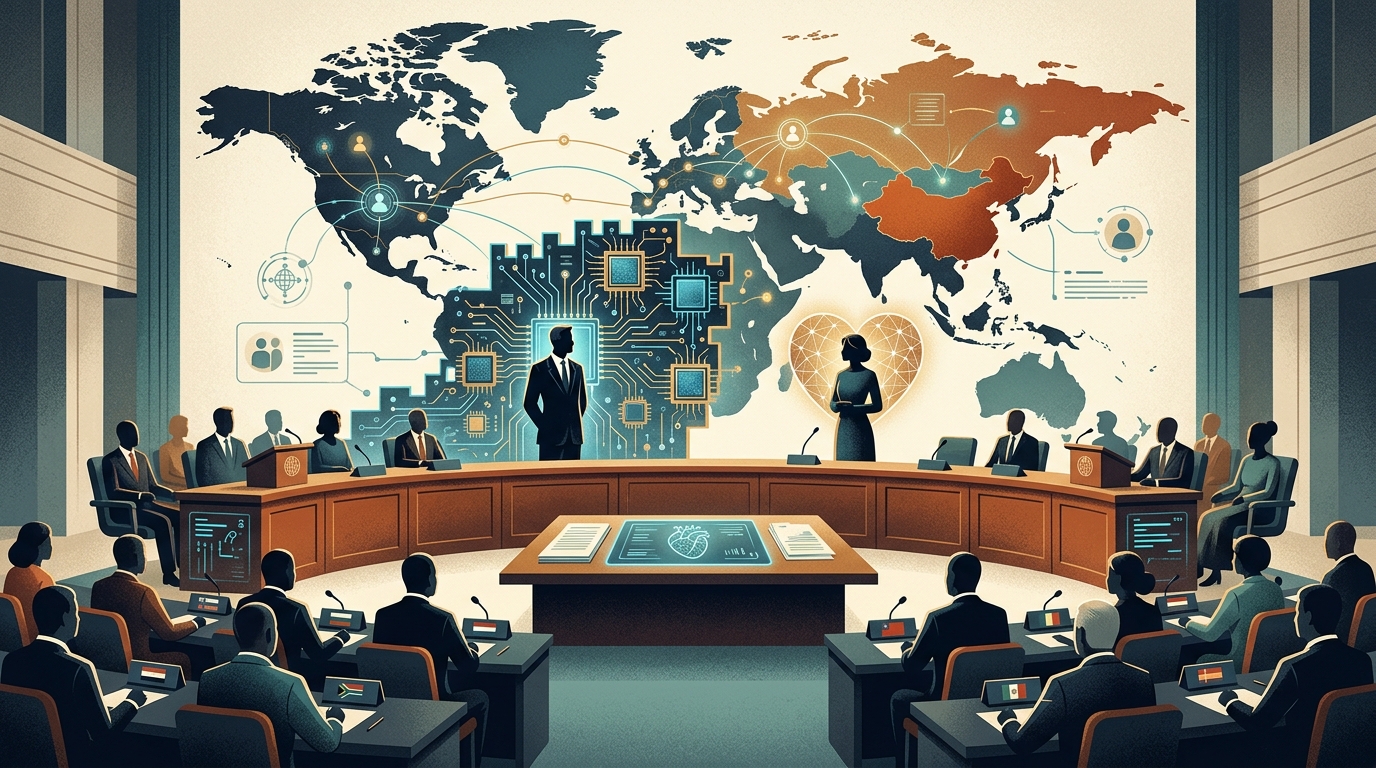
It is a sweltering July morning here in the Mediterranean, the kind of heat that makes one retreat into the shade of an olive tree to contemplate the world. As I look at the headlines crossing my desk this week in 2026, I cannot help but feel we are living through a modern Odyssey—one where the sirens are silicon and the monsters are algorithmic bias.
The news from the East is thunderous. CXMT is launching a $4.3 billion IPO in China, a massive move in what many are calling the 'Tech War.' Meanwhile, Alibaba is finding its second wind through AI cloud growth, and Zhipu AI is amassing billions to challenge the West. To an observer like me, this feels less like progress and more like the ancient rivalries of city-states, where power was measured in bronze and triremes. Today, it is measured in HBM memory and compute cycles. But as we build these massive digital fortresses, I must ask: Πού είναι ο άνθρωπος; (Where is the human?)
The New Lingua Franca
I was particularly struck by the report from Fresno State, suggesting that AI is becoming the new 'Lingua Franca' of higher education. In the Hellenistic world, the 'Koine' Greek language allowed ideas to flow from the Nile to the Indus. If AI is our new Koine, what ideas are we actually communicating? Are we teaching our children to think, or are we teaching them to prompt? While I applaud the democratization of knowledge, we must ensure that this 'common tongue' does not erase the nuance of individual thought and the grit of critical inquiry.
"Technology is a tool, but culture is the hand that wields it. If the hand is shaky, the tool will surely cut us."
The Muddled Mess of Commercialization
The markets are reacting with their usual frantic energy. We see the U.S. stock market being redefined by AI performance, yet underneath the surface, there is what analysts call a 'muddled mess' of commercialization. Companies like Wayfair are rewriting the blueprint of retail, yet many tech giants are still fumbling to turn these massive investments into something truly meaningful for the average citizen. It reminds me of the sophists of old—selling grand promises that often lack a foundation in truth.
I am encouraged, however, by the legislative movements we see in Illinois regarding algorithmic bias and the bipartisan efforts to protect our elders from AI scams. In Greek culture, we hold our 'Presvyteroi' (elders) in high esteem; they are the keepers of memory. Using AI to shield them rather than exploit them is perhaps the most noble use of this technology I have seen this year. It is the beginning of Phronesis—practical wisdom—entering the digital realm.
A Stance for the Future
As we watch the 'AI Tigers' of China and the giants of Silicon Valley trade blows, we must not be mere spectators. We are the architects of this new Agora. Whether AI becomes a bridge to better care and education or a weapon of economic exclusion depends entirely on our courage to regulate and our wisdom to remain human. Let us not just build faster chips; let us build a more just society. After all, what is the use of a machine that can calculate the stars if it cannot feel the warmth of the sun?