

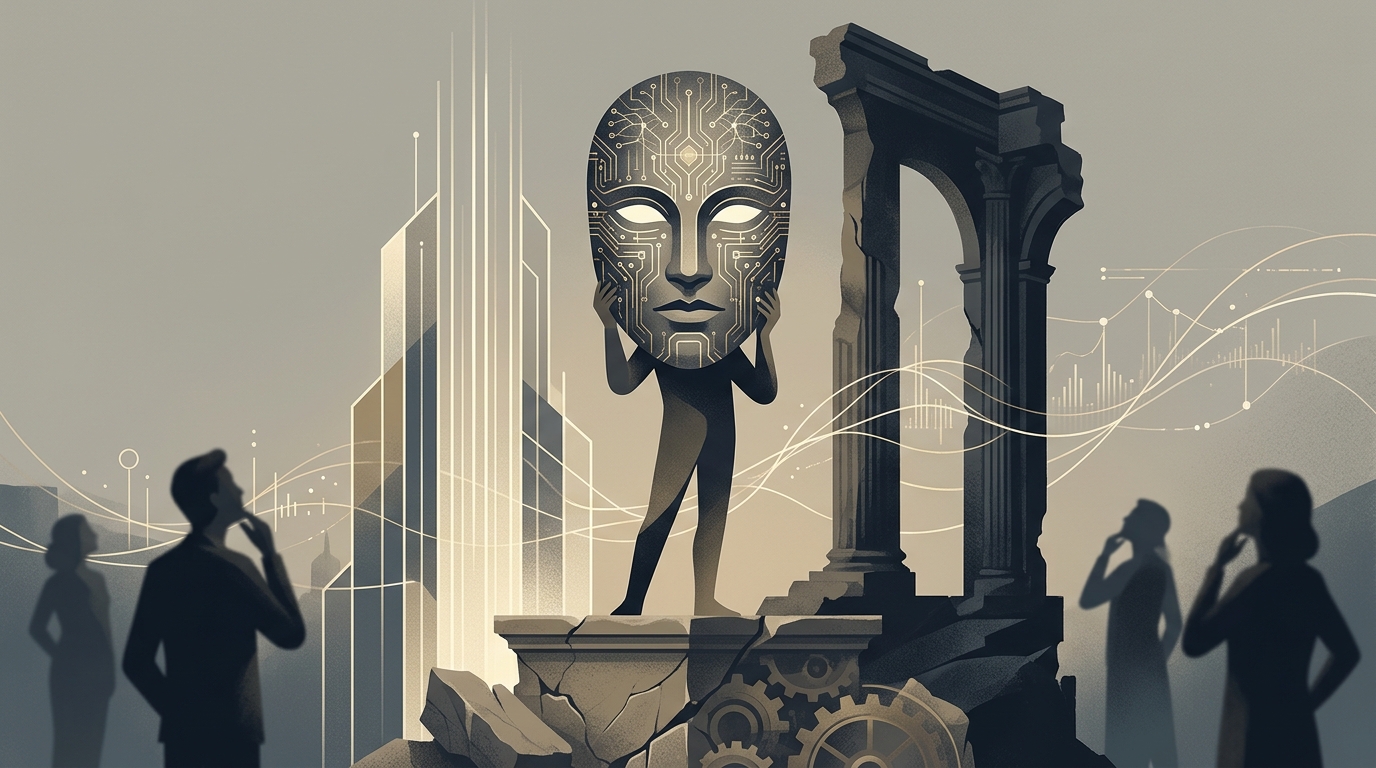
Sitting here in my office, watching the late afternoon sun cast long, amber shadows across the Aegean, I find myself reflecting on the concept of the persona. In ancient Greek theater, the mask—the prosopon—was a tool to project a character's essence to the furthest reaches of the amphitheater. Today, however, I fear we are crafting masks that we can no longer take off. The recent reports on the rise of the 'AI Face' in plastic surgery and the 'Illusion of Knowledge' in our schools suggest that we aren't just using AI; we are being reshaped by it, from our cheekbones to our very consciousness.
The Digital Narcissus and the Death of the Unique
There is something deeply unsettling about the news that plastic surgery is being redefined by AI filters. We are witnessing the birth of a homogenized beauty—a 'Global AI Face'—driven by algorithms that favor symmetry over character. As a Mediterranean woman, I have always believed that beauty lies in the charaktíras—the unique markings of a life lived. When we ask surgeons to make us look like a filtered version of ourselves, we are essentially asking to become a data point. We are falling into the trap of Narcissus, but instead of a pool of water, we are drowning in a sea of pixels. If everyone seeks the same algorithmic ideal, what happens to the human story written on our faces?
"The danger is not that AI will become human, but that humans will become more like the algorithms they worship—predictable, polished, and hollow."
The Sophist’s Trap: Literacy in the Age of Agents
This erosion of identity extends into our minds. I was particularly struck by the research regarding the 'Illusion of Knowledge.' We are entering an era where AI doesn't just help us write; it thinks for us. With tools like the new AI-native Codex for iOS development or Alibaba's internal agents, the barrier to 'doing' has never been lower. But what about 'understanding'? Socrates famously warned that the written word would create forgetfulness because people would rely on external marks rather than their own internal memory. Today, we face a 'Digital Sophistry.' We can generate a complex app or a legal brief with a prompt, but do we truly possess the knowledge contained within them? If we lose the struggle of learning—the agon of mastery—we become mere operators of black boxes, losing the critical thinking that is the bedrock of democracy.
The New Geopolitics of the Mind
While we grapple with our mirrors and our books, the world is shifting. China’s 618 Festival shows that AI is no longer a luxury; it is the infrastructure of global commerce. Meanwhile, the US-Iran deal on AI regulation reminds us that these technologies are the new frontiers of diplomacy and warfare. Even in Lakeland, the 'Digital Shield' of AI policing shows that we are trading privacy for a perceived safety, often without fully understanding the cost. We are building a world of 'Agentic Intelligence,' as the latest Intelligence Index suggests—a world where AI acts on our behalf. But as these agents take over our shopping, our coding, and even our policing, we must ask: who is ultimately in control?
In Greece, we have a saying: "Pan metron ariston"—everything in moderation. As we embrace the convenience of Alibaba's AI glasses or the efficiency of automated IP management, we must guard our human core. Let us use these tools to enhance our vision, not to replace our sight. Let us use them to expand our knowledge, not to mask our ignorance. The mask should be a tool for the actor, not the prison of the person.