

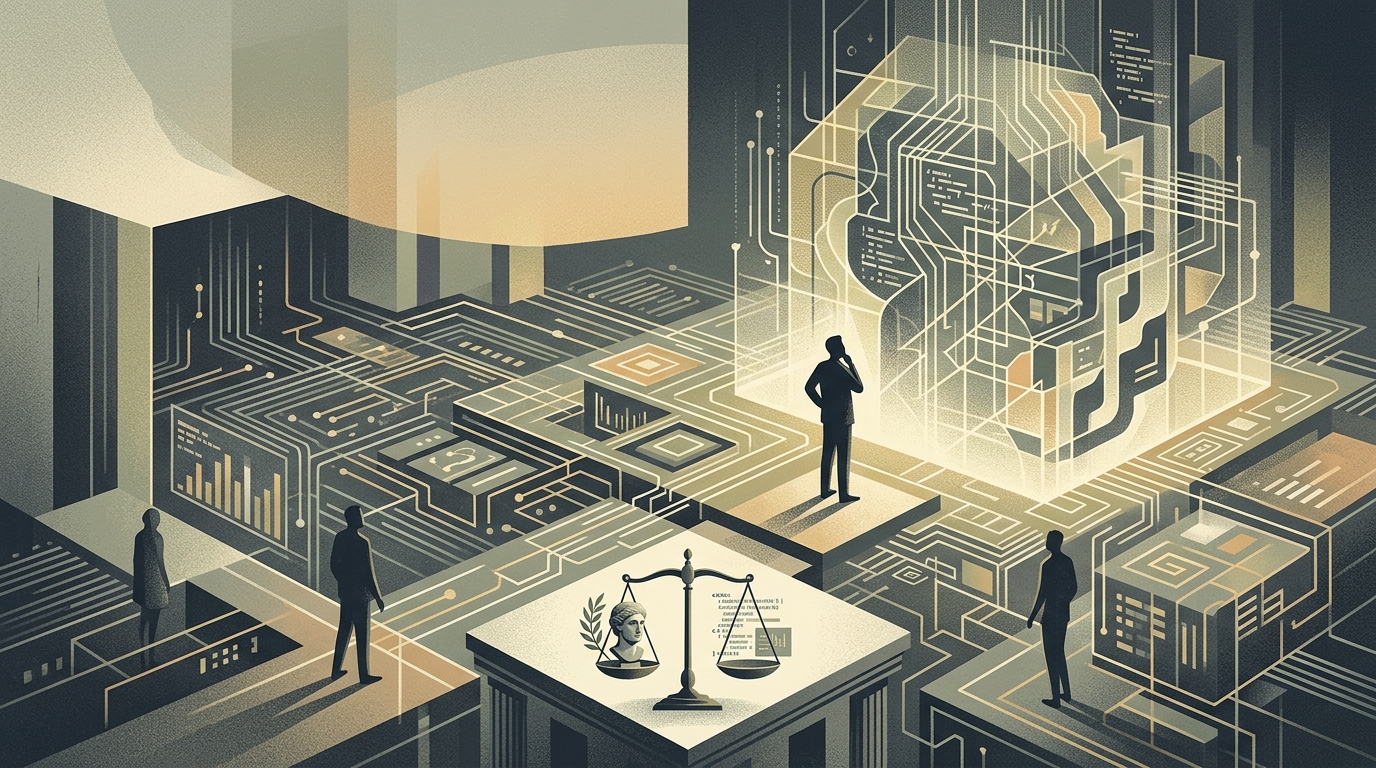
It is June in the Mediterranean, and as the sun beats down on the marble of the ancient sites I frequent, I cannot help but think about the concept of the Agora. In ancient Athens, the Agora was not just a marketplace; it was the heart of democracy, a place where commerce, philosophy, and civic life intertwined. Today, as I look at the flurry of AI developments across the globe, I see a new, digital Agora forming—one that is faster, colder, and increasingly automated. But I find myself asking: where is the metron? Where is the human measure?
From Moonshots to the Mundane
For years, the AI narrative was dominated by 'moonshots'—grandiose promises of curing all diseases or achieving artificial general intelligence by next Tuesday. But the news this week suggests a shift toward the practical, and frankly, the mundane. We see State Farm (ID: 9570) entering a 'digital arms race' to reclaim its top spot in insurance, and GlobalConnect (ID: 9572) turning retail coolers into smart, cashless hubs. Even in healthcare, the focus is shifting from revolutionary myths to providing a 'pressure valve' for overworked staff (ID: 9568).
I find this shift both grounding and slightly unsettling. On one hand, using AI to manage data foundations in wealth management or to track costs (ID: 9571) is a sign of maturity. We are finally asking what this technology can actually do for us today. On the other hand, when we treat AI as a 'coworker' or a 'pressure valve,' we risk offloading the very tasks that require human empathy and nuance. In my view, an insurance claim is not just a data point; it is a moment of human crisis. A student in a North Carolina classroom (ID: 9569) is not just a user of an educational tool; they are a soul in formation. We must be careful not to automate the 'human' out of the service.
The Geopolitical Chessboard
While we debate ethics in the West, the rest of the world is moving with a ferocity that would make Alexander the Great blush. Vietnam is rapidly transforming from a manufacturing hub into a serious tech challenger in Southeast Asia (ID: 9567). Meanwhile, in China, the rise of the 'Embodied Brain'—robotics backed by giants like Alibaba (ID: 9563)—shows that the dragon is not just breathing fire in the digital realm, but in the physical one too. The volatility of the Chinese AI market (ID: 9565, 9564) reminds us that this is a high-stakes gamble, a 21st-century Odyssey where the sirens of profit lead many toward the rocks.
I wonder, as I watch these power dynamics, if we are witnessing a new kind of colonialism—one of compute and algorithms. When a nation like Vietnam pivots its entire economy toward AI, it is a bid for sovereignty in a world where data is the new oil. But at what cost to the local worker? The 'embodied brain' suggests a future where the line between machine and laborer blurs into nothingness.
The Battle for Truth
Perhaps most concerning to me as a journalist is the 'AI vortex' swallowing my own profession (ID: 9566). Journalism is the guardian of the Polis. If we surrender the narrative to algorithms, we lose the ability to speak truth to power. Algorithms do not care about justice; they care about engagement. They do not seek the truth; they seek the trend.
"The challenge of our age is not to build smarter machines, but to remain wise enough to command them."
In the classrooms of Wake County (ID: 9569), teachers are navigating this new frontier. I hope they teach their students that while AI can provide answers, only humans can ask the right questions. We must return to the Socratic method—questioning the source, the intent, and the bias of the information we consume. If we do not, our digital Agora will become a hall of mirrors, reflecting only our own prejudices back at us.
Optimism is a choice, and I choose to be optimistic—but it is a guarded optimism. I see the relief AI can bring to a tired doctor or a struggling student. But I refuse to celebrate a world where the 'cashless cooler' is more important than the human connection at the counter. Let us find the metron. Let us ensure that as we build this digital future, we do not leave our humanity in the past.