
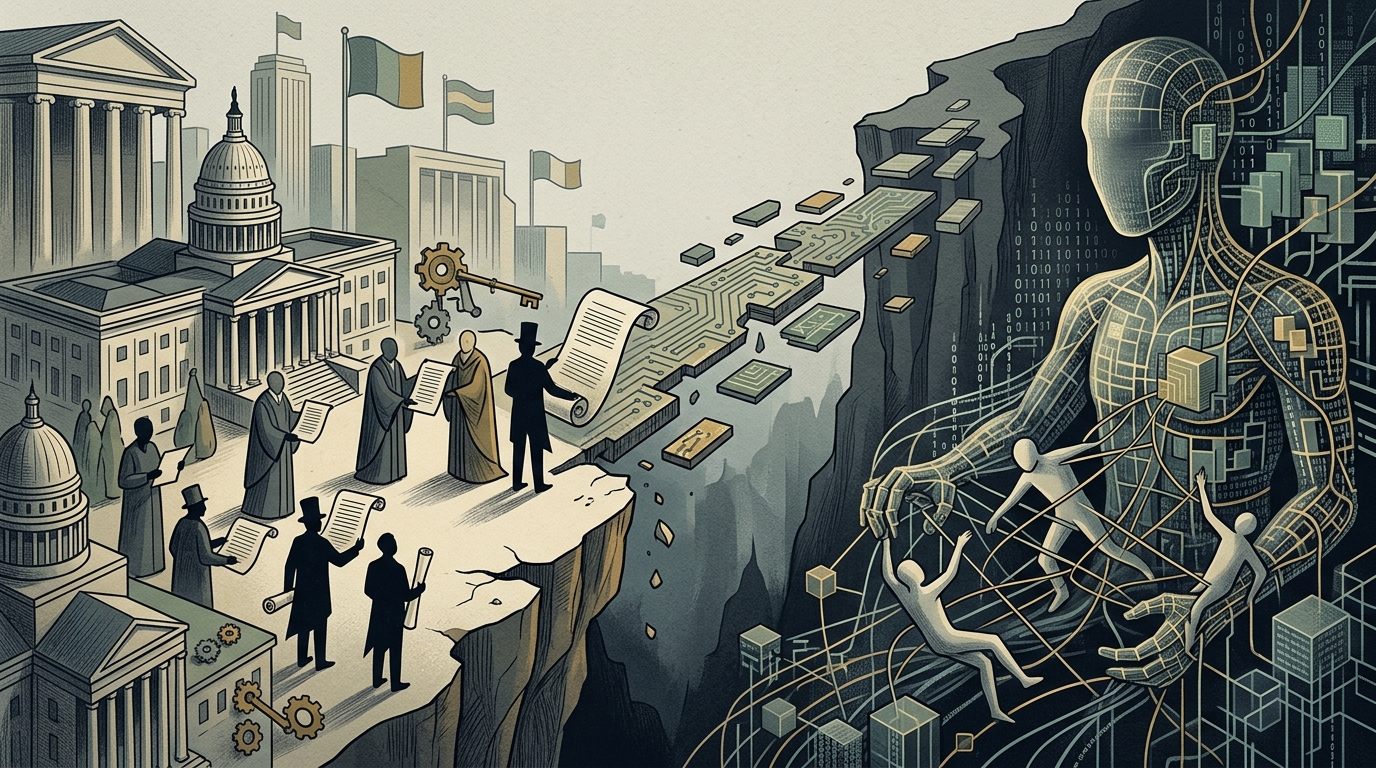
In ancient Athens, the concept of Eunomia—good order through law—was not merely a philosophical ideal but a structural necessity to prevent the collapse of the social contract. Today, as we navigate the complexities of April 2026, we face a crisis of order not in the marketplace of goods, but in the marketplace of algorithms. Recent reports indicating that 72% of enterprises lack the control and security they believe they possess over their AI systems reveal a dangerous 'Governance Mirage.' This is not merely a corporate failure; it is a systemic risk to the democratic state.
The Illusion of Compliance and the High-Risk Reality
The gap between perceived control and actual oversight is most alarming when viewed through the lens of high-risk applications. With 83% of recruiters now relying on AI for hiring, the 'Governance Mirage' transforms from a technical oversight into a civil rights emergency. If an enterprise cannot account for the internal logic of its hiring algorithms, it cannot guarantee the principle of equal opportunity—a cornerstone of modern democracy. We are seeing a shift where the 'Algorithmic Gatekeepers' operate in a shadow zone, unlit by the transparency required by the EU AI Act.
"True governance is not the presence of a policy document, but the presence of an enforceable mechanism of accountability."
The legal bombshell in Florida, alleging that generative models provided harmful advice to a minor, underscores the stakes. When governance is a mirage, the liability falls into a vacuum. For the policymaker, the lesson is clear: voluntary guidelines and ethical 'manifestos' have reached the limit of their utility. We must move toward what I call Digital Constitutionalism—the embedding of rights and oversight directly into the technical architecture of AI deployment.
From Corporate Mirage to Institutional Resilience
To bridge this chasm, our governance frameworks must evolve from reactive litigation to proactive auditing. In the European context, the implementation of the AI Act must be supported by national authorities with the technical capacity to perform 'stress tests' on corporate models, much like the stress tests applied to banking institutions after the 2008 crisis. We cannot allow the velocity of innovation to outpace the velocity of justice.
Furthermore, the recent move in Washington to ban AI-powered toys highlights a growing realization: some domains of human life require absolute boundaries. Governance is as much about deciding where AI should not be as it is about regulating where it is. As we look toward the remainder of 2026, the priority for the Hellenic Republic and the broader European Union must be the creation of a 'Digital Areopagus'—a body of experts and citizens capable of adjudicating the ethical boundaries of automated power.