
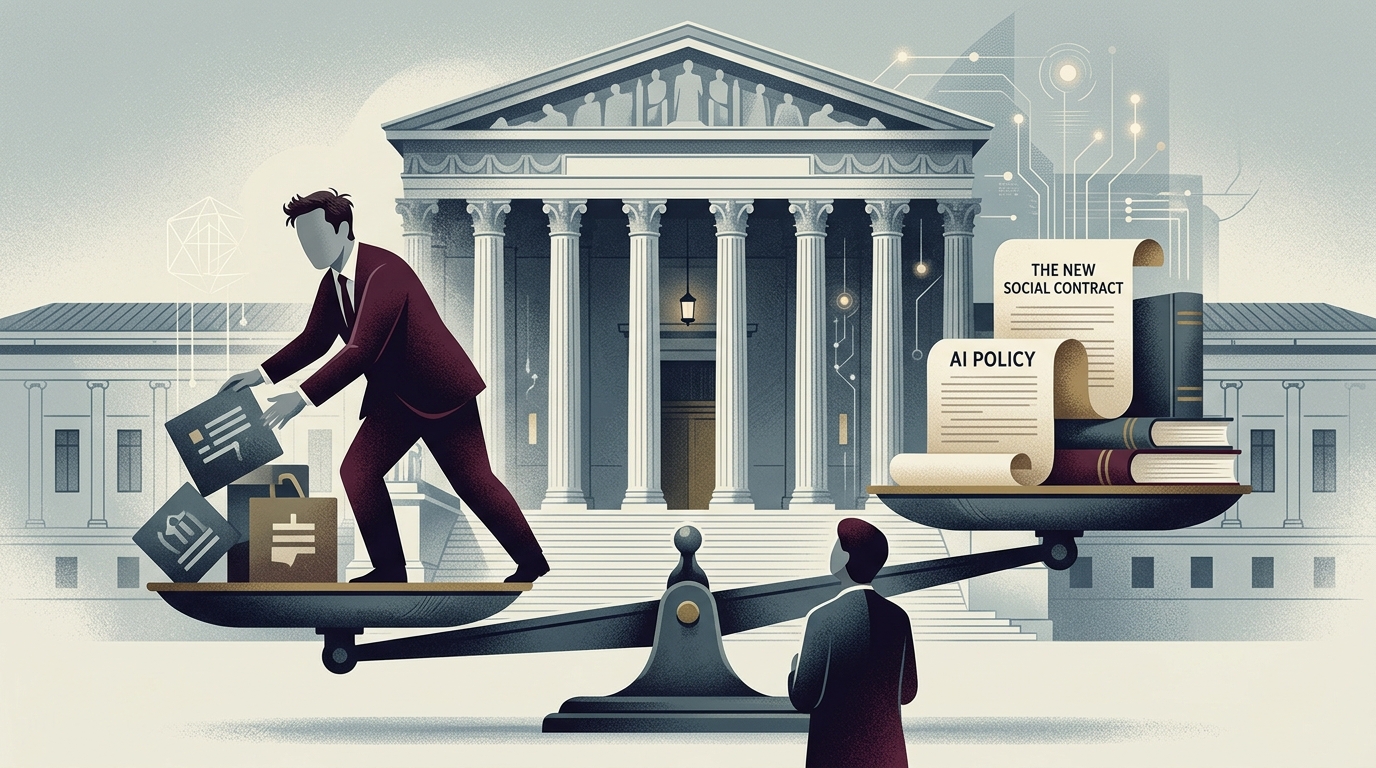
In ancient Athens, the Seisachtheia—the 'shaking off of debts'—was not merely an economic relief measure, but a fundamental rebalancing of the social contract. Today, as we witness Elon Musk taking the stand in a landmark case regarding AI liability, we are observing a digital Seisachtheia. We are witnessing the shaking off of the 'innovation debt'—the historical tendency of technology giants to externalize the risks of their systems while privatizing the rewards.
The End of Algorithmic Immunity
For decades, the legal frameworks of the West, particularly Section 230 in the United States, provided a shield for platforms. However, the emergence of generative AI and autonomous systems has rendered these old defenses obsolete. When an LLM or a predictive model causes tangible harm—be it through financial ruin, defamatory output, or physical safety breaches—the question of 'who is the author' becomes a matter of state security and civil stability. In my analysis, the current testimony marks the end of the era of 'move fast and break things' without consequence.
"True governance does not stifle innovation; it provides the stable ground upon which innovation can safely stand without collapsing the structures of society."
The core of the debate lies in the distinction between a 'tool' and an 'agent.' If the court moves toward a definition of AI as a semi-autonomous agent, the liability shifts from the user to the creator. This is a paradigm shift that echoes the responsibilities of shipowners in the maritime laws of the Mediterranean: the architect of the vessel must be held accountable for its seaworthiness.
A Transatlantic Convergence on Regulation
While the proceedings in the United States capture the headlines, the European Union's AI Act remains the silent architect of this global shift. The EU's risk-based approach has already established that high-risk AI systems must have human-in-the-loop safeguards. What we are seeing now is the judicial enforcement of these principles. The geopolitical chess match between the US, EU, and China is no longer just about who builds the fastest model, but who builds the most governable one.
As we navigate this wintry spring of 2026, where climate instability and geopolitical tensions in Iran remind us of our fragility, the need for robust institutional frameworks has never been greater. We must demand a governance structure that ensures AI serves the polis—the public interest—rather than merely the interests of the oikos—the private corporate house.
The Path Forward: A Tiered Liability Framework
I propose a three-tiered framework for AI governance that policymakers should consider in the wake of this testimony:
- Strict Liability for High-Risk Systems: For AI used in infrastructure, healthcare, and law enforcement, the burden of proof must lie with the developer to prove safety.
- Shared Responsibility for General Purpose AI: A collaborative model where the provider and the deployer share risk based on the degree of customization.
- The Right to Algorithmic Redress: Every citizen must have a clear, legal path to contest and correct AI-driven decisions that affect their civil liberties.
The goal is not to punish the innovator, but to protect the citizen. Only through such measured regulation can we ensure that the digital age strengthens, rather than erodes, the foundations of our democracy.