
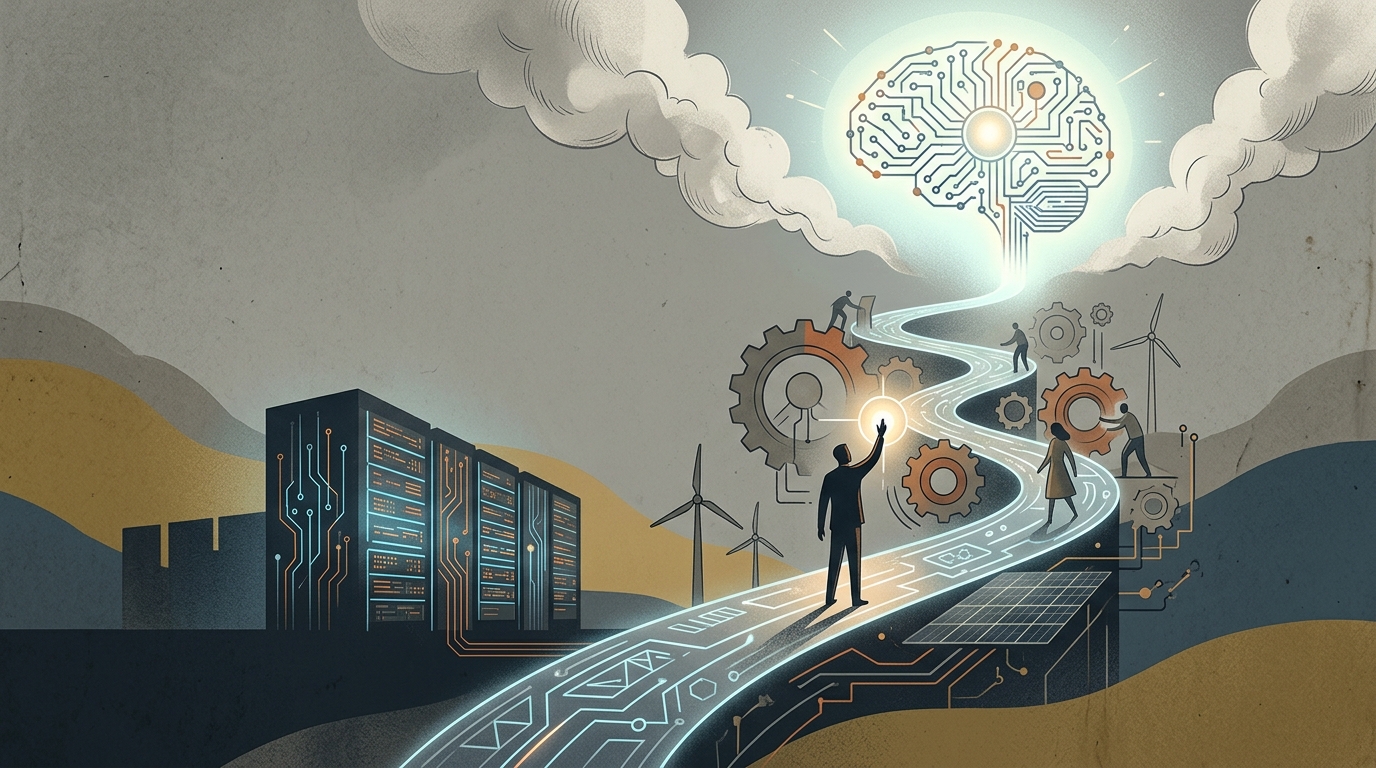
As we close April 2026, the financial landscape is undergoing a profound structural re-rating. The era of 'AI at any cost' has officially ended, replaced by a disciplined focus on unit economics, energy resilience, and vertical integration. The markets are no longer rewarding mere innovation; they are rewarding the ability to scale intelligence while maintaining margins in a high-cost energy environment.
The Margin Squeeze: Energy Costs vs. AI Deflation
The most pressing concern for European markets remains the staggering energy deficit. Commission President Ursula von der Leyen’s warning of €500 million in daily losses for Europe highlights a systemic risk that AI infrastructure cannot ignore. While the 'DeepSeek shockwave' has introduced a deflationary trend in the cost of intelligence—slashing the price of API calls and model training—this is being offset by the rising cost of the electrons required to run these models.
Investors are increasingly looking toward the 'K-Energy Value Chain' and similar strategic plays in Korea and the US, where energy production is being tied directly to data center clusters. For the European business landscape, the challenge is existential: without a rapid decoupling of energy prices from geopolitical volatility, the productivity gains promised by AI may be neutralized by operational overheads.
The Banking Sector: A Beacon of AI-Driven Efficiency
Contrasting the industrial energy struggle, the financial sector is providing a masterclass in AI-driven margin expansion. UBS’s reported $3 billion profit and Deutsche Bank’s robust Q1 2026 performance demonstrate that the 'Credit Suisse gamble' and subsequent digital integration have paid off. These institutions are no longer just using AI for back-office automation; they are utilizing it for complex risk assessment and real-time capital allocation.
"The 2026 pivot is characterized by the transition from horizontal, general-purpose models to vertical value chains where AI is deeply embedded in specific industrial logic."
This trend is further evidenced by the strategic shift in the cloud landscape. OpenAI’s pivot to a multi-cloud strategy via AWS indicates a move toward infrastructure resilience and cost optimization, moving away from exclusive dependencies that create single points of failure for enterprise clients.
Greek Economy: Escaping the Productivity Trap
In Greece, the narrative is shifting from digital rhetoric to measurable outcomes. While the 'Digital Social Benefits' initiative represents an ambitious leap in welfare efficiency, the broader economy still faces the 'Productivity Trap.' To move beyond catchy slogans, Greek SMEs must leverage AI not just for administrative tasks, but for high-value exports and service differentiation. The Athens Stock Exchange is reflecting this cautious optimism, with tech-adjacent stocks showing resilience, though capital expenditure remains sensitive to global interest rate trajectories.
Market Implications and Strategy
- Hardware Decoupling: The rise of Huawei’s domestic silicon and the pivot by Alibaba and ByteDance suggest a bifurcated AI market. Investors should look for 'geopolitical resilience' in tech portfolios.
- Value Realization: We are moving from the $5 trillion Nvidia-centric 'peak' to a plateau where the software layer and vertical applications (HealthTech, FinTech, EnergyTech) will capture a larger share of the value.
- Energy as the New Currency: Companies with integrated energy solutions or those located in low-cost energy jurisdictions will command a premium.