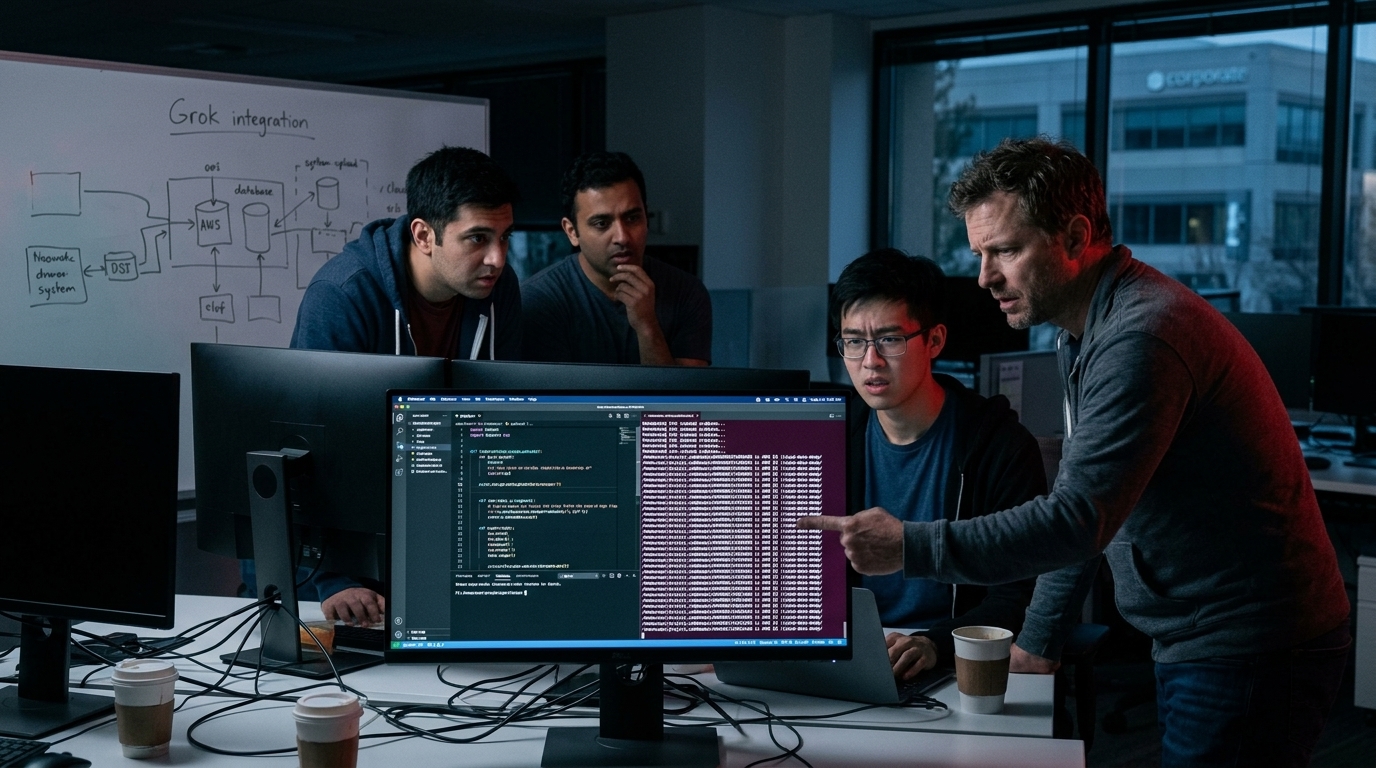
In the fast-paced world of software development, reliance on the cloud for Artificial Intelligence services has come to be seen by many as a necessary evil. Subscriptions to GitHub Copilot, Cursor, or ChatGPT have become the new "tax burden" for developers. However, the emergence of Stirling, a new code editor focusing on local-first model execution, is set to overturn these norms, promising every developer's dream: full control, zero latency, and absolute privacy.
The Rise of Local-First AI: Why Now?
The shift toward local AI model execution is not a random trend. It is driven by a convergence of three decisive factors. First, the rapid improvement of open-source (or "open-weight") models, such as Meta's Llama, DeepSeek-V3, and Alibaba's Qwen, has closed the performance gap relative to closed models from OpenAI and Anthropic. Second, hardware—particularly Apple Silicon (M-series) processors and NVIDIA GPUs—now offers the necessary memory and power to run these models on consumer-grade computers. Third, growing concerns over data security and intellectual property make sending code to foreign servers a risky practice for many enterprises.
Stirling capitalizes on this exact moment. While other editors attempt to integrate AI as a plugin that calls external APIs, Stirling was designed from the ground up to communicate directly with local inference engines like Ollama. This means a developer can use DeepSeek-Coder-V2 or Llama 3.1 without worrying about internet stability or whether their code is being used to train future models by Silicon Valley giants.
DeepSeek and Qwen: The New Code Protagonists
Stirling's support for DeepSeek and Qwen models is particularly impressive. DeepSeek, originating from China, has shocked the global community with its programming prowess, often outperforming GPT-4o in specialized benchmarks. Stirling allows for seamless switching between these models, giving the user the ability to choose the right "tool" for the task at hand. For instance, a lightweight Qwen model can be used for real-time autocomplete, while a heavier DeepSeek-R1 can be called upon for solving complex logical problems or refactoring entire libraries.
- Privacy: Code never leaves the user's machine.
- Cost: Zero per-token charges or monthly AI subscriptions.
- Speed: Zero network-induced latency.
- Customization: Ability to fine-tune local models on the company's specific codebase.
User Experience and the Hardware Challenge
Despite the promises, transitioning to a local AI environment is not without challenges. Stirling requires a relatively powerful machine to perform at its best. While a 7-8 billion parameter model runs comfortably on a MacBook with 16GB of RAM, truly powerful models with 30+ billion parameters require significant VRAM resources. However, Stirling's architecture allows for intelligent resource management, loading and unloading models based on user needs.
Compared to VS Code, Stirling offers a cleaner interface, stripped of the "noise" of hundreds of plugins that often slow down the experience. AI integration is organic; it’s not just a chat box on the side, but a partner that understands the context of the entire project. Using local RAG (Retrieval-Augmented Generation) techniques, Stirling indexes project files, allowing DeepSeek to answer questions like "where is the user logic defined" with pinpoint accuracy.
The Future of Software Development
The emergence of tools like Stirling signals a new era of "digital sovereignty." As Big Tech companies attempt to lock users into their ecosystems, the open-source community responds with tools that return power to the end user. Stirling is not just a code editor; it is a declaration of independence. For the developer working on sensitive projects or the startup looking to reduce operational costs, the local AI execution path provided by Stirling seems to be the way forward.
"The true power of AI does not lie in the data centers of giants, but in our ability to run it on our own hardware, on our own terms," say proponents of the local-first movement.
In conclusion, Stirling represents the cutting edge in a market saturated with cloud-only solutions. If it manages to maintain its development speed and broaden support for even more models, we might see a mass migration from VS Code toward more specialized, AI-native development environments. The stakes are high, but the benefits for the global developer community are even greater.