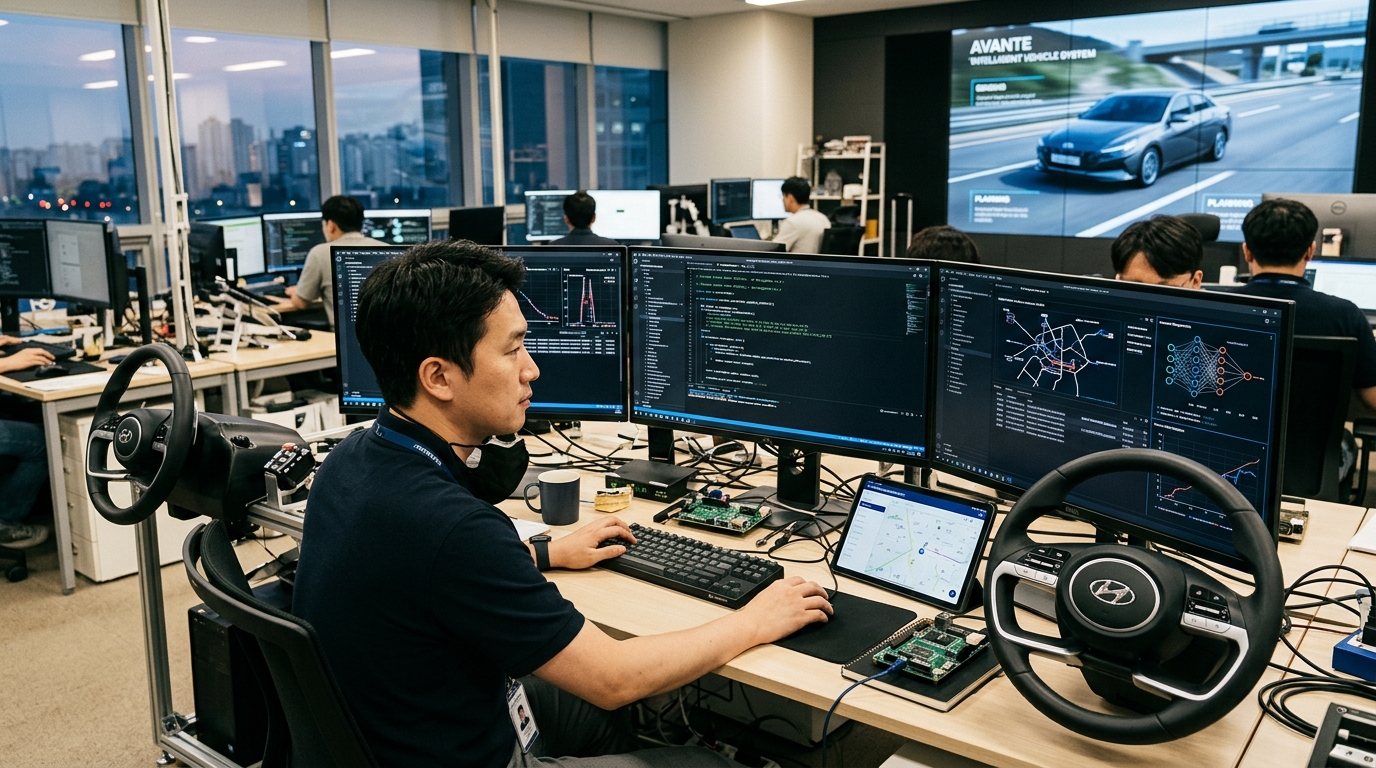
The automotive industry is no longer in a phase of mere evolution, but in a state of complete transformation. Hyundai's recent announcement regarding the new generation of the Avante (known in international markets as the Elantra) is not just the unveiling of another model, but the Korean giant's manifesto for the future of Software-Defined Vehicles (SDVs). In an era where horsepower is giving way to processing power, the new Avante proves that Artificial Intelligence (AI) is now the core ingredient of the driving experience.
Revolution in the Cabin: The Digital Assistant and Generative AI
The centerpiece of the new Avante is the integration of a sophisticated AI system based on Large Language Models (LLMs). Unlike traditional voice assistants that were limited to predefined commands, Hyundai's new system can understand conversational context, answer complex queries, and perform multiple tasks simultaneously. A driver can now ask the car to "find a healthy restaurant on the route and book a table," with the AI handling the process via internet connectivity.
However, the innovation doesn't stop at infotainment. Hyundai has embedded AI into the very core of the vehicle's operation. The energy management system uses machine learning algorithms to predict driving conditions and optimize fuel or energy consumption (in the hybrid version). This means the car "learns" the driver's habits and adjusts engine performance and suspension in real-time, offering a personalized experience that was unthinkable just a few years ago.
Safety and Autonomous Driving: The Next Level
Safety remains the cornerstone of Hyundai's strategy. The new Avante is equipped with the latest version of the SmartSense suite, now enhanced by AI-driven visual recognition. The vehicle's cameras and sensors don't just detect obstacles; they can categorize the behavior of other road users. For example, the system can recognize if a cyclist is about to change lanes based on their body lean, warning the driver seconds earlier than conventional systems.
"The car ceases to be a passive tool. With AI, it becomes an active guardian that perceives the environment with greater precision than human senses," company executives noted during the official presentation.
Furthermore, Over-the-Air (OTA) update capabilities allow the Avante to continuously improve. Hyundai promises that autonomous driving algorithms will be updated regularly, adding new features without requiring a visit to the service center. This radically changes the concept of vehicle depreciation, as the software remains current throughout the car's lifespan.
Strategic Importance for the Global Market
Choosing the Avante for the introduction of these technologies is no coincidence. It is a mass-production model with immense appeal in markets such as Asia and North America. With this move, Hyundai attempts to democratize high technology, bringing features previously found only in luxury vehicles (such as Mercedes-Benz or Tesla) to the mid-range segment. Competition with Chinese manufacturers, who are investing heavily in "smart" car interiors, is now palpable, and Hyundai appears ready to fight with innovation as its weapon.
In a broader context, this move reflects Hyundai's collaboration with its subsidiary, 42dot, which specializes in autonomous driving software. The "Software First" strategy seems to be bearing fruit as the company transforms from a traditional manufacturer into a mobility service provider. The remaining question is how consumers will react to the increasing reliance on technology and how the personal data collected by these "intelligent" computers on wheels will be protected.