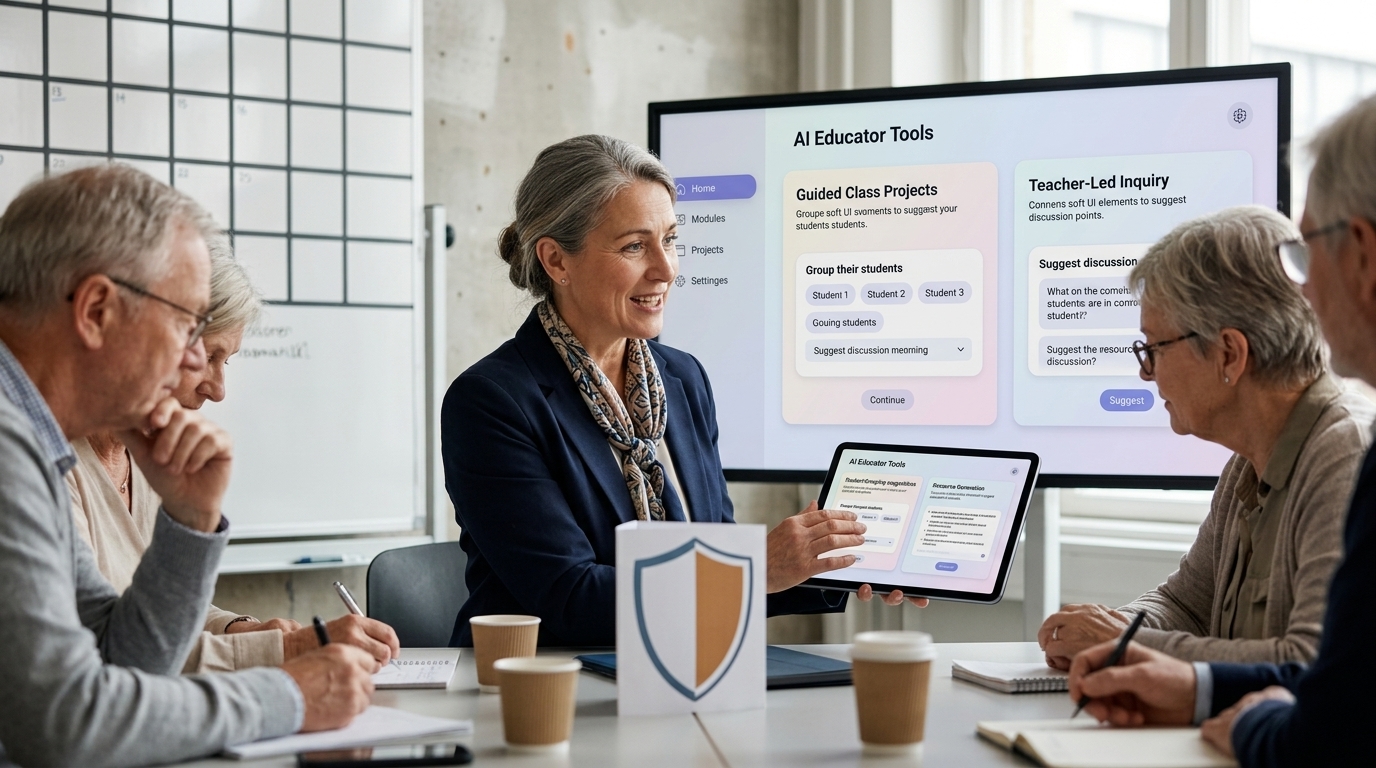
At the ISTE 2026 conference, Google unveiled a suite of groundbreaking updates aimed at redefining the role of Artificial Intelligence (AI) in classrooms. The company's core philosophy appears to be shifting: moving from tools directed primarily at students to systems designed first and foremost to empower educators. In an era where teacher burnout is at historic highs, Google proposes AI not as a replacement, but as a digital assistant that handles administrative burdens, allowing pedagogues to focus on what they do best: inspiring students.
Empowering the Educator: The Assistant That Never Sleeps
The new Gemini capabilities for Workspace for Education focus on automating the most time-consuming processes. Teachers can now generate entire lesson plans, tailored to specific national curricula, in mere seconds. The system doesn't just suggest content; it allows the teacher to define the difficulty level, tone, and necessary references, ensuring the final output bears their personal touch.
Furthermore, Google is introducing the "Smart Feedback Loop," a tool that analyzes student assignments and suggests feedback for the teacher. Instead of generic responses, the AI identifies specific points where a student is struggling and suggests ways for the teacher to approach the issue. The educator remains the final arbiter, approving or modifying every comment before it reaches the student. This "human-in-the-loop" approach is critical for maintaining pedagogical integrity.
Personalized Learning Paths for Every Student
One of the greatest challenges in traditional education is managing a classroom with diverse knowledge levels. Google addresses this with "Dynamic Learning Paths." Through Google Classroom, AI can now adapt educational material in real-time. If a student struggles with a mathematical concept, the system provides additional visual aids or simplified explanations while simultaneously updating the teacher on the child's progress.
Inclusivity is also a key pillar. New accessibility features include enhanced real-time captions for hearing-impaired students and text-to-speech tools using emotionally nuanced voices to help students on the autism spectrum better understand the context of discussions. Technology here acts as a bridge, reducing the barriers that often marginalize students with special educational needs.
Safety, Privacy, and the Digital Divide
As AI penetrates deeper into schools, concerns regarding data protection intensify. Google reassures that student data is not used to train its large language models (LLMs) without explicit consent and that schools maintain full control over their information. However, the challenge remains: how to ensure these tools do not widen the gap between wealthy and underfunded school districts?
Google’s strategy includes releasing lighter versions of AI tools that can run on older Chromebooks, reducing the need for expensive hardware upgrades. Nevertheless, high-speed internet access remains a prerequisite, highlighting the need for state investment in infrastructure. The education of the future requires not just smart software, but equitable distribution of resources.
In conclusion, Google's move to place educators at the helm of the AI revolution is an acknowledgment of the irreplaceable value of human guidance. If these tools are used correctly, they can transform the school from a space of mass-produced knowledge into an environment where every child receives the attention they deserve, with the teacher reclaiming the time and creativity lost to decades of bureaucracy.