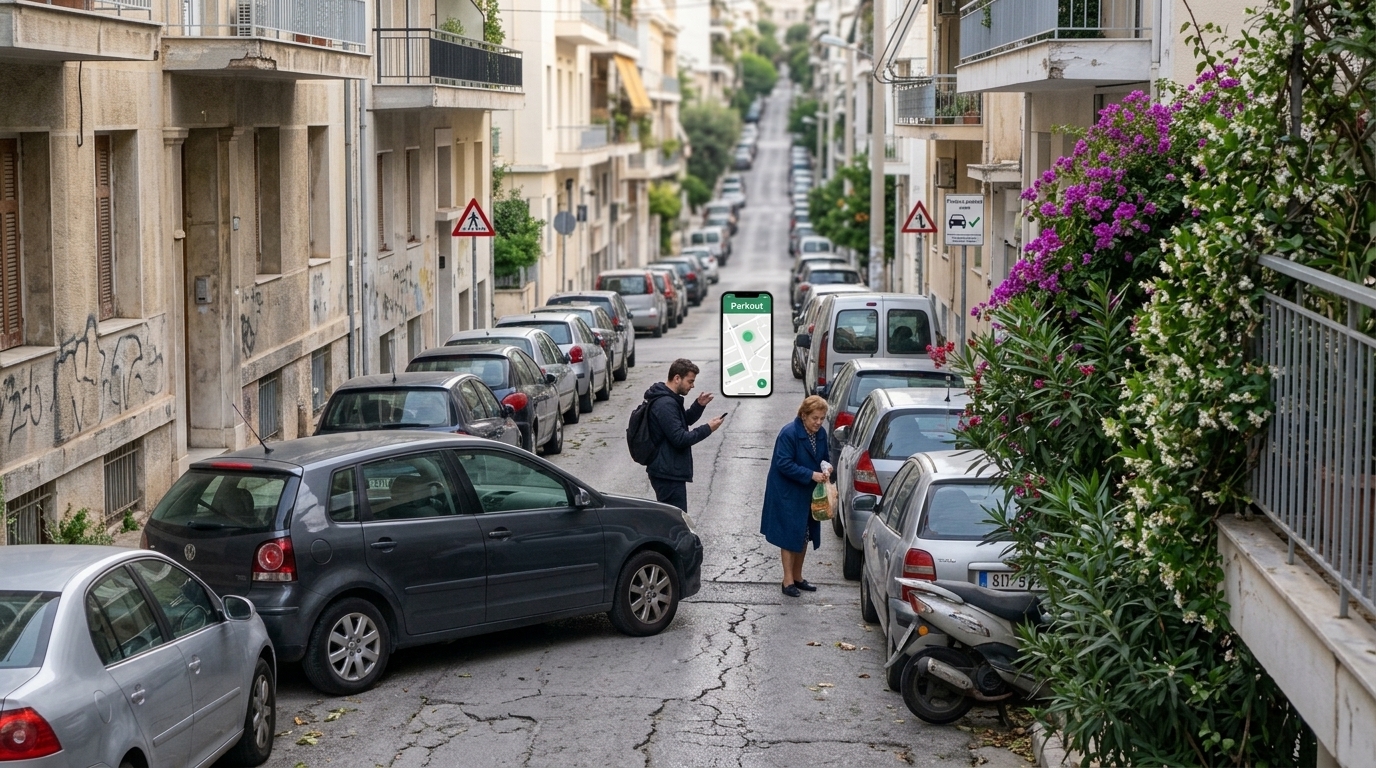
Athens, a city that pulses with life but simultaneously suffocates under the weight of chronic traffic congestion, is facing a new digital challenge. The Municipality of Athens, recognizing that the search for a parking space is one of the primary causes of driver frustration and environmental degradation, has introduced Parkout. This free application aims to transform individual desperation into a collective solution, creating a network of solidarity among drivers.
The Philosophy of Crowdsourcing in Public Service
Unlike traditional "smart parking" systems that rely on expensive sensors embedded in the asphalt, Parkout adopts a crowdsourcing model. The logic is simple yet revolutionary for Greek standards: a driver about to vacate a parking spot updates the app, and a driver searching in the same area receives a real-time notification. This immediacy eliminates the need for heavy infrastructure, making the system flexible and instantly scalable to every neighborhood in the capital.
The app functions as a digital mediator. When a user "opens" their spot, the system calculates the distance of interested drivers and connects them. The success of the project relies entirely on participation. The more Athenians use Parkout, the more accurate and effective the network becomes. It is a classic example of the "network effect," where the service's value increases exponentially with every new member.
Environmental Footprint and Urban Sustainability
The numbers behind the parking hunt are staggering. Research indicates that in densely populated areas like Pagrati, Kypseli, or Kolonaki, up to 30% of traffic volume is caused by drivers circling in search of a vacant spot. This translates into thousands of tons of additional CO2 emissions and countless lost hours of productivity and peace of mind.
- Reduction of unnecessary mileage within the urban fabric.
- Limitation of noise pollution and exhaust emissions.
- Improvement of traffic flow on main arterial roads.
- Digital mapping of parking needs for future urban planning.
The Municipality of Athens, through this initiative, isn't just offering a "tool"; it's promoting a new mobility culture. Using technology to optimize existing resources (parking spots) is a significantly more sustainable approach than the indiscriminate construction of new underground garages, which often encourage car use rather than regulating it.
Challenges and the Future of the "Smart City"
Of course, the Parkout app is not without its challenges. The biggest gamble is user trust and consistency. What happens if someone claims to be leaving but delays? Or if two drivers arrive at the same spot simultaneously? The app includes rating systems and gamification to encourage proper behavior, yet the human variable remains the unpredictable factor.
"Technology is the medium, but the community is the solution. With Parkout, we are giving citizens the power to solve a problem that affects us all," state sources from the Municipality's technical development team.
Furthermore, there is the issue of the digital divide. While younger generations will adopt the app with ease, older drivers might be left out of the system, creating an inequality in access to public space. Nevertheless, this move represents a significant milestone in transforming Athens into a "Smart City," where data and citizen interaction produce immediate results in daily life.
In conclusion, Parkout is a bold experiment. If successful, it could serve as a blueprint for similar applications in other municipalities across the country or even for other services, such as carpooling or waste management. Athens is called upon to prove that it can be not only historical but also functionally modern.