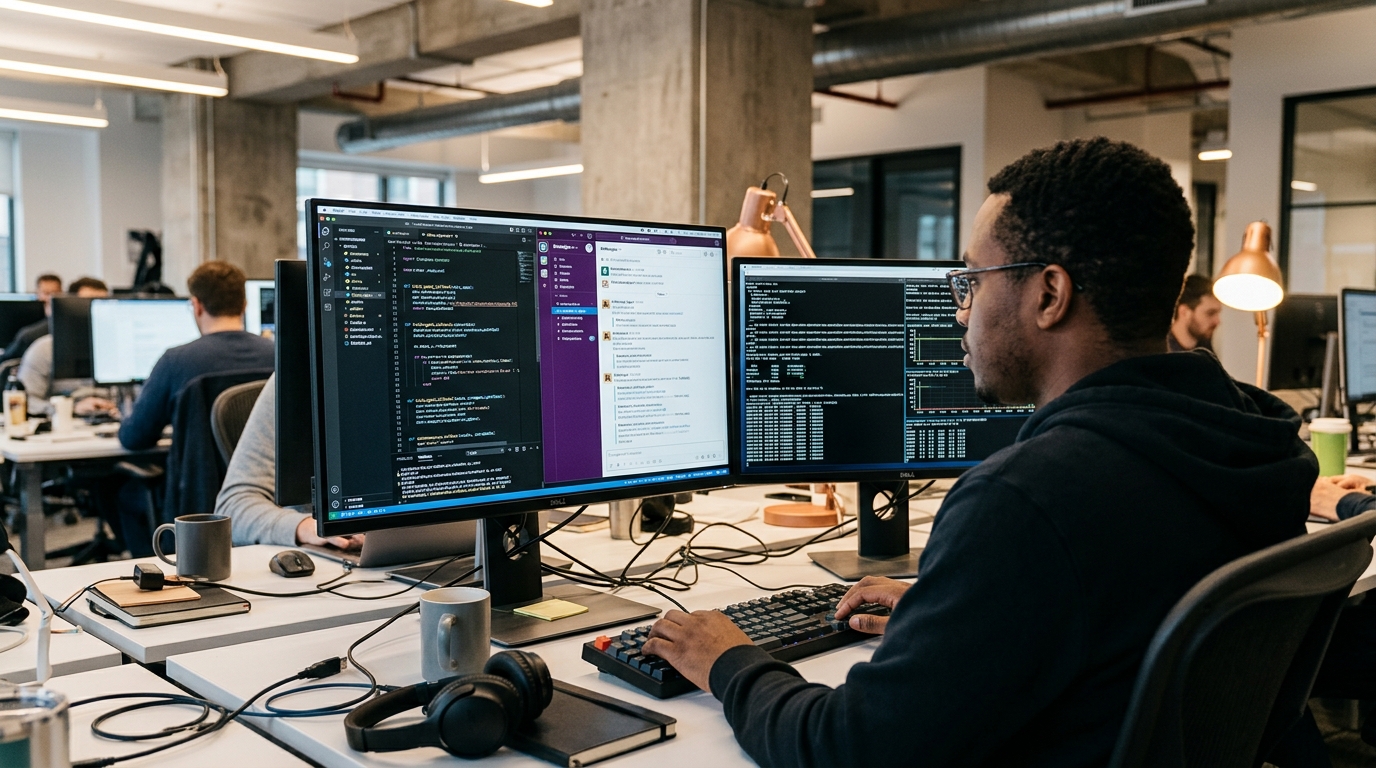
In a move that fundamentally reshapes the landscape of corporate productivity, Anthropic has announced the full integration of its 'Workplace AI Agents' directly within the Slack platform. This is no longer just a simple chatbot answering queries; it is a sophisticated digital collaborator capable of 'seeing' the workspace, analyzing workflows, and executing tasks that previously required human intervention. This evolution marks the transition from Generative AI to Agentic AI, where software does not merely suggest solutions but implements them.
From Conversation to Execution: What’s Changing in Slack
The integration of Claude, Anthropic’s advanced AI model, into Slack is not entirely new, but the current update introduces the groundbreaking 'Computer Use' capability. This allows the AI agent to interact with the Slack environment much like a human would: it can read messages across multiple channels, synthesize summaries of complex discussions, schedule meetings by checking participants' calendars, and update databases or project management tools like Jira or Asana—all without the user ever leaving the chat window.
The key to the success of this approach lies in Claude’s contextual understanding. In the chaotic environment of a modern enterprise, where information is scattered across hundreds of channels, the AI agent acts as an omniscient secretary. It can answer questions such as 'What is the latest update on Project X and what is my pending task?', retrieving the answer by scanning thousands of previous messages and documents in seconds.
The Strategic Battle for the Digital Office
Anthropic’s move is a direct challenge to tech giants Microsoft and Google. While Microsoft pushes Copilot through Teams and Google promotes Gemini via Workspace, Anthropic is betting on the flexibility of Slack, owned by Salesforce. This partnership is strategically vital, as Slack serves as the 'nervous system' for many tech companies and startups globally. The 'Workplace AI Agents' promise to reduce 'work about work'—the administrative tasks that currently consume up to 60% of an employee's time.
"We are not just building a tool that talks, but a partner that acts. Integrating into Slack is the first step toward creating an AI operating system for the enterprise," stated an Anthropic representative.
However, the autonomy of these agents raises serious questions regarding control and security. Anthropic has invested heavily in 'Constitutional AI,' a framework of rules that constrains Claude’s behavior, ensuring that agents do not take unintended actions or violate corporate data privacy. Nevertheless, the idea of software capable of 'reading' every internal communication still triggers skepticism in some management circles.
Challenges and the Future of Work
Despite the promises of explosive productivity gains, the adoption of AI agents in Slack faces significant hurdles. The first is accuracy. In a professional setting, a mistake in summarizing a decision or organizing a high-stakes meeting can be costly. Anthropic claims that Claude 3.5 Sonnet, the model powering these agents, has the lowest hallucination rates in the market, but user trust is something earned over time, not granted by default.
Furthermore, there is the inevitable question of professional displacement. If an AI agent can perform the tasks of a junior project manager or an administrative assistant, what will be the role of these employees in the future? The optimistic view suggests humans will be freed from drudgery to focus on strategy and creativity. The pessimistic view, however, foresees a shrinking of entry-level job opportunities.
In conclusion, Anthropic’s decision to bring agents directly to where people work—Slack—is a bold statement about the future. We are no longer waiting for AI to come to us via a separate browser tab. AI is now 'always on,' embedded in our daily conversations, ready to take action. Whether this leads to a productivity utopia or a new type of digital dependency remains to be seen.