In the heart of Europe, where the tradition of engineering precision meets digital innovation, Germany is attempting to solve one of the most persistent problems of urban life: the safety and efficiency of pedestrians at intersections. Traditional traffic lights, operating on fixed timers or simple pressure sensors, are becoming a thing of the past in several pilot cities. The new era demands the use of Artificial Intelligence (AI) to manage traffic, transforming streets into a dynamic environment that perceives and reacts to citizens' needs in real-time.
The Technology Behind the 'Smart' Traffic Light
The system currently being tested in cities like Lemgo and Hamm does not rely on simple cameras, but on a sophisticated combination of LiDAR (Light Detection and Ranging) sensors and thermal imaging. This choice is deliberate. LiDAR sensors emit laser pulses to create a 3D map of the environment, allowing the system to recognize not just the presence of a human, but their walking speed, direction, and even if they are a person with mobility issues or a parent with a stroller. The use of thermal cameras ensures the system functions perfectly in darkness, fog, or rain, without capturing personal features that could identify an individual.
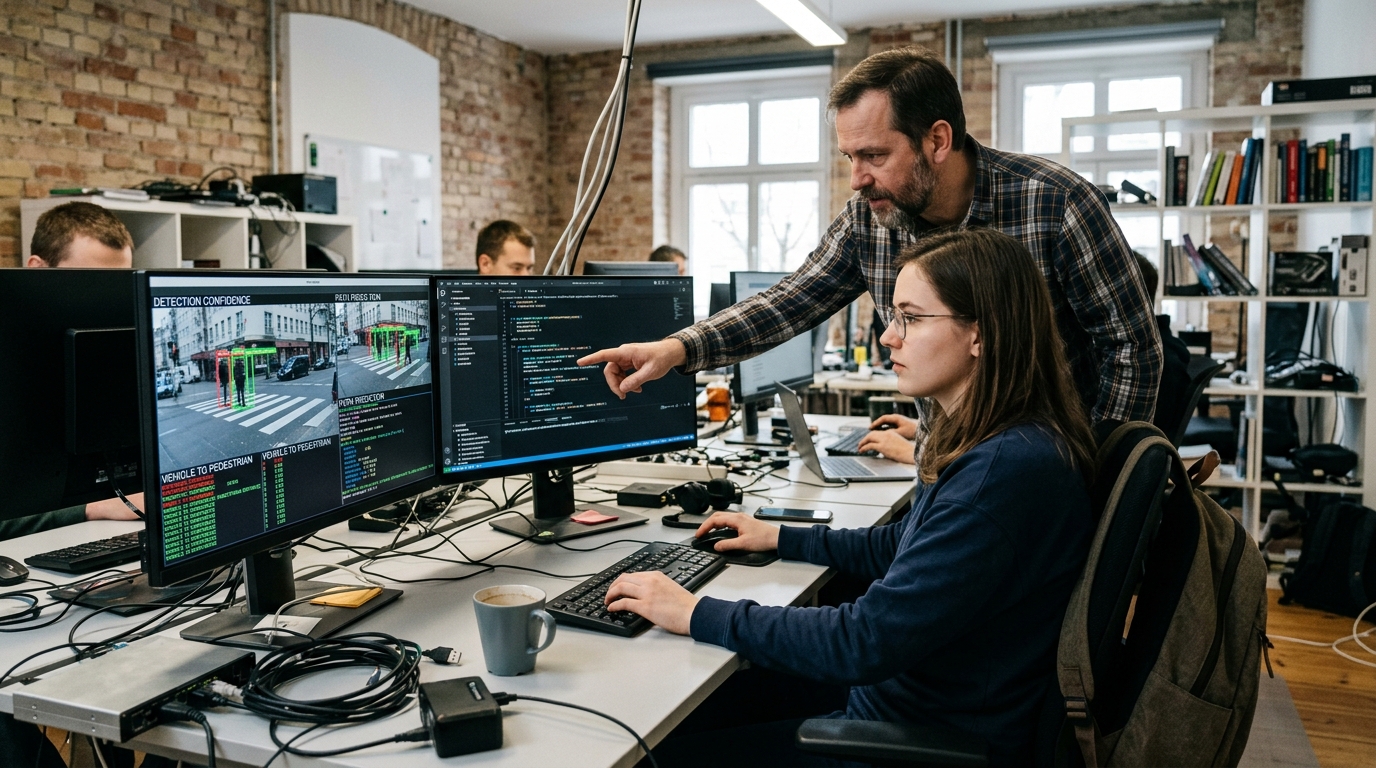
The core of the system is a local processor running deep learning algorithms. These algorithms have been trained on thousands of traffic scenarios, enabling them to predict if a pedestrian intends to cross the street before they even reach the curb. When the system detects a group of children or an elderly person moving slowly, it can automatically extend the duration of the green light for pedestrians, ensuring they complete their crossing safely without the stress of waiting cars revving their engines.
Beyond Speed: The Social and Environmental Dimension
The introduction of AI on the streets is not just about reducing wait times. It represents a fundamental shift in the prioritization of urban mobility. For decades, city planning focused on the seamless flow of cars. Pedestrians were often 'secondary' users, forced to wait in uncomfortable conditions. The German model flips this balance. According to early data from pilot programs, wait times for pedestrians have been reduced by up to 30%, while instances of pedestrians crossing on red (due to impatience) have drastically decreased.
- Emission Reduction: As vehicle flow is optimized based on real demand, the 'stop-and-go' phenomenon—responsible for a large portion of urban CO2 emissions—is minimized.
- Protection of Vulnerable Groups: AI recognizes wheelchairs and walking aids, giving priority where the need is greatest.
- Psychological Relief: The feeling that infrastructure 'sees' and 'cares' for the citizen reduces the stress of daily commuting.
Furthermore, the economic dimension is significant. Although the installation cost of these systems is higher than traditional lights, the reduction in accidents saves millions of euros annually for healthcare systems and insurance companies. Germany, as a global leader in the automotive industry, understands that the future of mobility is connected and multimodal.
Privacy Concerns and Implementation Challenges
In a country like Germany, where data protection (GDPR) is considered sacred, the use of cameras and sensors in public spaces always sparks debate. Authorities and tech companies involved in the project have taken strict measures. Data is processed locally at the traffic light (edge computing) and is not sent to central servers, nor are images stored that would allow facial recognition. The system 'sees' anonymous shapes and thermal footprints.
"Our goal is not surveillance, but spatial awareness. AI allows us to respect citizen privacy while simultaneously offering a safer environment," states a lead researcher from the KI4PED project.
Despite the successes, challenges remain. Maintaining these sensitive sensors in extreme weather conditions and integrating them into older infrastructure requires time and significant capital. However, the message is clear: Artificial Intelligence is no longer a tool confined to laboratories or computer screens, but an active companion for the citizen on the road.