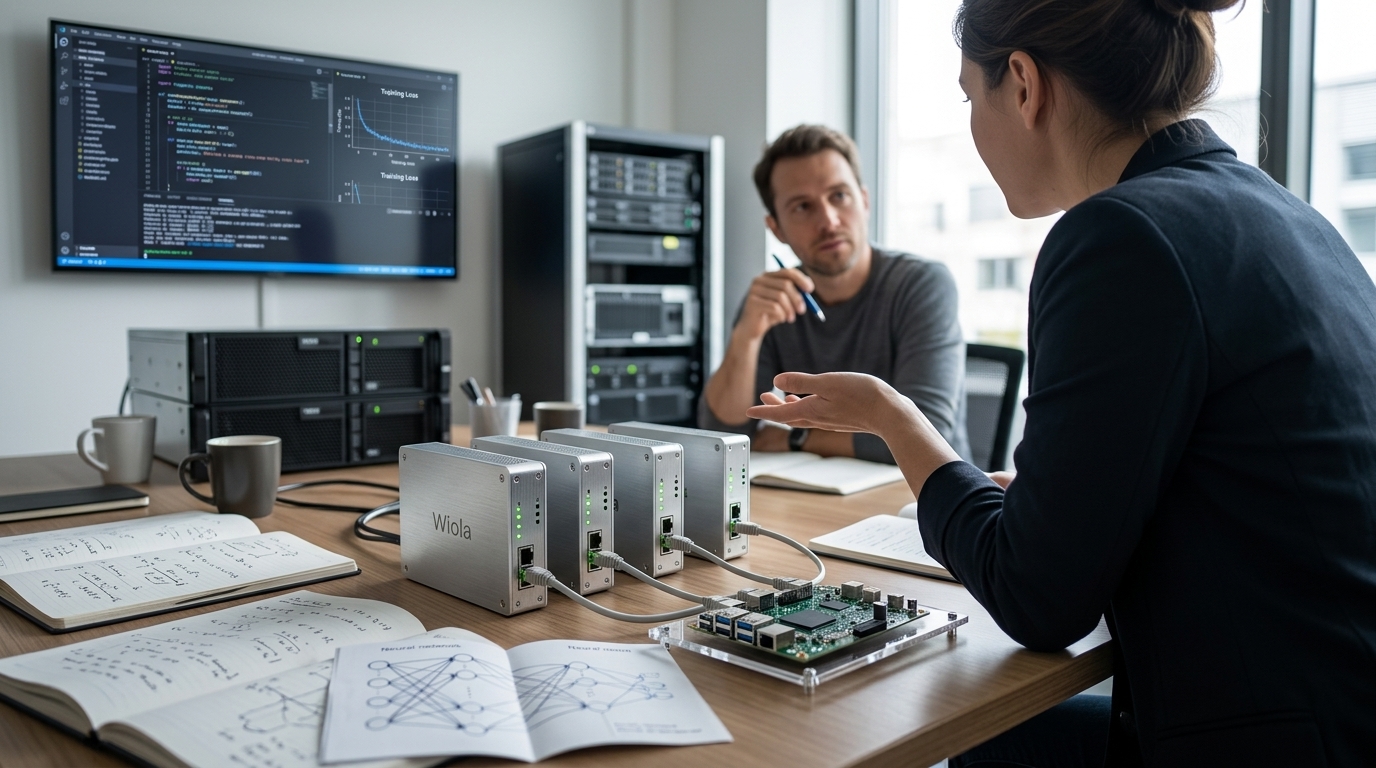
In an era where the AI industry seems locked in an endless arms race to build the largest and most energy-hungry models, the emergence of the Wiola architecture (arXiv:2607.01394) arrives as a profound disruptor. Published in early July 2026, this research is not merely an incremental improvement of existing structures but a radical reboot. Wiola is a Small Language Model (SLM) built from the ground up, sharing no structural lineage with the dominant GPT, LLaMA, Mistral, or Falcon families.
The 'Clean Sheet' Philosophy
For nearly a decade, the Transformer architecture has held a near-monopoly on the field. While it has proven remarkably scalable, it carries inherent limitations, such as quadratic complexity in its attention mechanism and massive memory overhead. The researchers behind Wiola chose to ignore the beaten path. Instead of trying to 'shrink' a giant, they asked: what would intelligence look like if we designed it today specifically for resource-constrained environments?
The result is an architecture that introduces five independently novel components. The first, and perhaps most significant, is the 'Dynamic Selective Memory Mechanism.' Unlike traditional models that process every token with the same computational cost, Wiola prioritizes information in real-time, allocating resources only where semantic density is high. This allows the model to maintain context over much longer sequences without being overwhelmed by data volume.
The Five Pillars of Innovation
The paper details five innovations that make Wiola unique:
- Asymmetric Parameter Correlation: A method that allows model weights to rearrange themselves during training, creating more efficient information pathways.
- Neural-Symbolic Bridge: Wiola inherently integrates logical rules within the neural network, reducing hallucinations without the need for external RAG tools.
- Quantized Energy Activation: The model 'hibernates' parts of the network not required for a specific query, reducing power consumption by 40%.
- Hierarchical Multi-Level Attention: Instead of a single attention layer, Wiola uses a structure mimicking the human visual system, focusing first on the global context and then on granular details.
- Self-Correcting Learning Loop: The architecture allows the model to recognize internal uncertainty and seek alternative interpretations before generating an output.
From the Cloud to the Pocket
The significance of Wiola is not purely theoretical. In benchmarks presented on arXiv, a Wiola model with just 2 billion parameters managed to outperform 10-billion and 15-billion parameter models from the LLaMA family in coding and mathematical reasoning tasks. This suggests that we can now have a personal assistant of GPT-4 caliber running locally on a smartphone, without an internet connection and with total privacy protection.
"Wiola is not just a smaller model; it is a smarter model. It proves that brute force computation cannot replace elegant architectural design," the study's authors state.
Breaking the dependency on massive Silicon Valley datacenters is the next great frontier. If Wiola is widely adopted, it could lead to a new generation of devices that 'think' autonomously—from medical diagnostic tools in remote areas to smart home systems that never transmit personal data to the cloud.
The Geopolitics of Compute
Finally, Wiola brings a political and economic issue to the fore: the democratization of AI. When training and operating a model requires significantly fewer resources, the advantage held by tech giants diminishes. Smaller nations and research institutions can now develop specialized models that speak their language or understand local nuances without renting expensive infrastructure from Google or Microsoft. Wiola may well represent the beginning of the end for the Transformer monoculture.