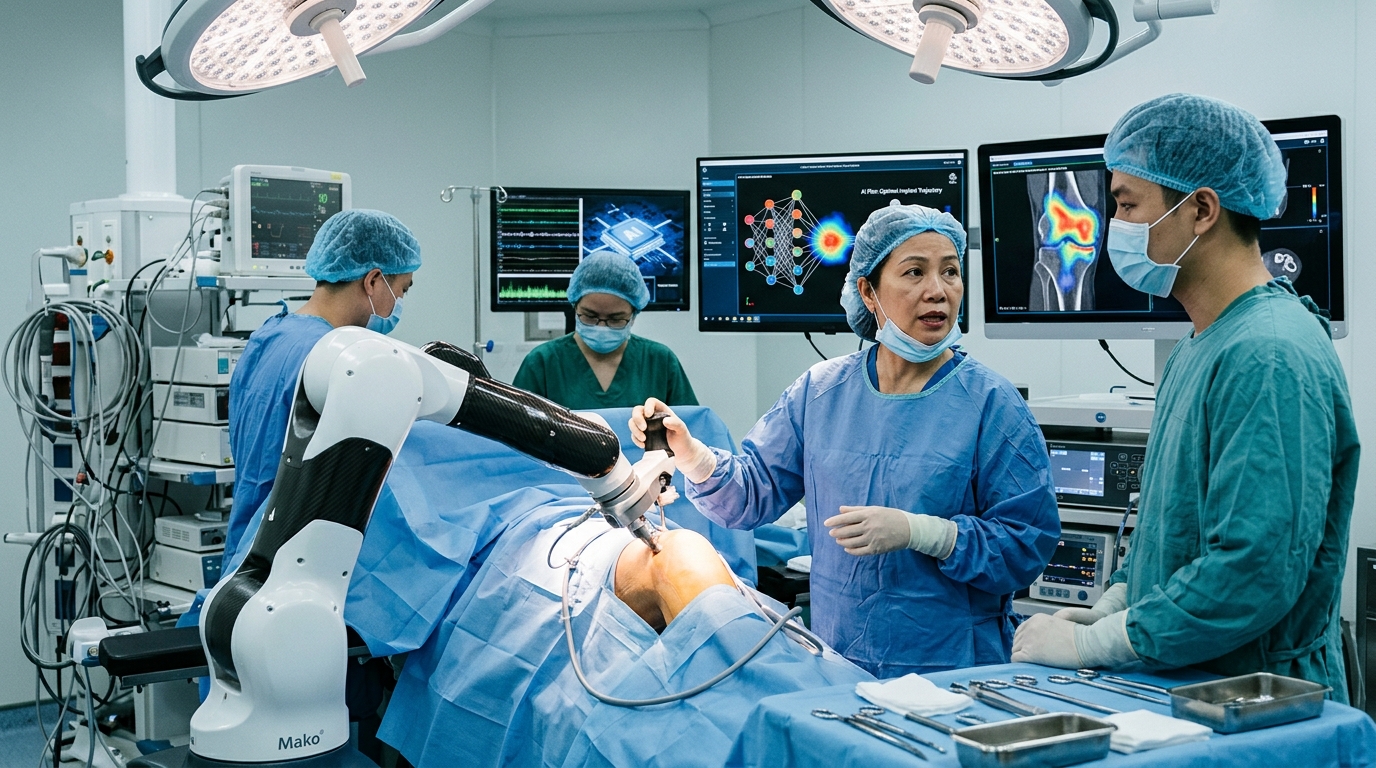
In a move that underscores Vietnam's rapid transformation from an emerging economy to a technological powerhouse in Southeast Asia, the country has inaugurated its first International Center of Excellence for AI-assisted robotic joint replacement. This development, realized through collaboration with leading international medical organizations, places Hanoi and Ho Chi Minh City at the center of the global digital health map, creating significant ripples in med-tech circles.
The new center is not merely an equipment upgrade; it represents a fundamental paradigm shift in how orthopedic surgery is approached. The integration of Artificial Intelligence (AI) allows for total treatment personalization, accounting for each patient's unique anatomy with a precision that exceeds the capabilities of the human eye and traditional surgical tools. In a region where joint disorders due to an aging population and lifestyle changes are on the rise, this move is considered of strategic importance.
The Fusion of AI and Robotic Precision
The heart of the new center beats with the help of advanced machine learning algorithms. Before a patient even enters the operating room, the AI system analyzes thousands of data points from imaging tests (CT and MRI) to create a 3D digital twin of the joint. This allows surgeons to "perform" the operation in a virtual environment, predicting potential complications and selecting the ideal placement angle for the implant.
During surgery, the robotic arm, guided in real-time by AI, executes cuts with a precision of a tenth of a millimeter. This technology ensures that soft tissues remain intact, drastically reducing blood loss and post-operative pain. "It's not about replacing the surgeon, but about empowering them with superhuman accuracy," center officials state. The use of AI also extends to recovery monitoring, where sensors and applications analyze patient movement to tailor physiotherapy programs.
Strategic Goals: Medical Tourism and Regional Leadership
The establishment of this Center of Excellence is no coincidence. Vietnam is systematically investing in upgrading its healthcare infrastructure to compete with traditional medical tourism giants like Thailand and Singapore. By offering cutting-edge services at a fraction of the cost one would pay in the West, the country attracts patients from around the globe while simultaneously strengthening the domestic healthcare system.
The center's international certification means that procedures, protocols, and outcomes align with the strictest global standards. This creates an environment of trust, essential for attracting international capital and highly specialized scientific personnel. Furthermore, the center will serve as an educational hub for surgeons from across Southeast Asia, consolidating Vietnam's influence in the regional medical community.
Challenges and the Future of Digital Surgery
Despite the excitement, the adoption of such technologies comes with challenges. The high cost of robotic systems and the need for continuous staff training are hurdles for mass implementation in public hospitals. There is also the ethical question of access: will these technologies remain a privilege for the few and foreign visitors, or will they manage to permeate wider society?
However, the path forward seems clear. The success of the center in Vietnam proves that Artificial Intelligence is no longer a theoretical promise but a practical tool that saves lives and improves their quality. As algorithms become smarter and robots more agile, the day when surgeries will be fully automated and personalized is drawing near, with Vietnam standing, unexpectedly for many, at the forefront of this race.