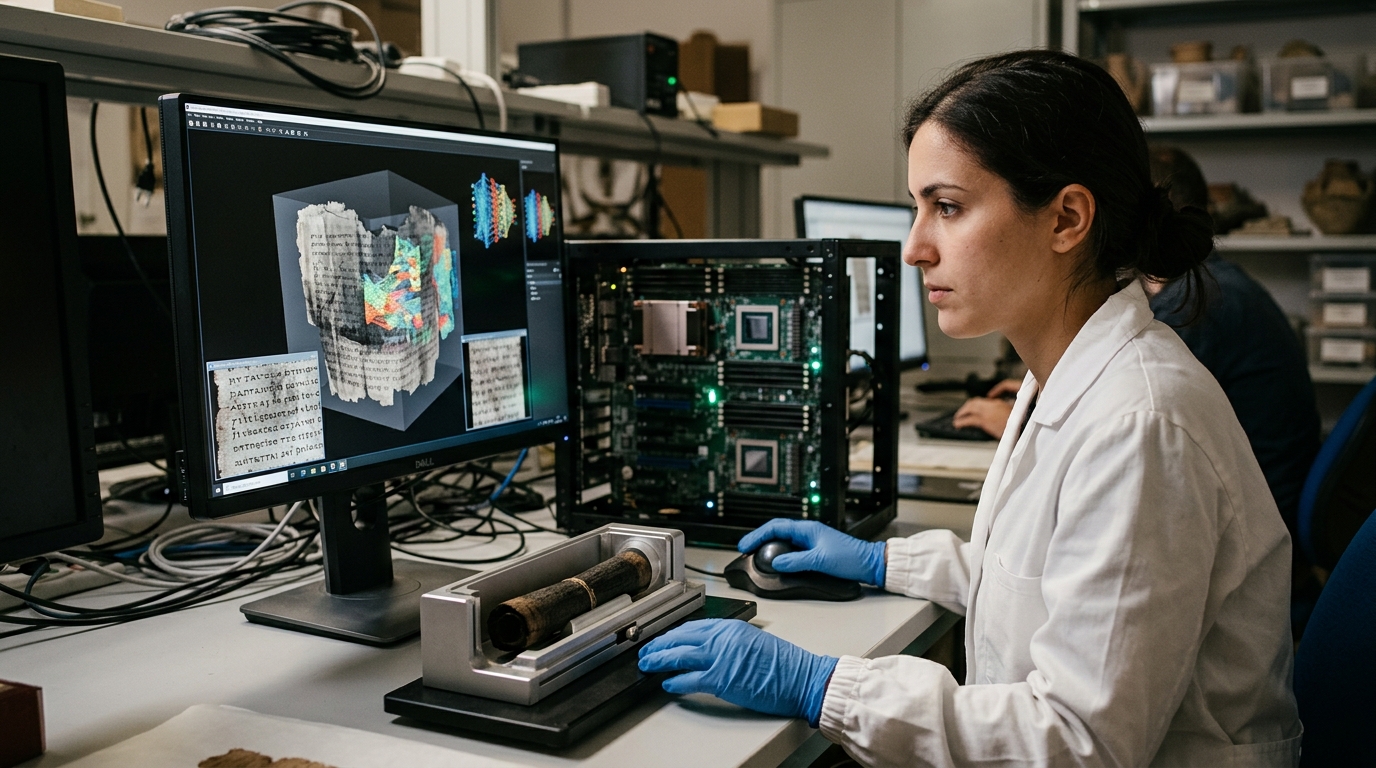
The eruption of Mount Vesuvius in 79 AD did not just bury cities; it froze time, preserving beneath layers of volcanic ash an intellectual heritage that was considered lost for centuries. Today, at the dawn of 2026, artificial intelligence is achieving the unthinkable: reading the carbonized scrolls of Herculaneum without unrolling them, bringing to light the thoughts of the Epicurean philosopher Philodemus of Gadara. This discovery is not merely a technological feat but a profound cultural milestone that reshapes our understanding of ancient Greek thought.
The Vesuvius Challenge: From Carbon to Digital Light
For more than 250 years, the scrolls found in the 'Villa of the Papyri' represented the greatest enigma of classical archaeology. Any attempt at physical unrolling led to the crumbling of the fragile, charred material. The solution came through the 'Vesuvius Challenge,' a global initiative that leveraged computational power and machine learning to 'see' through the layers of carbon.
Using high-resolution CT scans from particle accelerators, researchers managed to create three-dimensional models of the scrolls. The critical step, however, was taken by AI algorithms trained to recognize the subtle differences in the texture of the papyrus where ink was present. The ink used by ancient scribes was carbon-based, making it practically invisible to traditional X-rays. AI, however, was able to discern the 'relief' of the ink, retrieving words and entire sentences from absolute darkness.
Philodemus: The Philosophy of Impulse and Wisdom
The deciphered texts belong to Philodemus, a philosopher who lived in the 1st century BC and was a student of Zeno of Sidon. In the new fragments, Philodemus analyzes the concepts of 'horme' (impulse) and 'phronesis' (practical wisdom), offering a fresh perspective on Epicurean ethics. 'Horme' here is not understood as a blind urge, but as the internal movement of the soul toward pleasure and the avoidance of pain.
Philodemus links impulse with 'phronesis,' the practical wisdom that allows a person to evaluate which desires lead to true happiness and which to turmoil. According to analyses by expert papyrologists, the text also discusses the influence of music and food on the mental state, arguing that the enjoyment of the senses, when governed by moderation, is fundamental to ataraxia (tranquility).
"Wisdom is the rudder of impulse; without it, the pursuit of pleasure turns into a shipwreck of the soul," the philosopher seems to imply in one of the critical passages.
The Significance of the Discovery for Global Literature
The importance of this development is hard to overstate. The Villa of the Papyri is believed to contain thousands more texts, many of which could be lost works of Aristotle, Sophocles, or Epicurus himself. The successful reading of the first pages of Philodemus paves the way for a massive digital excavation.
- Doubling of Knowledge: It is estimated that the full decipherment of the library could double the volume of surviving ancient Greek literature.
- New AI Techniques: Algorithms developed for Vesuvius are already finding applications in medical imaging and the analysis of damaged historical documents.
- Reevaluating Epicureanism: Philodemus forces us to view Epicureanism not as simple hedonism, but as a rigorous system of logic and self-awareness.
Toward a New Renaissance
As we move through 2026, the collaboration between developers from Silicon Valley and classical philologists from Oxford and Naples is creating a new model for interdisciplinary research. Artificial intelligence, often accused of alienating humans from their past, here becomes the bridge that allows us to converse again with ancient masters. The 'impulse' for knowledge and the 'wisdom' of technology meet in the ashes of Vesuvius, reminding us that human thought is, ultimately, indestructible.