In the industrial heartlands of South Korea, from the sprawling shipyards of Ulsan to the high-tech semiconductor clusters of Suwon, a silent yet monumental transition is underway. The Seoul government, in collaboration with major industrial conglomerates, has launched an ambitious initiative to extract and codify the 'tacit knowledge' of the nation’s aging master craftsmen. This is a systematic effort to transform decades of experience, intuition, and manual dexterity into structured datasets designed to fuel the next generation of industrial Artificial Intelligence.
The Demographic Time Bomb and the Need for Memory
South Korea is currently grappling with one of the world's most severe demographic crises, with fertility rates hitting record lows year after year. As the generation of 'Meisters'—the skilled veterans who built the country into a global manufacturing powerhouse—approaches retirement, there is a legitimate fear that the specialized techniques they possess will vanish. The traditional apprenticeship model, where a novice learns alongside a mentor for years, is no longer sufficient in terms of speed or scale to meet modern economic demands.
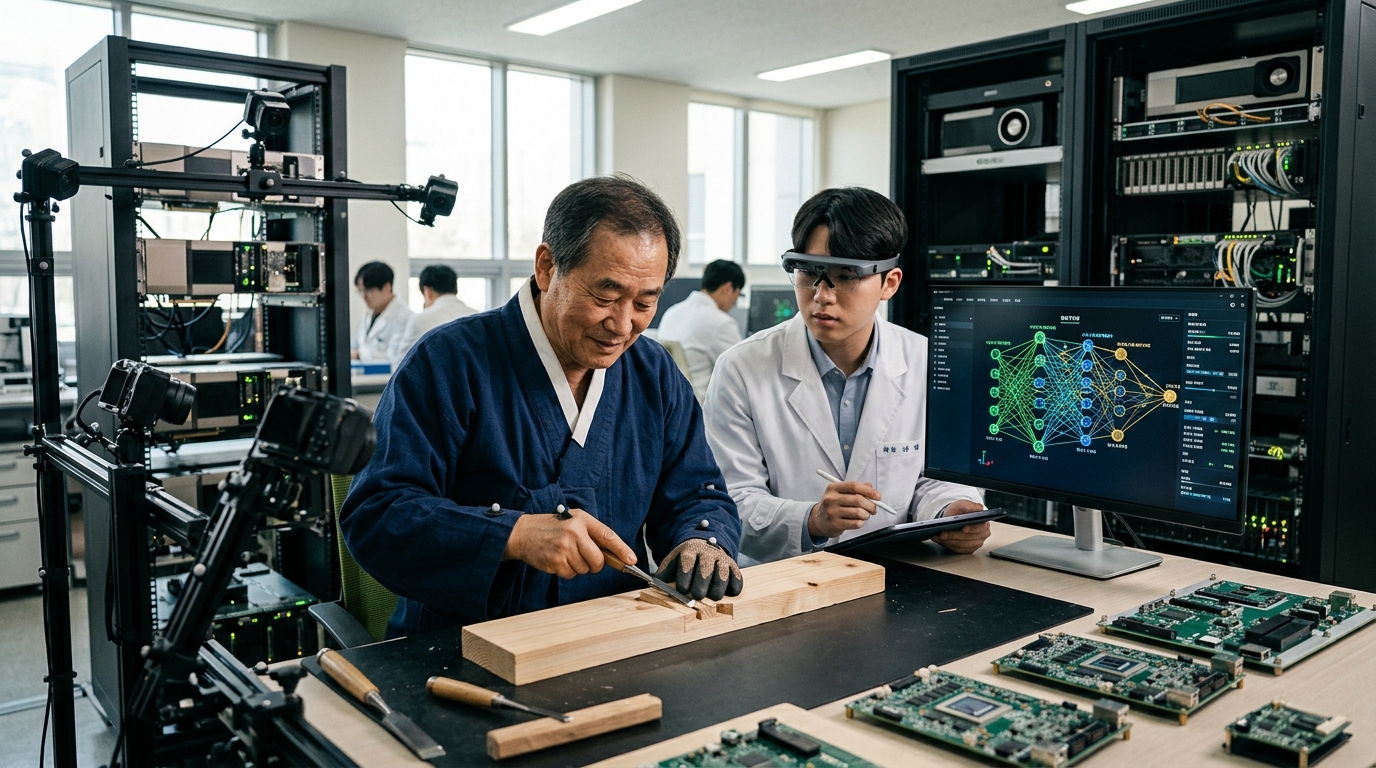
The 'AI Master Data' project aims to bridge this existential gap. By employing cutting-edge technologies such as high-fidelity motion capture, haptic sensors, and computer vision, researchers are recording every subtle hand movement, the specific pressure applied to tools, and even the eye-tracking patterns of masters during critical tasks. Whether it is precision welding for LNG carriers or the delicate calibration of lithography equipment, the 'magic' of the human touch is being translated into binary code.
Digitizing the Intangible
The primary challenge in this endeavor is not the technical recording, but the interpretation of intuition. Experienced workers often speak of a 'sound' that signals a machine malfunction or a 'feel' in the resistance of the metal. The South Korean approach utilizes deep learning models to correlate these subjective stimuli with objective sensor data.
- Acoustic Analysis: High-fidelity microphones capture the ambient noise of the workspace, allowing AI to recognize patterns of wear and tear that only a veteran ear could detect.
- Haptic Feedback: Sensor-laden gloves record the force and angle of manual operations, creating a digital blueprint for future robotic actuators.
- Cognitive Modeling: Through interviews analyzed by Large Language Models (LLMs), the decision-making strategies of masters are codified into decision trees for AI-driven support systems.
This process is not merely about automation. The goal is to create 'digital twins' of human skill. These can be used for accelerated training of new workers through Augmented Reality (AR), where a trainee sees the master’s movements superimposed over their own in real-time, effectively 'wearing' the expert's experience.
Ethical Dilemmas and the Future of Labor
Despite the technological triumph, the program raises profound questions regarding intellectual property and the inherent value of human labor. If the 'essence' of a craftsman’s lifelong work is extracted into a data file, who owns that file? The masters themselves often express a complex mix of pride and anxiety: pride that their legacy is preserved, but fear that they are making themselves obsolete.
"We aren't just giving away data; we are giving away our lives," says a 65-year-old welding master. "If a robot can do what took me 40 years to master, what is left for the human worker?"
The South Korean government maintains that this move is vital for national competitiveness. In a global economy where production often shifts to low-cost labor markets, advanced economies must pivot toward extreme specialization and the integration of human-level quality into AI-driven industrial scales. Seoul’s experiment will likely serve as the blueprint for Germany, Japan, and other industrial powers facing similar demographic headwinds. The legacy of the human hand is being secured, but at the cost of its unique indispensability.