In the dawn of the Fourth Industrial Revolution, the stability of sensor networks forms the backbone of modern infrastructure. From smart power grids to autonomous transport systems, the ability to predict and manage faults before they manifest is critical. However, classical Artificial Intelligence (AI) often hits a wall when tasked with managing the massive data volumes and multidimensional complexity of contemporary IoT networks. The answer to this deadlock comes from a study published in the journal Nature, which introduces the DynaQuAI (Dynamic Quantum-AI) architecture.
The Fusion of Quantum Superiority and Machine Learning
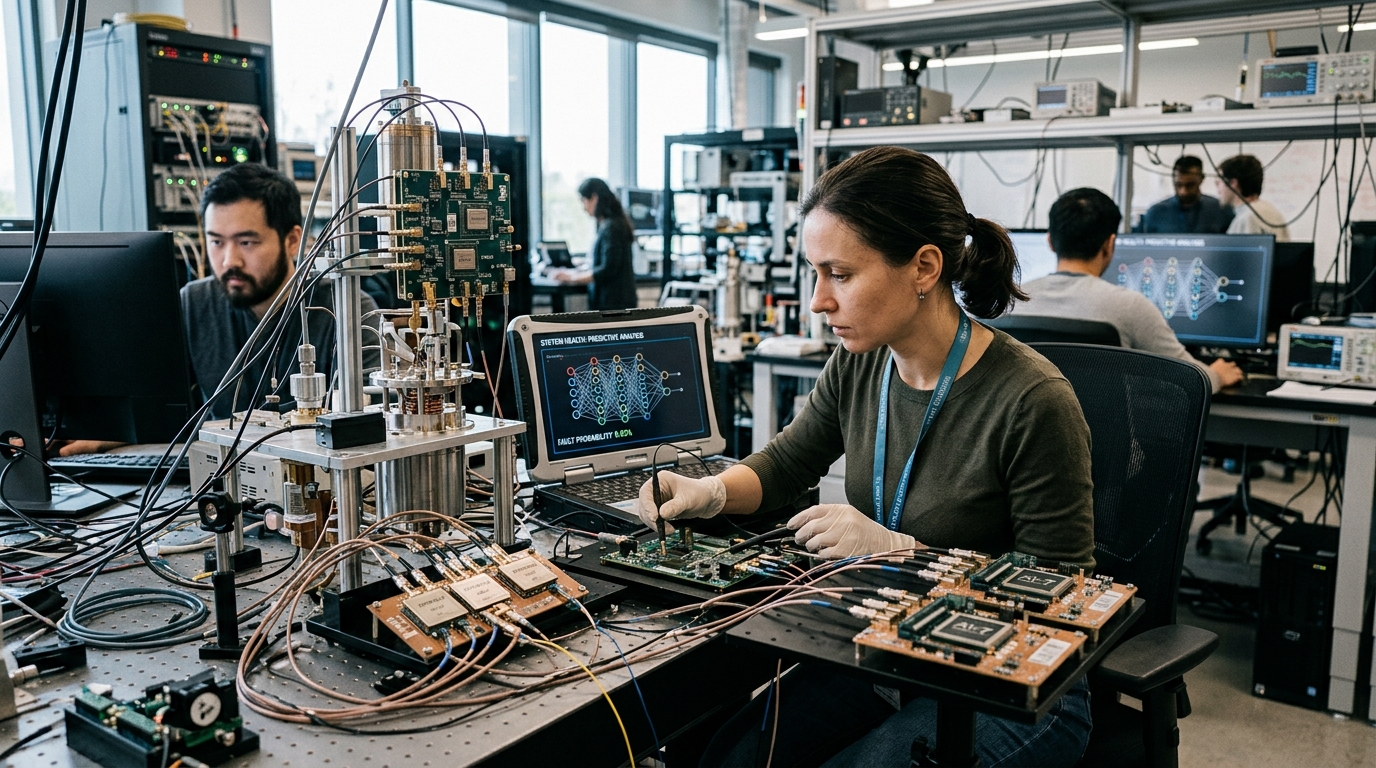
The DynaQuAI architecture is not merely an upgrade of existing systems; it is a radical reimagining of information processing. The system employs quantum algorithms to analyze data patterns that are practically invisible to classical computers. At the heart of DynaQuAI lies the ability of quantum bits (qubits) to exist in superposition, allowing for the simultaneous evaluation of billions of potential sensor failure scenarios.
The dynamic nature of the architecture allows the system to self-correct in real-time. While traditional AI models often require extensive retraining when network conditions shift, DynaQuAI adapts instantaneously. This is achieved through a hybrid feedback loop, where the quantum component identifies high-dimensional anomalies and the classical AI component translates them into actionable maintenance strategies.
Applications in Critical Infrastructure and Smart Cities
The implications of this technology are far-reaching. In the smart cities of the future, thousands of sensors monitor everything from air quality to traffic flow and water consumption. A fault in a single node can trigger a domino effect, leading to erroneous decisions by central management systems. DynaQuAI eliminates this risk, providing a level of fault prediction reaching 99.8% in high-noise data environments.
- Energy Grids: Preventing overloads through precise prediction of transformer failures.
- Industry 4.0: Reducing downtime in factories with automated wear diagnosis.
- Environmental Monitoring: Ensuring data accuracy in climate change monitoring networks.
Challenges and the Future of Digital Resilience
Despite the impressive prospects, the adoption of DynaQuAI is not without challenges. The need for stable quantum hardware remains the primary obstacle. However, researchers emphasize that the architecture is designed to function even on Noisy Intermediate-Scale Quantum (NISQ) computers, making it applicable in the near future.
"DynaQuAI represents the transition from reactive to clairvoyant technology. We no longer wait for something to break to fix it; we know it will break before it even happens," the research team notes in the publication.
In a world increasingly dependent on data, the ability to trust the integrity of our sensors is fundamental. The convergence of quantum physics and artificial intelligence through DynaQuAI offers a roadmap for a more secure, efficient, and resilient digital society. This research is not just a technical achievement but a necessary step in securing the infrastructure that will support humanity in the coming decades.