In an era where global connectivity serves as the backbone of both economy and society, the convergence of Artificial Intelligence (AI) and wireless communications is emerging as the next great technological frontier. The recent grant from NVIDIA to the University of Hawaii at Mānoa (UH Mānoa) is more than just a financial boost; it is a strategic move that places the academic institution at the vanguard of sixth-generation (6G) network development.
The Shift to AI-RAN: A New Network Architecture
Traditional wireless network architecture has long relied on fixed hardware and pre-defined algorithms. However, the research at UH Mānoa, powered by NVIDIA’s technology, aims to completely overhaul this approach through the concept of AI-RAN (AI Radio Access Network). This is a paradigm where AI is not merely an add-on but the very core of the network's operations.
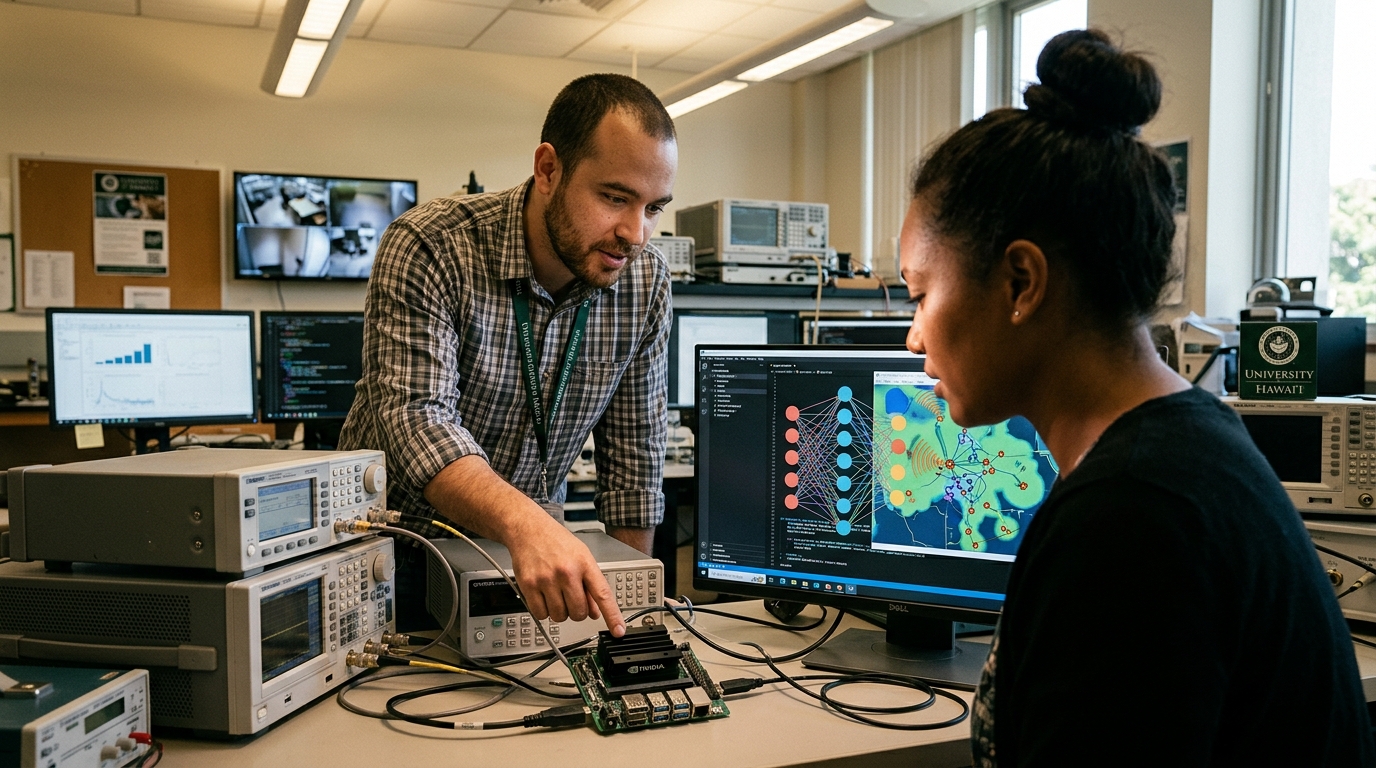
By utilizing NVIDIA GPUs and advanced software suites like NVIDIA Aerial, researchers can simulate and optimize data transmission in real-time. AI can predict network congestion, dynamically reallocate frequency spectrum, and adjust beamforming with millisecond precision, offering speeds and reliability that were previously unthinkable using legacy methods. This transition marks the end of the 'one-size-fits-all' hardware era and the beginning of the software-defined, intelligent era.
Why Hawaii? The Geographic and Research Significance
The selection of the University of Hawaii is far from arbitrary. The geographic isolation of the islands and their unique topographical features provide an ideal 'living laboratory' for testing wireless technologies under challenging conditions. The research focuses heavily on network resilience, which is critical for remote areas or during natural disasters.
UH Mānoa researchers are developing machine learning algorithms that allow networks to become 'self-healing.' If a base station fails, the AI can automatically reconfigure neighboring stations to fill the gap, ensuring uninterrupted communication. This research has direct applications not only in civilian telecommunications but also in national security, maritime safety, and oceanographic exploration, where traditional signals often struggle to penetrate.
NVIDIA’s Strategy and the Global 6G Race
For NVIDIA, this grant is part of a broader blueprint to dominate the infrastructure of the future. As the market for data center GPUs matures, the company is pivoting toward the telecommunications sector. CEO Jensen Huang’s vision is clear: every cell tower in the future should essentially function as a micro-AI data center. This concept, known as 'Sovereign AI,' encourages nations and institutions to build their own AI capabilities on NVIDIA hardware.
The race for 6G supremacy is already intensifying between the United States, China, and Europe. Investing in academic research allows NVIDIA to influence the standards that will govern the next several decades of connectivity. By bundling high-performance hardware (like H100 or Blackwell GPUs) with specialized software (CUDA and the Aerial platform), the company is creating an ecosystem that will be indispensable to global telecom providers.
Challenges and Ethical Considerations
Despite the immense promise, integrating AI into the very fabric of our communication networks raises significant concerns. The energy consumption of AI systems is notorious, and deploying them across global telecom networks could significantly increase the industry's carbon footprint. Furthermore, data privacy remains a paramount issue; as AI systems process vast amounts of user metadata to optimize traffic, the potential for surveillance or data misuse grows.
In conclusion, the partnership between NVIDIA and UH Mānoa represents a milestone on the path toward hyper-connectivity. The success of this research will determine whether 6G will simply be a faster version of 5G, or a genuine revolution that transforms our interaction with the digital world. As we move closer to 2030, the work being done in the middle of the Pacific may very well dictate the digital future of the entire planet.