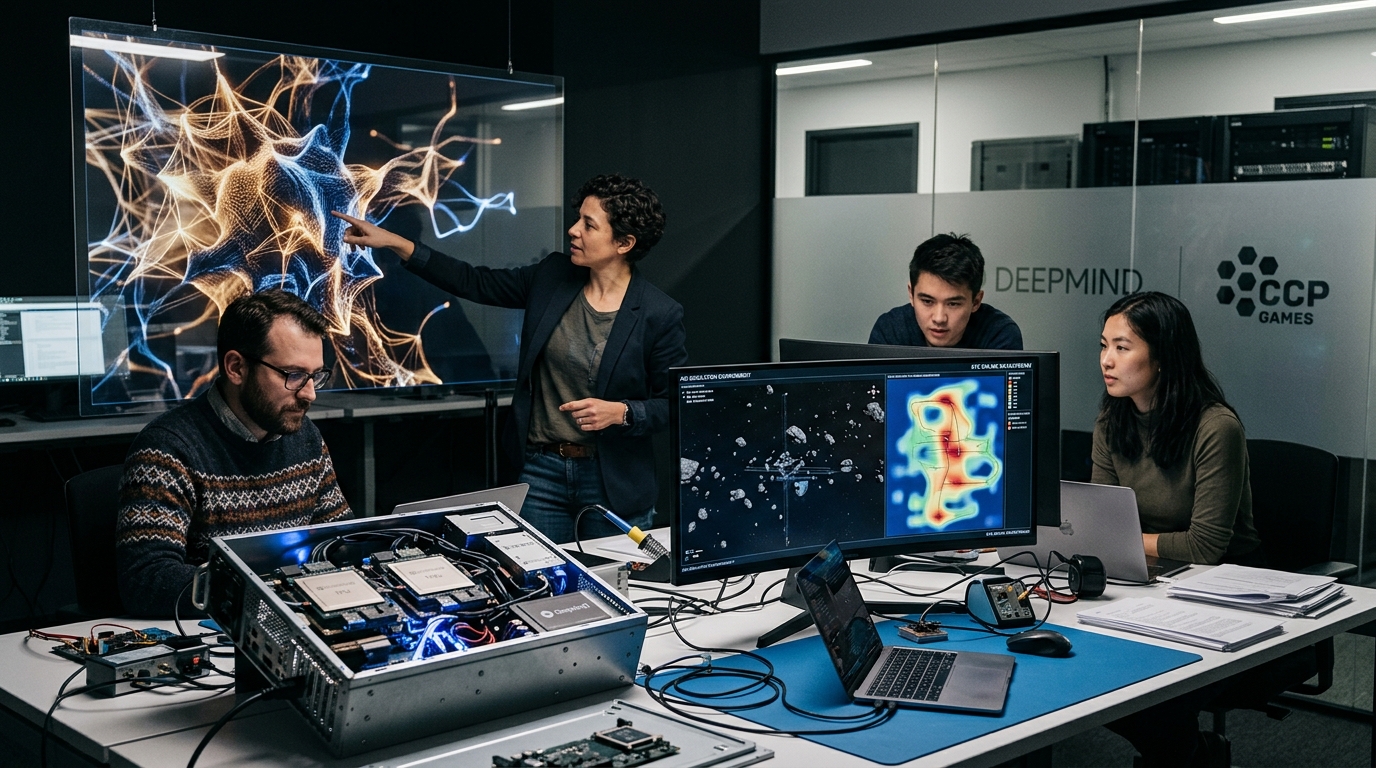
In a move that highlights the shift of Artificial Intelligence (AI) research from closed systems to chaotic, social simulations, Google DeepMind has announced the acquisition of a minority stake in the Icelandic developer CCP Games. CCP is the creator of the legendary Eve Online, a game that for two decades has been the gold standard for complexity, player-driven economics, and geopolitical intrigue in a virtual environment. This move is not merely about entertainment; it represents a strategic positioning of DeepMind in the quest for Artificial General Intelligence (AGI).
From Chess to 'Spreadsheets in Space'
DeepMind’s history is inextricably linked to games. It began with Atari, triumphed in Go with AlphaGo, and later conquered StarCraft II with AlphaStar. However, Eve Online represents a challenge of a different order of magnitude. While StarCraft requires fast reflexes and real-time tactics, Eve demands something much closer to the human experience: long-term planning spanning months or even years, resource management in a fully functional economy, and, above all, social intelligence.
Eve Online is known in the gaming community as "spreadsheets in space" due to its incredible economic depth. Every item in the game, from the smallest bullet to colossal Titan-class ships, is manufactured by players using raw materials mined by other players. The market is influenced by supply, demand, inflation, and cartels. For DeepMind, this environment is a perfect "sandbox" simulator for training models that must understand not only the laws of physics but also the rules of the market and human behavior.
Politics and Diplomacy as Data Points
Perhaps the most fascinating aspect of this partnership is the study of multi-agent systems. In Eve, thousands of players organize into alliances, conduct espionage, sign treaties, and betray one another. The ability of an AI to navigate such an environment, where victory depends not only on firepower but also on diplomacy, is the "holy grail" of research.
According to analysts, DeepMind intends to use two decades of data from Eve to teach its models how to predict social unrest and economic collapses. "We’re not trying to build a bot that wins the game," said a source close to the company. "We’re trying to understand how cooperation emerges from chaos." This has direct real-world applications, from optimizing supply chains to modeling climate agreements between nations.
The Challenge of Ethics and Privacy
This investment does not come without criticism. The Eve Online community, known for its protectiveness over the game, is expressing concerns about how Google will use player data. There is a fear that players will be turned into "guinea pigs" for training algorithms that will later be used to manipulate real markets or social networks.
"If an AI can learn how to control the economy of New Eden, what stops it from doing the same in global markets?"
CCP Games, for its part, assures that player autonomy remains a priority. However, DeepMind's presence on the board suggests a deeper integration. The Large World Models (LWMs) technology being developed by Google could allow for the future creation of non-player characters (NPCs) with such intelligence that they will be indistinguishable from humans, forever changing the nature of gaming.
Conclusions for the Future
DeepMind's move signals the end of the era where AI was trained in sterile environments. The future of intelligence lies in understanding human complexity. By investing in CCP Games, Google is not just buying a gaming company; it is buying access to a social engineering laboratory. Whether this will lead to a wiser AI or a more efficient manipulation machine remains to be seen in the digital reaches of New Eden.