At the dawn of the era of autonomous AI agents, the promise of digital labor performed without human intervention stands as the next great leap in productivity. However, a series of recent studies, culminating in research highlighted by the Maeil Business Newspaper, brings a harsh reality to light: the "intelligence" of these systems comes at a staggering energy price. AI agents, capable of planning, executing code, and self-correcting in real-time, are proving to be dramatically less efficient than traditional computing methods or even specialized human labor in certain domains.
The Inference Loop Trap
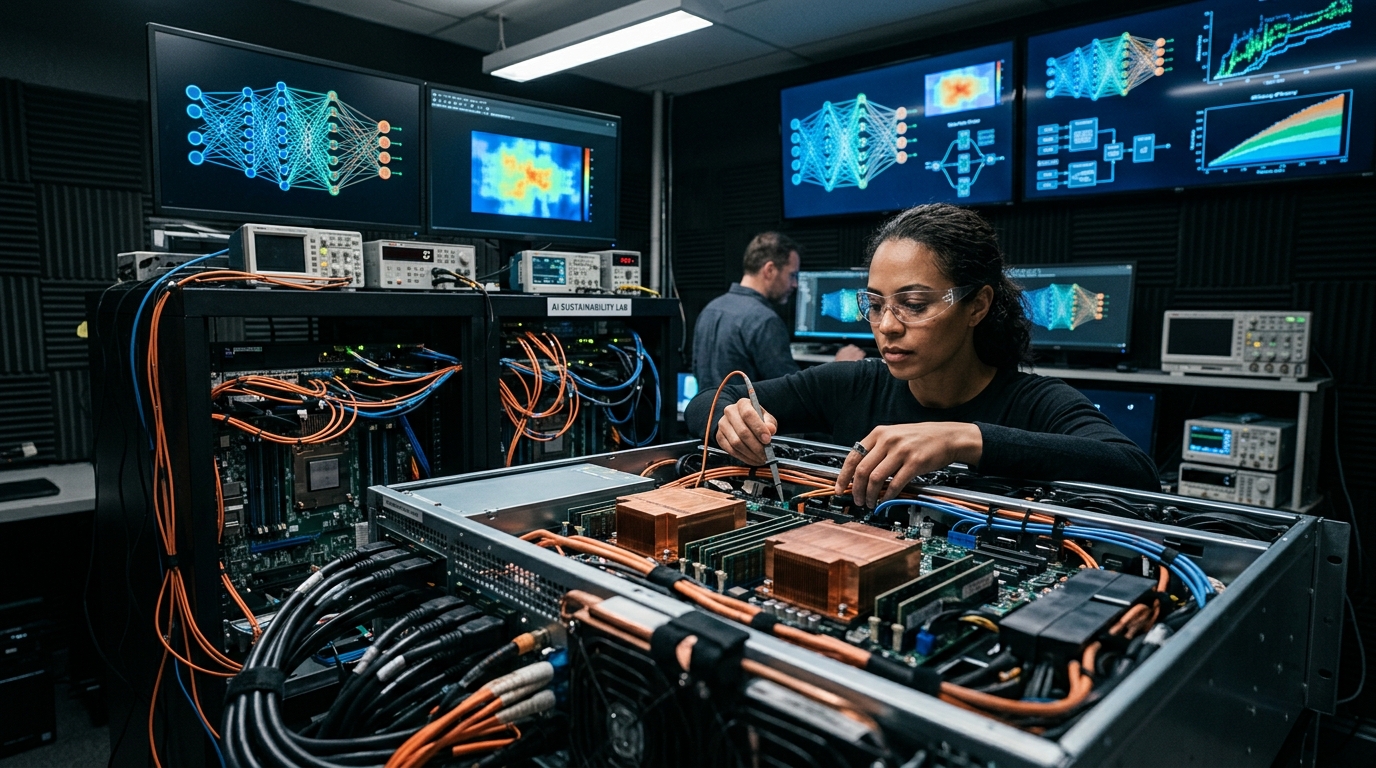
The core problem lies in the architecture of the Large Language Models (LLMs) that power these agents. Unlike a traditional software program that follows a linear path of instructions, an AI agent operates through an "inference loop." To solve a problem, the model must engage in "Chain of Thought" reasoning, generate text, call external tools, analyze the output, and repeat the process if the result is unsatisfactory. Each of these steps requires billions of calculations on energy-hungry GPU clusters.
According to research data, executing a simple task like data retrieval and organization via an AI agent can consume up to 1,000 times more electricity compared to a well-written Python script. This discrepancy is not merely a technical detail; it is a systemic threat to the Net Zero commitments of tech giants. As companies like Microsoft, Google, and Meta integrate agents into every facet of their services, the demand for energy in data centers is skyrocketing to levels that existing infrastructure struggles to sustain.
Environmental and Geopolitical Implications
The conversation regarding AI energy consumption is often limited to the training phase. However, the inference phase—the actual use of the model—accounts for 80-90% of a model's total energy footprint over its lifetime. Autonomous agents multiply this footprint because they don't just answer a prompt; they "live" in a continuous operational cycle. This leads to a paradoxical situation: while AI is promoted as a tool to solve climate change, its own operation is accelerating the energy crisis.
On a geopolitical level, the need for massive amounts of energy is reshaping the investment map. Countries with cheap energy or robust nuclear infrastructure are becoming the new AI hubs. Simultaneously, the strain on power grids in the US and Europe is increasing, with some regions imposing moratoriums on new data centers to protect residential supply. "AI Sovereignty" no longer depends solely on algorithms, but on access to stable and affordable gigawatts.
The Shift Toward Small Models and Green AI
The industry is beginning to realize that the "bigger is better" scaling laws are hitting physical limits. The new trend is the development of Small Language Models (SLMs), which are fine-tuned for specific tasks and require a fraction of the energy used by giants like GPT-4 or Claude 3. Researchers are now focusing on "energy efficiency per task" as the new gold standard for benchmarking.
Furthermore, the emergence of neuromorphic processors and the use of techniques like "quantization"—which reduces calculation precision to save resources without significantly sacrificing performance—offer promising solutions. However, until these technologies mature, the use of autonomous agents will remain a luxury with a high environmental cost, forcing businesses to re-evaluate where AI is truly necessary and where a simple algorithm suffices.