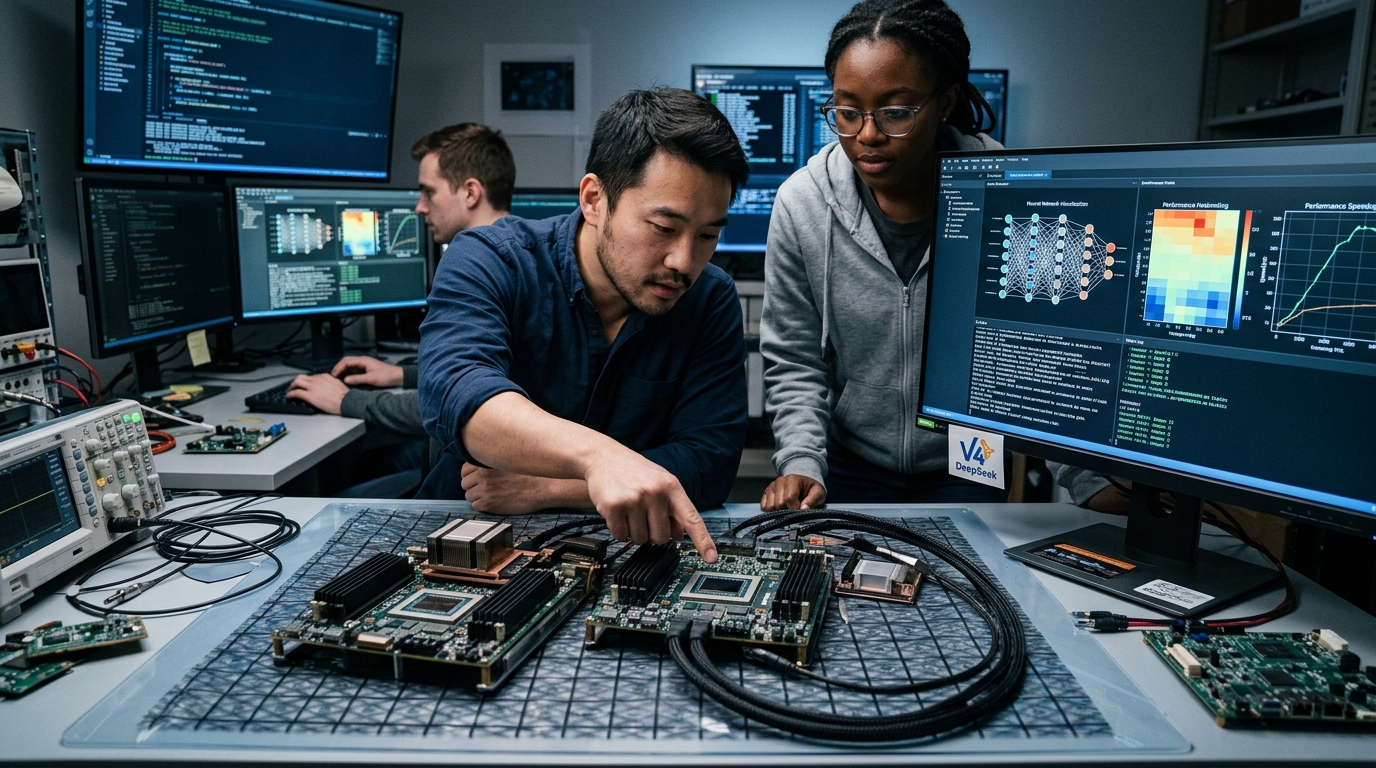
In the relentless race for Artificial Intelligence supremacy, DeepSeek has once again demonstrated that brute force computing is not the only path to the top. With the official announcement of DSpark, a specialized framework for Speculative Decoding, the company has managed to boost the text generation speed of its flagship model, DeepSeek-V4, by up to 85%. This development is not merely a technical refinement; it is a strategic shift that redefines the economic viability of Large Language Models (LLMs) in 2026.
The Architecture of Speed: What is DSpark?
DSpark is DeepSeek’s answer to the most significant bottleneck in modern LLMs: inference latency. The traditional auto-regressive method requires the primary, massive model to perform full computations for every single token produced. DSpark utilizes Speculative Decoding, a technique where a smaller, faster, and 'cheaper' draft model suggests a sequence of potential next tokens. Subsequently, the large target model verifies these suggestions in parallel within a single forward pass.
This approach allows the system to 'guess' the future of a sentence and confirm it instantaneously. If the draft model’s prediction is correct, the time gain is massive. If it misses, the target model corrects the error with no significant time loss compared to the old method. With V4, DeepSeek has optimized this process to such an extent that performance now nears the theoretical limits of the Transformer architecture, effectively doubling the output throughput for complex reasoning tasks.
DeepSeek-V4: The New Hegemon of Open Source?
DeepSeek-V4, already considered one of the most formidable rivals to OpenAI’s GPT-4o and Anthropic’s Claude 3.5 series, now gains an insurmountable advantage in production environments. An 85% speed increase means that applications built on this model—ranging from AI coding assistants to real-time data analysis systems—become nearly instantaneous. According to technical reports, DSpark manages to maintain 100% model accuracy, as verification by the primary model remains the final stage of the pipeline.
Furthermore, DeepSeek has chosen to release DSpark as part of its open-source ecosystem, continuing its tradition of providing high-quality tools to the global developer community. This move is expected to send shockwaves through Silicon Valley firms that rely on closed, expensive APIs. When an open-source model can run at nearly double the speed for a fraction of the cost, the market is forced to pivot toward efficiency rather than just scale.
Market Implications and the Geopolitics of AI
DeepSeek’s success with DSpark highlights a major trend of 2026: the focus on algorithmic efficiency over sheer parameter counts. While Nvidia continues to sell billions of dollars worth of GPUs, researchers are finding ways to do more with less. For China, facing restricted access to high-end hardware due to US export controls, such innovations are a matter of strategic necessity.
- Reduction of inference costs for AI-driven startups.
- Enhanced user experience in conversational AI and real-time agents.
- Feasibility of local hosting (on-premise) for powerful models on mid-tier hardware.
In conclusion, DSpark is more than just an acceleration tool. It is proof that software innovation can bypass hardware bottlenecks. DeepSeek-V4, empowered by this technology, sets a new benchmark for what we should expect from AI in the near future: speed, accessibility, and intelligence without compromise. The era of waiting for tokens to crawl across the screen is officially coming to an end.