In the high-stakes world of artificial intelligence, the "scaling law" is the guiding star of development. Until recently, the prevailing wisdom was straightforward: add more data and more compute, and the model inevitably becomes smarter. However, as these resources become increasingly scarce and prohibitively expensive, industry experts began to fear we were hitting a "scaling wall." ByteDance, the parent company of TikTok, appears to have breached that wall with a groundbreaking new research paper, proposing a new scaling law that could sustain the AI boom for years to come.
Beyond the Chinchilla Paradigm
Traditional scaling laws, most notably the Chinchilla optimality formulated by DeepMind, suggested a nearly linear relationship between parameters, training tokens, and performance. ByteDance’s research challenges this by focusing on Mixture-of-Experts (MoE) architectures. Their findings suggest that MoE models follow a different set of rules, allowing for continued performance gains even when traditional inputs face diminishing returns. This isn't just an academic exercise; it's a strategic necessity for a company operating under the shadow of geopolitical trade restrictions.
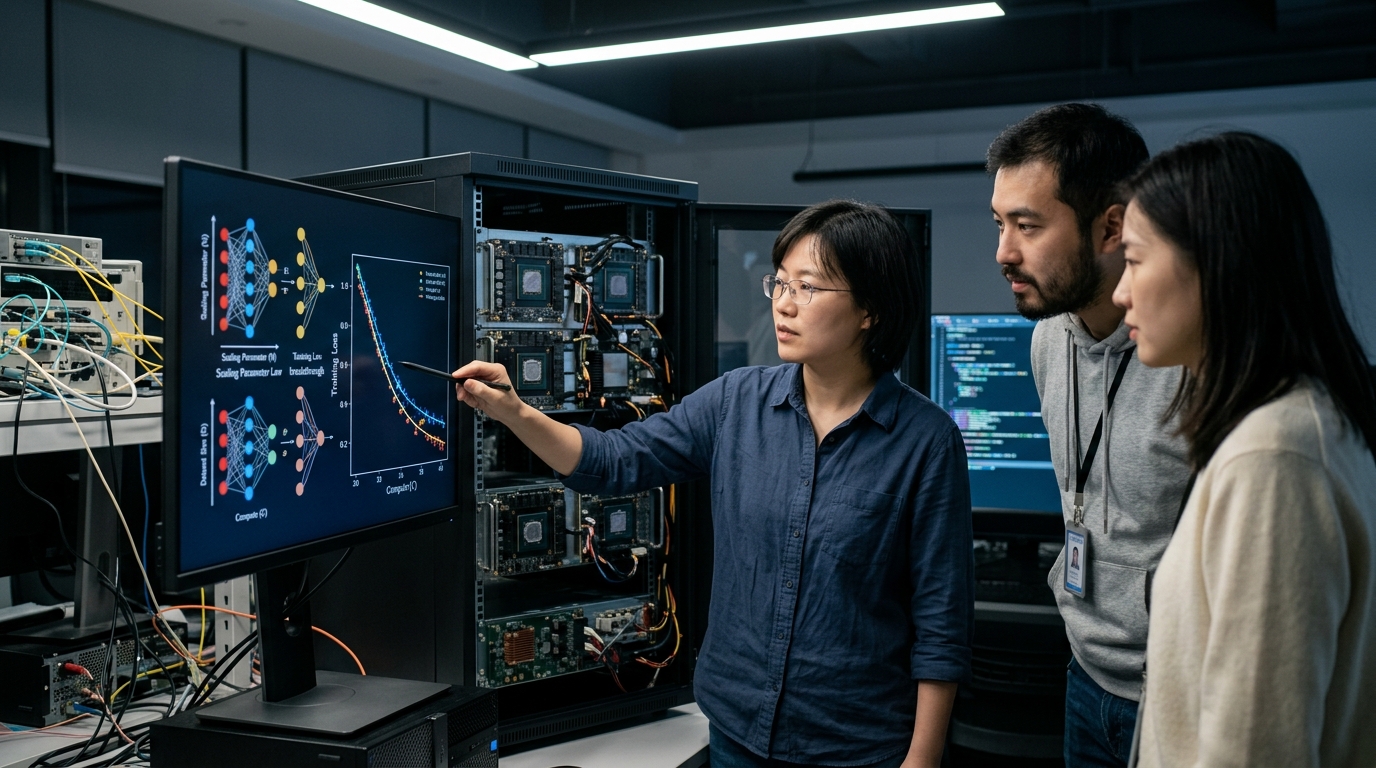
The study demonstrates that training efficiency can be dramatically enhanced if data distribution and computational routing are handled dynamically. Instead of a monolithic model where every neuron fires for every word generated, ByteDance’s approach utilizes specialized sub-networks. The new scaling law precisely describes how these experts can be scaled independently, offering a pathway toward Artificial General Intelligence (AGI) with a fraction of the energy and hardware footprint previously thought necessary.
Geopolitics and Algorithmic Sovereignty
This breakthrough arrives at a pivotal moment. With the United States imposing stringent export controls on high-end AI chips like Nvidia’s H100s to China, Chinese tech giants are forced to innovate through software and architectural ingenuity. If ByteDance can achieve state-of-the-art performance with less raw compute, US sanctions lose much of their bite. This "algorithmic compensation" is the new front line in the global race for AI supremacy.
Furthermore, ByteDance’s research places a heavy emphasis on data quality over quantity. The new law suggests that scaling is no longer just about the volume of data, but about "information density." By analyzing how models learn from diverse content types—ranging from text to the short-form video content where ByteDance reigns supreme—the company has developed a unique understanding of multimodal learning. This suggests that the next major leap in AI capability might not emerge from Silicon Valley, but from the R&D labs of Beijing.
Implications for the AI Industry
The discovery fundamentally alters the economics of AI. If scaling remains viable through architectural refinements rather than just hardware expansion, the much-feared "AI bubble" may have a longer runway. We might see a shift in investment capital from pure hardware plays toward algorithmic research and specialized software stacks. For ByteDance, this ensures that TikTok and its suite of apps will become even more personalized and efficient, powered by models that "think" faster and cheaper.
"ByteDance’s discovery proves that intelligence is not merely a matter of brute force, but of architectural elegance. The road to AGI is now wider, yet more strategically complex than ever before."
In conclusion, ByteDance’s new scaling law serves as a reminder that innovation often thrives under constraint. While the global gaze is fixed on chip shortages, ByteDance has focused on the underlying mathematics of machine learning. This pivot toward efficiency could be the catalyst that keeps the AI revolution's momentum alive for the next decade, potentially shifting the balance of power in the global technology landscape.