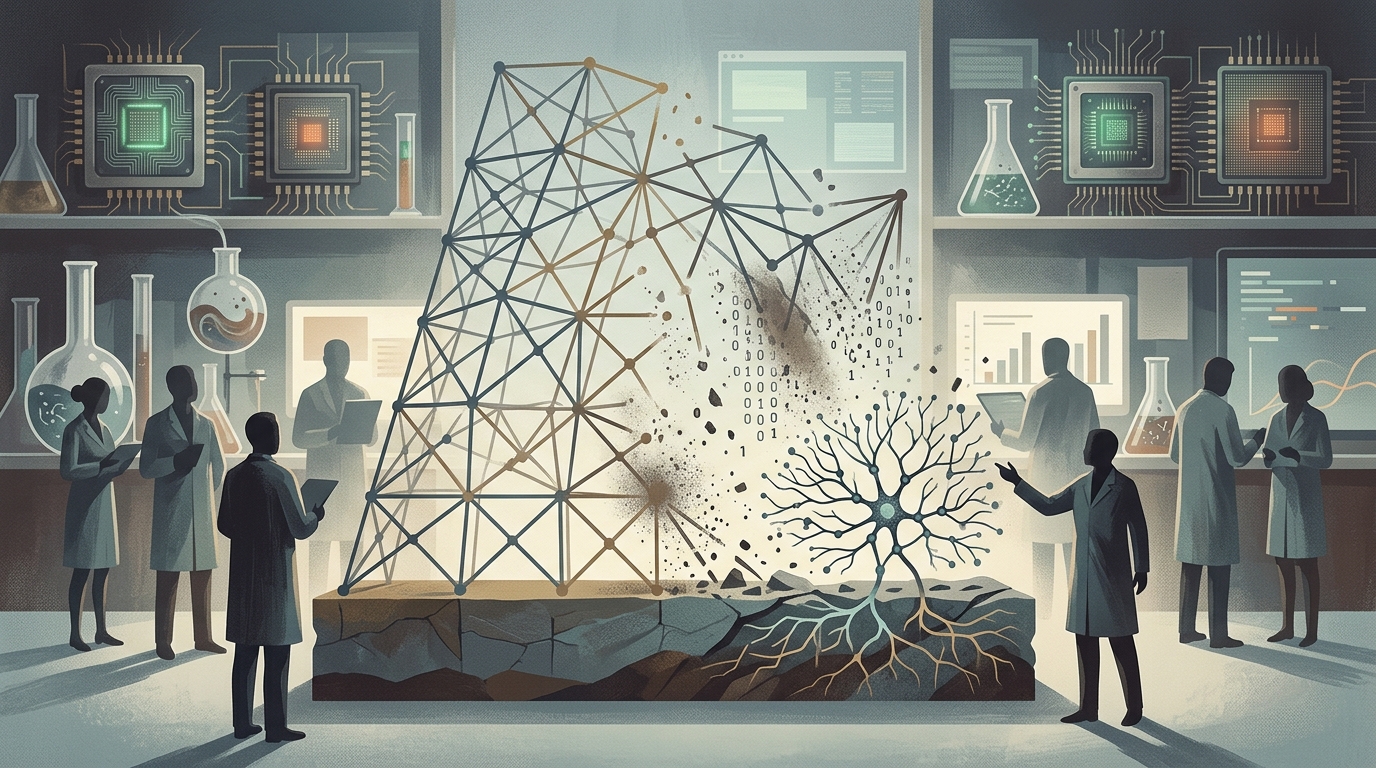
In the early days of the generative AI boom, circa 2023 and 2024, building an LLM-based application felt like assembling a complex RAG (Retrieval-Augmented Generation) puzzle. Developers were forced to stitch together vector databases, retrieval pipelines, orchestration frameworks, and agentic loops. This intermediate layer of tools became known as the "scaffolding." Today, in May 2026, that scaffolding is collapsing. According to Jerry Liu, co-founder and CEO of LlamaIndex, this isn't a failure of the ecosystem—it’s the point.
Liu’s thesis, shared in a recent deep-dive, suggests that the complexity defining the first generation of AI apps was a temporary workaround for the limitations of early base models. As frontier models from OpenAI, Anthropic, and Google evolve—boasting massive context windows and native reasoning capabilities—the need for external "crutches" is diminishing. What once required hundreds of lines of orchestration code can now often be handled by a single prompt or a native model feature.
The Shift from Orchestration to Data Intelligence
For LlamaIndex, which rose to prominence as the go-to library for connecting private data to LLMs, the collapse of the scaffolding layer might seem like an existential threat. However, Liu argues the opposite. The focus is shifting from "how to connect the pipes" to "what is flowing through them." The scaffolding is collapsing because it is becoming invisible, hardening into standardized infrastructure.
“Initially, everyone focused on just getting the system to work once,” Liu explains. “Now, the challenge is making it work reliably at production scale.” This means value is no longer found in simple retrieval, but in data engineering and precision. LlamaIndex is transitioning from a "glue code" library to a comprehensive data framework that allows enterprises to maintain data sovereignty and quality, regardless of which underlying model they use.
The Long Context Paradox
A major driver of this collapse is the advent of models with near-infinite working memory. When a model can ingest an entire codebase or a library of documents in a single turn, traditional RAG—which breaks documents into small chunks—seems less vital. Yet, Liu remains skeptical that long context windows will kill RAG entirely.
- Cost remains a barrier; sending millions of tokens per query is economically unsustainable for most high-volume apps.
- Latency increases as the model processes massive amounts of data in real-time.
- Accuracy can degrade due to the "lost in the middle" phenomenon, where models struggle to find specific facts in vast contexts.
Consequently, the scaffolding isn't vanishing; it’s being compressed. It is becoming more intelligent, dynamically deciding when to use expensive long-context processing versus efficient, targeted retrieval.
The Agentic Future and Production Reality
The discourse around AI agents has moved from hype to disillusionment and finally to pragmatic utility. Liu notes that early agents were brittle because they relied on autonomous loops that frequently hallucinated or spiraled. The new paradigm focuses on "structured workflows"—agents with specific guardrails and defined protocols that can execute complex tasks with repeatable success.
“The industry is realizing we don’t need one agent that can do everything, but a fleet of specialized agents communicating via a stable data protocol.”
This pivot toward evaluation is the hallmark of 2026. Companies are no longer asking "what can AI do?" but "how do I prove it did it correctly?". The scaffolding that survives is the one that provides the tools for observability, rigorous testing, and quality assurance.
Conclusion: The New AI Stack
The collapse of the orchestration layer signals the maturation of the AI market. "Thin wrappers"—apps that provide minimal value over a base API—are being swept away. What remains is a deep focus on data architecture. For developers, the lesson is clear: do not build complex workarounds for problems that the next generation of models will solve natively. Instead, focus on the data layer. In an era of commoditized intelligence, proprietary data and the ability to curate it remain the only defensible moats.