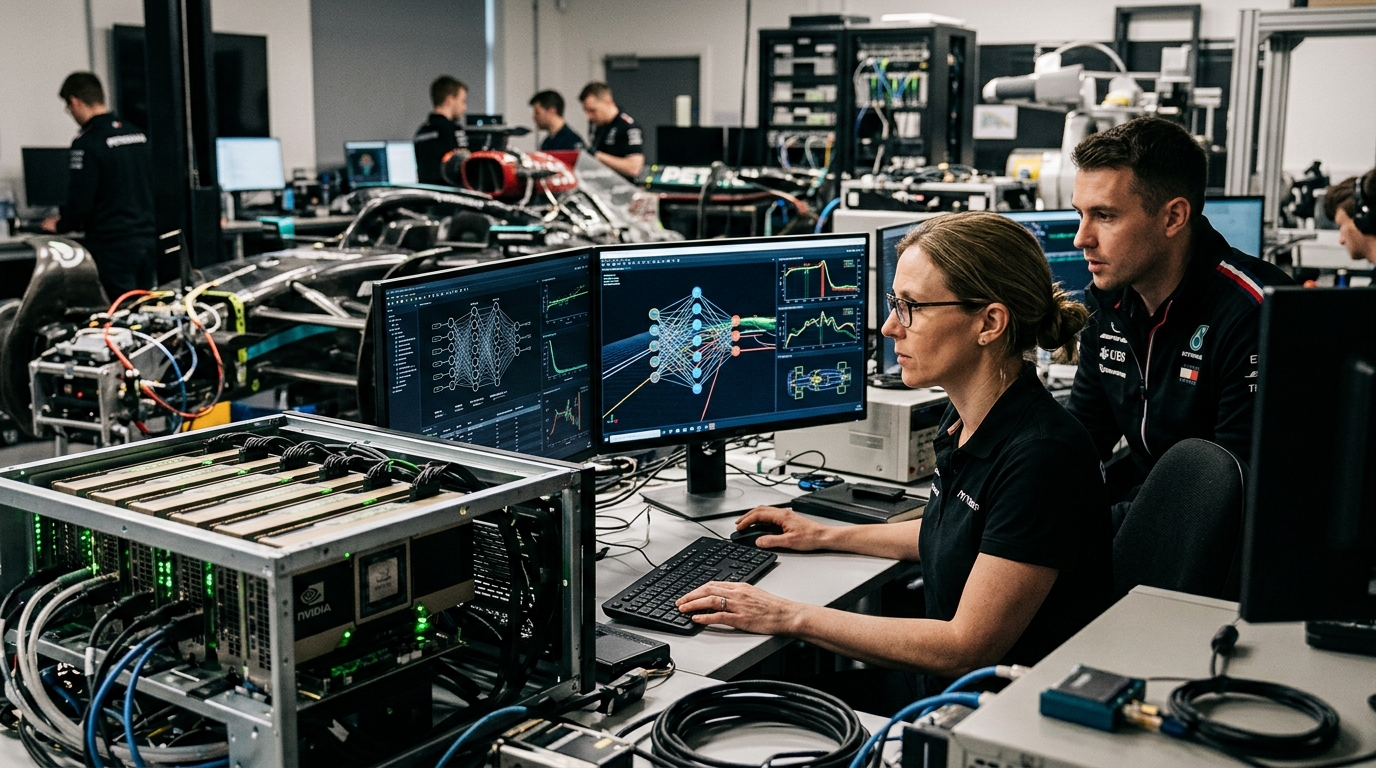
In the high-octane world of Formula 1, where milliseconds define the boundary between glory and obscurity, technology has always been the primary catalyst for success. However, we have entered a new era where the battle is fought not just on the asphalt or in the garage, but within the silicon hearts of massive computing clusters. Artificial Intelligence (AI) is no longer an experimental luxury; it is the backbone of modern F1, influencing every facet of the sport from the initial sketches of a chassis to the real-time graphics on a fan's smartphone.
Design and Aerodynamics: The Digital Revolution
Historically, car design relied on physical testing in wind tunnels and traditional Computational Fluid Dynamics (CFD). With the integration of AI and Machine Learning, this process has undergone an exponential acceleration. Teams now deploy algorithms capable of simulating millions of aerodynamic permutations in a fraction of the time previously required. AI analyzes airflow patterns around the bodywork, identifying microscopic turbulence that human engineers or legacy software might overlook.
Furthermore, the FIA's strict regulations on wind tunnel time and computational limits—part of the overarching cost cap—have made AI efficiency a necessity. Teams must maximize every second of simulation. 'Smart' simulation tools allow engineers to discard non-viable concepts before they ever reach the prototyping stage, saving millions of dollars and critical development hours. This results in cars that are inherently more stable, faster, and more adaptable to the unique characteristics of each circuit on the global calendar.
Pit-Wall Strategy: The Algorithmic Chessboard
During a Grand Prix weekend, a single F1 car generates billions of data points from hundreds of sophisticated sensors. Tire temperatures, fuel flow, brake wear, and local atmospheric conditions are analyzed in real-time. This is where AI takes on the role of the 'Grandmaster.' Collaboration with tech giants like Amazon Web Services (AWS) and Oracle allows teams like Ferrari and Red Bull Racing to run thousands of race simulations per second to predict every possible outcome.
When is the optimal window for a pit stop? How will back-marker traffic impact a driver's out-lap? What are the odds of a Safety Car deployment based on historical track data? AI provides probabilistic answers, empowering strategists on the pit-wall to make high-stakes decisions with unprecedented confidence. The ability of AI to synthesize decades of historical data with live telemetry gives teams a competitive edge that once relied solely on a chief engineer's gut feeling and experience.
The Fan Experience: F1 in the Digital Age
The impact of AI extends far beyond the paddock, reaching the screens of millions of fans worldwide. Formula 1's partnership with AWS has introduced 'F1 Insights,' real-time broadcast graphics that inform viewers about overtake probabilities, tire performance degradation, and predicted gaps after pit stops. These are not mere guesses; they are the output of complex AI models running in the cloud, processing live timing data against historical benchmarks.
Moreover, AI is being used to personalize content across digital platforms. From automated highlight reels tailored to individual user preferences to augmented reality (AR) applications that allow fans to visualize 3D car models in their own environment, technology is bridging the gap between the track and the home. F1 is evolving from a passive viewing experience into an interactive, data-driven journey. This engagement is crucial for capturing younger, tech-savvy audiences who demand deeper insights into the mechanics of the sport.
Challenges and the Future of Human Intuition
Despite the dominance of algorithms, Formula 1 remains a fundamentally human endeavor. The challenge for the future lies in maintaining a delicate balance. There is a persistent concern that the ubiquity of AI could make racing too predictable if every team converges on the same 'perfect' algorithmic strategy. The FIA remains vigilant, ensuring that the driver remains the primary actor in controlling the car's performance and that technical aids do not overshadow human skill.
Ultimately, while AI can suggest the perfect strategy, it is the driver who must execute a daring overtake at 300 km/h under immense physical and mental pressure. Artificial Intelligence is the ultimate co-pilot—a digital advisor that pushes the boundaries of what is possible. Yet, the 'soul' of Formula 1 will always reside in human courage and the ability to defy the odds, even when the algorithm suggests they are insurmountable.