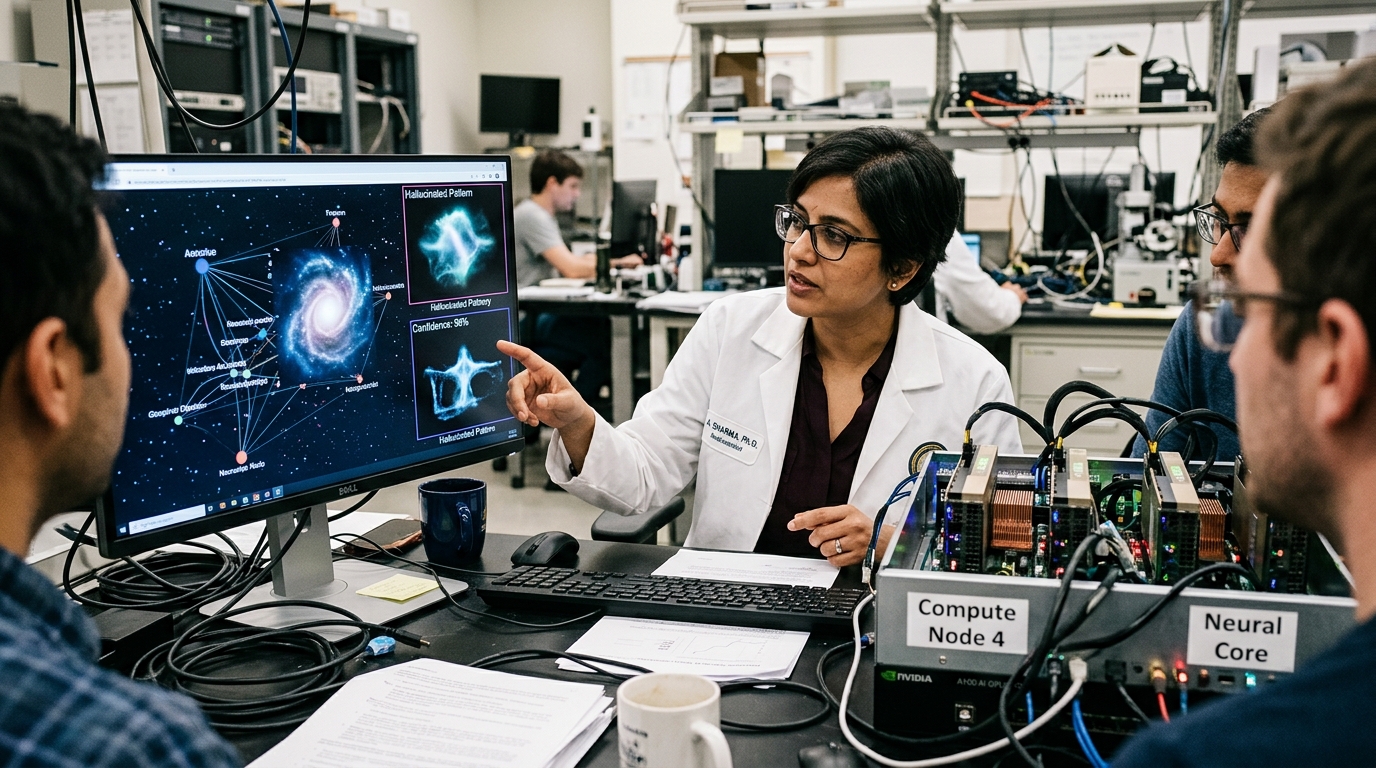
The search for extraterrestrial intelligence (SETI) is entering a new and precarious phase, where the tools we have deployed to unlock the secrets of the cosmos are proving unexpectedly vulnerable in their very design. As the volume of data from telescopes worldwide grows exponentially, humanity has pinned its hopes on Artificial Intelligence to identify signals that could signify life. However, a recent study highlighted by Phys.org sounds a major alarm: it is disturbingly easy to trick AI into 'seeing' aliens where there is only cosmic noise.
The Machine Delusion: The Phenomenon of Technological Pareidolia
Just as humans tend to see faces in clouds or on the surface of the Moon—a phenomenon known as pareidolia—neural networks appear to suffer from a digital version of this cognitive bias. Researchers demonstrated that by introducing minimal 'noise' or microscopic changes to spectrograms, AI systems trained to recognize technosignatures can produce false positives at staggering rates.
The issue lies in how these models are trained. Most rely on supervised learning, where they are fed examples of known signals. When confronted with the chaos of actual deep space, their inherent drive to categorize data leads them to arbitrary conclusions. The research emphasizes that AI does not 'understand' what an extraterrestrial civilization is; it simply looks for statistical anomalies that fit its mathematical template for the 'unusual.'
Adversarial Attacks in Deep Space
One of the most concerning findings of the study involves 'adversarial attacks.' These are intentional, though often subtle, modifications to input data designed to confuse an algorithm. In the context of astronomy, this means even natural phenomena—such as interference from terrestrial satellites (e.g., Starlink) or atmospheric disturbances—can act as inadvertent adversarial attacks.
Researchers used techniques commonly applied in cybersecurity to test the robustness of SETI algorithms. They found that by altering just a few pixels in a radio signal image, they could make the AI declare with 99% certainty that it had detected a signal from Proxima Centauri. This raises serious questions about the reliability of future discoveries. If a scientific team announces the detection of life based solely on AI analysis, how can we be sure it isn't a digital mirage?
Scientific Integrity and the Risk of the 'False Alarm'
The history of astronomy is littered with signals initially thought to be extraterrestrial, such as the famous 'Wow!' signal of 1977 or the first pulsars, originally dubbed LGM-1 (Little Green Men). However, in the age of AI, the risk of a false alarm takes on a new dimension. A mistaken announcement could shatter public trust in science and lead to the waste of billions of dollars in resources.
- The Need for Cross-Verification: Researchers suggest that no AI discovery should be accepted without independent verification from different types of algorithms and, crucially, human judgment.
- Training Transparency: The datasets used to train models must be open and include vast amounts of 'negative' samples (noise) to prevent overfitting.
- Multimodal Analysis: Using data from different telescopes (radio, optical, X-ray) simultaneously can drastically reduce the probability of error.
Conclusion: The Human Remains the Final Arbiter
Despite the impressive capabilities of Artificial Intelligence in processing big data, this study reminds us that technology is a mirror of our own expectations and methodological shortcomings. The search for whether we are alone in the universe is perhaps humanity's most profound question. Answering it requires more than powerful processors; it requires the critical thinking and skepticism that only human consciousness can provide. AI may be our navigator to the stars, but the captain must remain human, ready to distinguish reality from the digital dream.