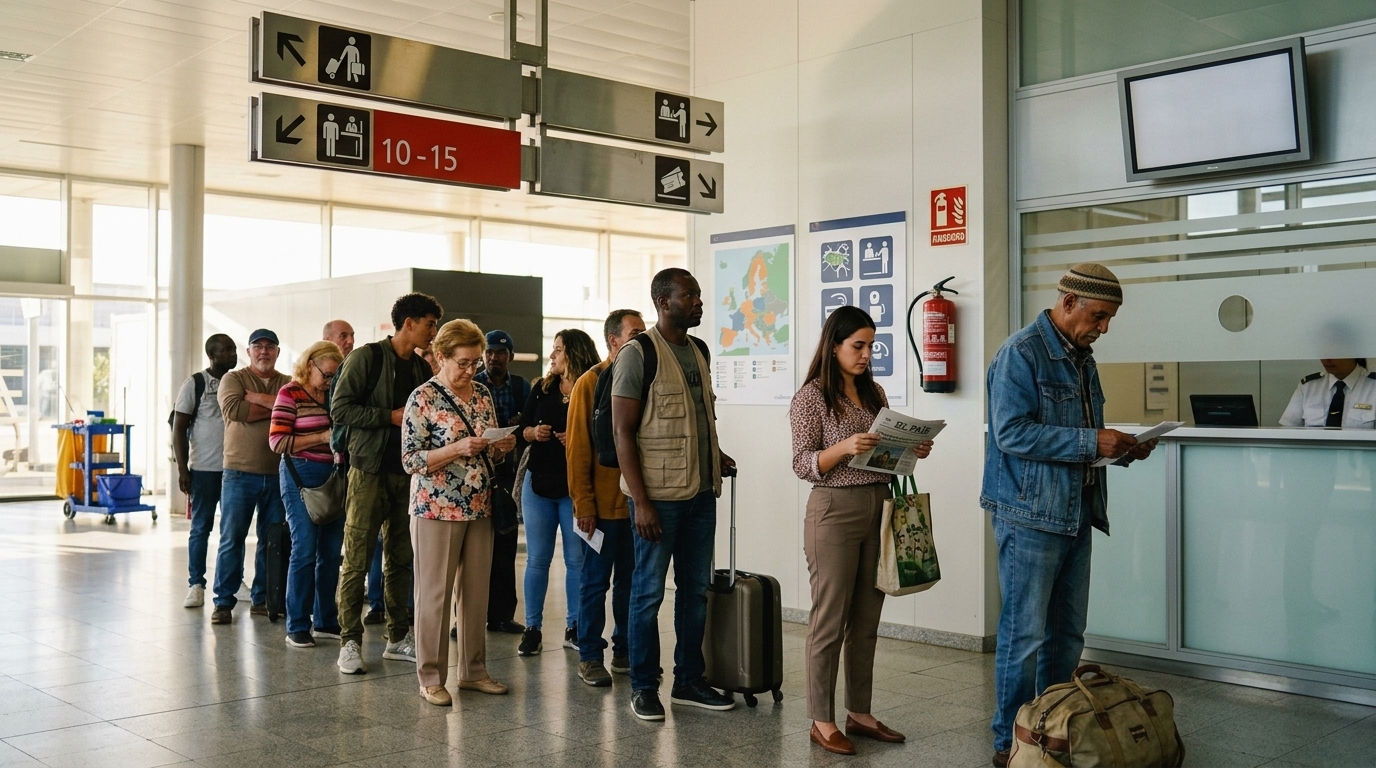
At a time when Europe seems trapped between the demographic winter and the rise of populist rhetoric, Spain is charting a course described by many as "radical pragmatism." The government of Pedro Sánchez, led by Migration Minister Elma Saiz, has launched an ambitious plan to regularize approximately 500,000 irregular migrants over the next three years. However, the defining characteristic of this reform is not just the scale, but the methodology: the direct matching of these individuals with the actual needs of the Spanish labor market.
Economic Logic Over Political Posturing
Spain, like much of Southern Europe, faces an existential threat: an aging population. With one of the lowest fertility rates in the EU, the sustainability of the social security system and GDP growth depend heavily on the influx of a new workforce. According to estimates by the Bank of Spain, the country requires hundreds of thousands of new workers annually to maintain its welfare state at current levels.
The new plan simplifies the bureaucratic maze for obtaining residency and work permits. Specifically, the reform focuses on three pillars:
- Training and Integration: Granting permits to those who enroll in vocational training programs for sectors facing labor shortages.
- Simplification of 'Arraigo' (Roots): Reducing the waiting time for regularization through social and labor integration from three years to two, or even less in specific cases.
- Seasonal Work: Strengthening the rights of seasonal workers, ensuring that circular migration operates under terms of dignity rather than exploitation.
Key Sectors and Market Response
The industries expected to benefit immediately are agriculture, construction, hospitality, and elderly care. Particularly in the care sector, the "shadow economy" has been the norm, with thousands of women from Latin America working without social security. Their regularization is not just an act of justice but a significant boost to public coffers through social security contributions.
"This is not just about humanitarianism; it is about the very survival of our economy," a government official in Madrid stated. "A worker in the shadows does not consume, is not taxed, and is not protected. This reform brings light to a reality we all knew existed but no one dared to regulate."
However, the move is not without its detractors. The right-wing People's Party (PP) and the far-right Vox accuse the government of creating a "pull factor" that will encourage new illegal arrivals. Madrid's rebuttal is clear: these people are already in Spain, living among us, and regularizing them is the only way to manage the situation and prevent the formation of ghettos.
The European Context: A Model to Follow?
Spain's move stands in stark contrast to the "closed borders" policies being adopted by other European capitals. While Germany tightens controls and Italy experiments with detention centers in Albania, Spain is betting on integration. The question arises whether the "Spanish model" can serve as a blueprint for the EU's New Pact on Migration and Asylum.
The success of this venture will be judged by the state's ability to handle the volume of applications and the speed at which businesses absorb the new workforce. If the gamble pays off, Spain will have demonstrated that migration, when handled with a plan rather than fear, can be transformed from a "problem" into a driving force for the future.