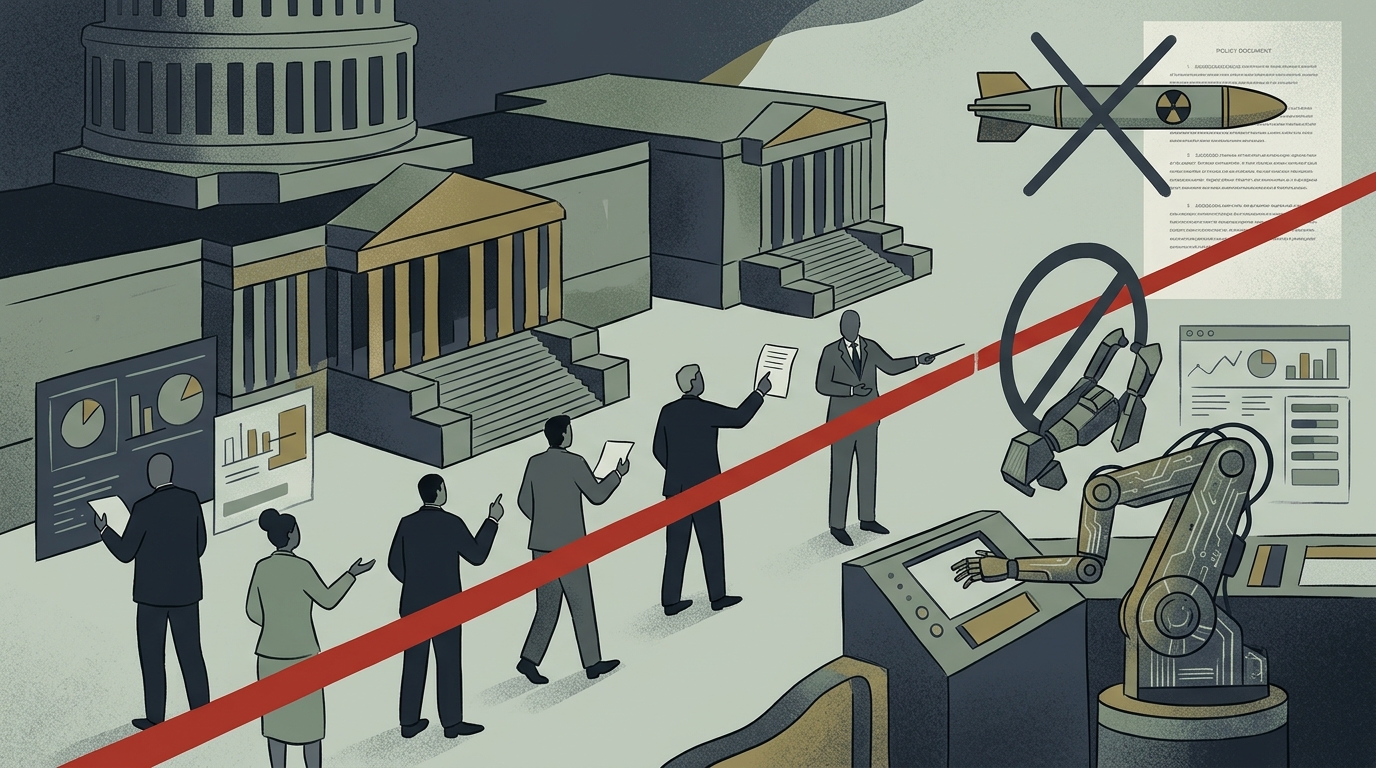
In an era where the velocity of technological advancement frequently outpaces the capacity for legislative oversight, the United States Senate has moved to draw an unnegotiable line in the sand. The recent inclusion of provisions in the National Defense Authorization Act (NDAA) for Fiscal Year 2025, which explicitly prohibits Artificial Intelligence (AI) from making autonomous decisions regarding the launch of nuclear weapons or the use of lethal force without human oversight, represents one of the most critical policy interventions of the 21st century.
The End of the 'Terminator' Scenario?
This decision is not merely a reaction to science fiction tropes but a profound acknowledgment of the existential risks posed by integrating AI into strategic defense systems. The Senate Armed Services Committee, led by Senators Jack Reed and Roger Wicker, appears to have reached a consensus: the complexity of 'black-box' algorithms cannot substitute for human moral judgment and accountability, particularly when dealing with weapons of mass destruction.
This legislative initiative codifies a long-standing, yet informal, Pentagon policy. To date, Department of Defense Directive 3000.09 required 'appropriate levels of human judgment' for the use of force. However, transforming this directive into federal law adds a new layer of institutional gravity and sends a clear signal to international adversaries, such as China and Russia, regarding the safety standards the U.S. intends to uphold.
The Challenge of 'Lethal Force'
While the ban on nuclear autonomy enjoys broad bipartisan support, the debate becomes more nuanced when addressing conventional weaponry and 'lethal force.' The NDAA stipulates that any system utilizing AI to select and engage targets must maintain a 'human-in-the-loop.' This ensures that a military officer or operator must authorize the final fire command.
However, critics and defense analysts highlight a critical paradox: the 'speed of relevance.' In an environment where enemy drones or missiles travel at hypersonic speeds, the latency introduced by human intervention could prove fatal. There is a persistent fear that if adversaries deploy fully autonomous systems capable of reacting in milliseconds, the U.S. might find itself at a tactical disadvantage by adhering to its own ethical constraints.
Geopolitical Implications and International Norms
The Senate's move is also a tool of high-stakes diplomacy. The U.S. has long advocated for an international agreement banning AI from controlling nuclear arsenals. By legislating first, Washington gains the moral high ground to demand reciprocal commitments from Beijing and Moscow. While China has previously expressed interest in limiting AI's role in nuclear command, ongoing tensions in the South China Sea and the Pacific arms race make any such agreement extremely fragile.
- Ensuring human accountability in instances of collateral damage or misidentification.
- Preventing accidental escalation triggered by algorithmic errors or 'hallucinations.'
- Advocating for global standards in the military application of emergent technologies.
The Technical Dimension: Can We Trust the Code?
The issue with AI on the battlefield is not just ethical; it is technical. Machine learning systems are trained on historical data. In the unprecedented scenarios of modern warfare, AI may encounter 'out-of-distribution' events that lead to unpredictable behavior. The Senate, through the NDAA, recognizes that the 'fog of war' requires intuition and ethical weighing—qualities that algorithms currently lack.
Conclusion
Ultimately, this move by the U.S. Senate acts as a necessary brake on the unchecked militarization of AI. While significant hurdles remain—particularly regarding the enforcement of these rules and the competitive pressure from autocratic regimes—codifying human control into law is a vital step for ensuring human agency remains at the heart of our most consequential decisions.