

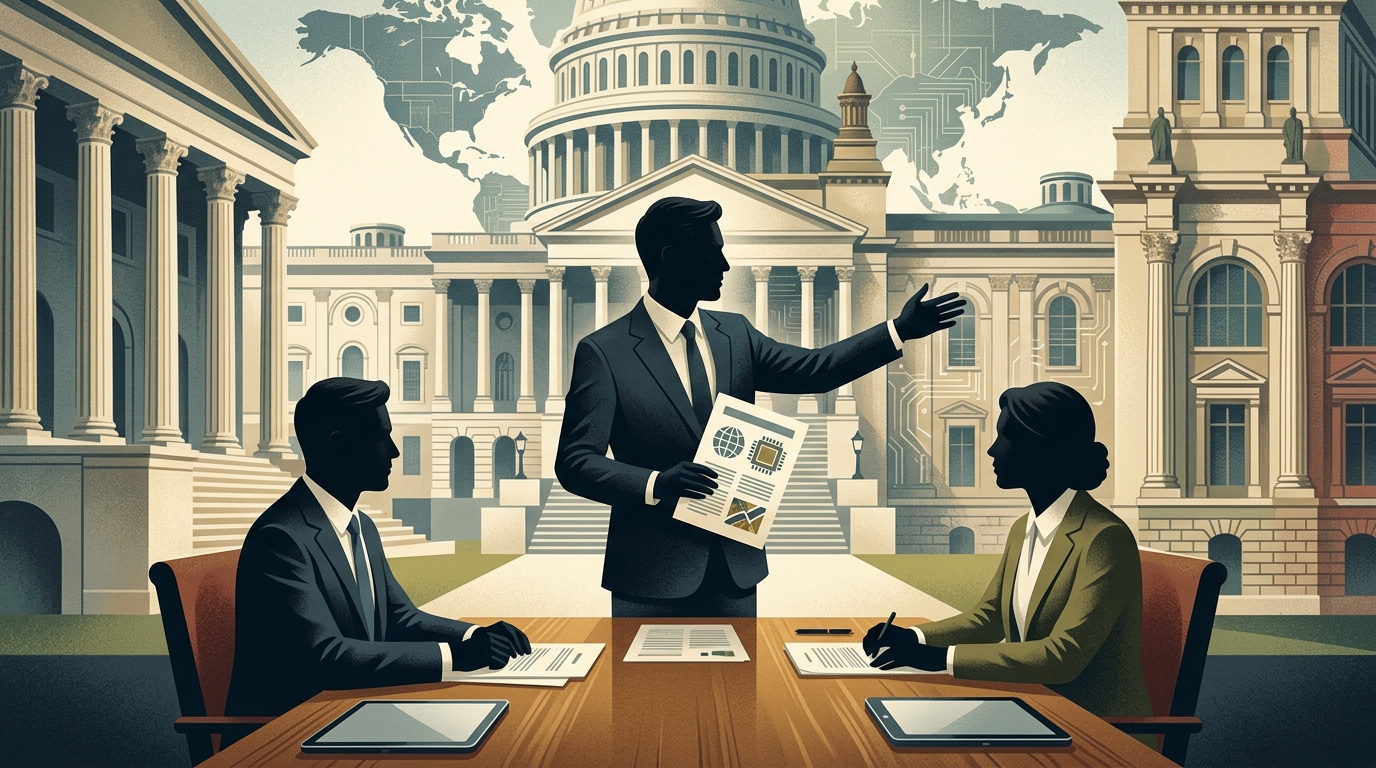
In a move that highlights the transformation of tech giants into geopolitical entities, Nvidia has announced the hiring of Bruce Andrews, a seasoned veteran with deep knowledge of Washington’s power corridors, as its new head of government affairs. This appointment is not merely a routine corporate reshuffle; it is a strategic fortification of a company now positioned at the absolute center of the global race for Artificial Intelligence (AI) supremacy.
The Strategist Behind the Shield
Bruce Andrews is no stranger to the political spotlight. Having served as Deputy Secretary of Commerce under the Obama administration and most recently as Vice President of Global Government Affairs at Intel, he brings a rare blend of public and private sector expertise. His tenure at the Department of Commerce is particularly significant, as this agency is responsible for the stringent export controls on semiconductors to China—an issue that represents perhaps the greatest long-term existential threat to Nvidia’s profitability.
The choice of Andrews signals that CEO Jensen Huang recognizes that market dominance is no longer just about chip architecture, but also about the company’s ability to navigate the complex waters of international diplomacy. With Nvidia controlling over 80% of the AI accelerator market, the company has effectively become a U.S. "national champion," a status that brings both immense privileges and massive responsibilities.
The Geopolitical Chessboard and the 'Silicon Curtain'
Andrews’ primary task will be managing relations with the Biden administration (and whoever follows), as Washington escalates its efforts to limit China’s access to cutting-edge technology. Nvidia has already been forced to redesign chips, such as the H20, to comply with Department of Commerce specifications—a process that is both costly and technically cumbersome.
- Export Controls: The need for constant dialogue with the Bureau of Industry and Security (BIS) to secure export licenses and clarify shifting regulations.
- European Union: Navigating the implementation of the EU AI Act and its potential impact on data center expansion and energy requirements.
- Domestic Subsidies: Engaging with the CHIPS and Science Act to bolster supply chain resilience and secure federal funding for R&D.
Nvidia is no longer a company that just makes graphics cards for gamers. It is the infrastructure provider for the next industrial revolution. This places it at the heart of trade wars where technology is utilized as a primary tool of foreign policy.
Antitrust Scrutiny: The Next Frontier
Beyond international relations, Andrews will be tasked with addressing the growing skepticism of regulatory bodies. The U.S. Federal Trade Commission (FTC) and the Department of Justice (DOJ) are closely monitoring Nvidia, as its dominant market position raises concerns about potential anti-competitive practices. In Europe, the French Competition Authority has already conducted raids on the company’s offices, while the European Commission is scrutinizing market dynamics.
"Success brings scrutiny. When a company becomes as central to the global economy as Nvidia has, the government ceases to be a mere observer and becomes a regulator," notes a senior tech policy analyst.
The presence of Andrews—a man who knows how to speak the language of bureaucrats—is a concerted effort to preempt aggressive moves toward breaking up or restricting the company’s operations. Nvidia aims to convince Washington that its own success is synonymous with American leadership in the AI era.
Conclusion: The Maturation of Silicon Valley
The hiring of Bruce Andrews marks the end of the age of "innocence" for Nvidia. Much like Microsoft in the 1990s and Google in the 2010s, Nvidia has realized that politics is just as important as code. In a world where semiconductors are the new oil, the head of government affairs is perhaps the most critical role after the CEO. Nvidia’s ability to maintain its hegemony will now depend on how well it can play the game of power on the global stage.





