

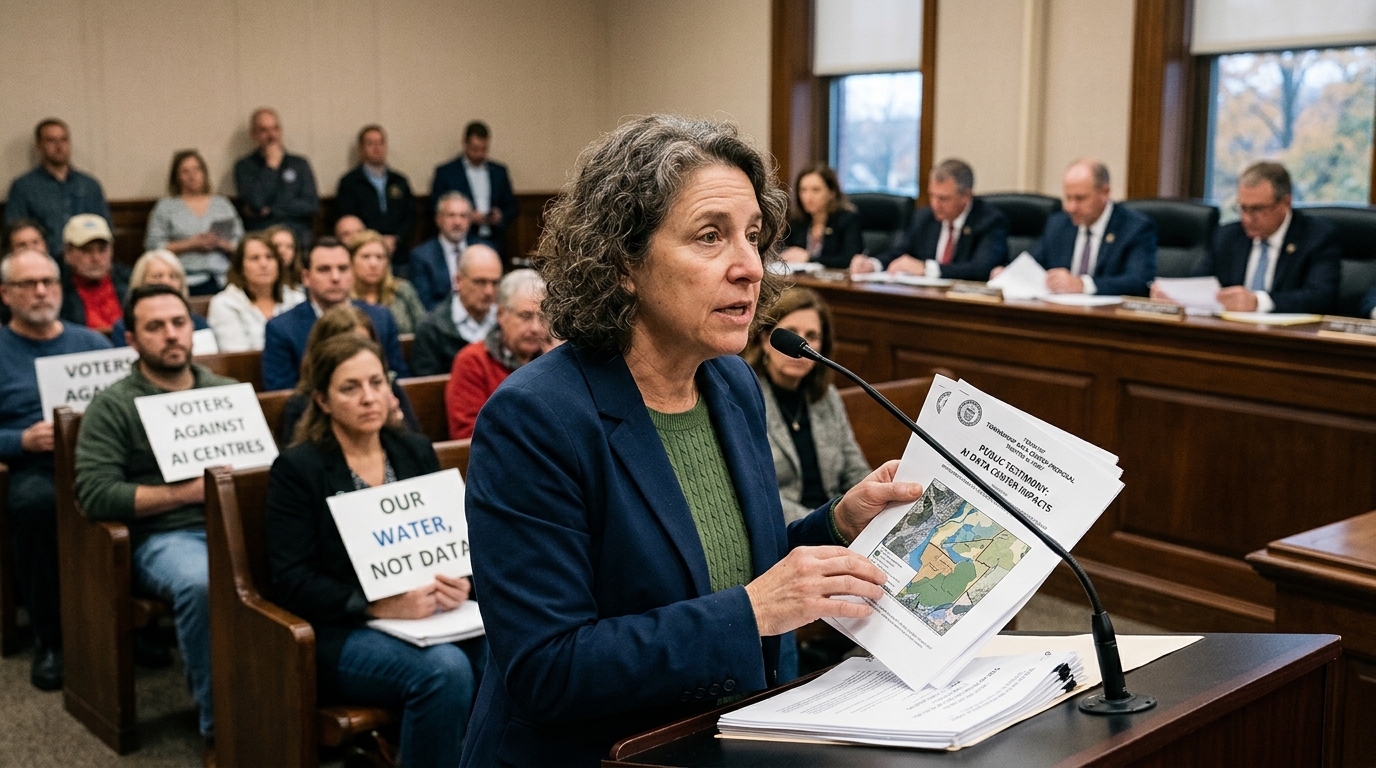
The state of New Jersey is at a critical crossroads where the ambitions of the digital age are colliding with the daily lives of its citizens. While Governor Phil Murphy aggressively promotes the idea of turning the state into a global "AI Hub," a new poll from Fairleigh Dickinson University (FDU) reveals a starkly different reality: a majority of voters now favor a ban on new data centers in their communities.
This resistance is not merely a passing reaction but the result of growing concerns over the environmental and social impacts of these technological behemoths. Data centers, essential for training AI models like GPT-4, require massive amounts of energy and water, while their operation is often accompanied by a constant, low-frequency noise that exhausts surrounding neighborhoods. For residents of the Garden State, the price of progress is increasingly seen as too high to pay.
The Poll That Shook Trenton
According to FDU findings, 54% of registered voters support a moratorium on the construction of new data centers. This percentage rises significantly when respondents are informed about the energy requirements of these facilities. The poll shows that opposition transcends party lines, with Democrats and Republicans alike agreeing that protecting quality of life takes precedence over corporate investment.
Analysts point out that New Jersey is the most densely populated state in the US, making the siting of industrial facilities an extremely sensitive issue. When a data center occupies hundreds of acres of land, often near residential zones or schools, residents feel their vital space is threatened by infrastructure that, unlike the factories of the past, offers very few permanent jobs once construction is complete.
The Energy Paradox and Environmental Costs
One of the strongest arguments against data centers is their electricity consumption. Artificial Intelligence is "thirsty" for resources. An average data center can consume as much energy as tens of thousands of households. In an era where New Jersey is striving to transition to clean energy and reduce emissions, adding massive loads to the power grid seems contradictory.
Furthermore, there is the issue of water. The cooling systems required to prevent thousands of processors (GPUs) from overheating consume millions of gallons of water daily. During drought periods, residents fear that the AI industry will be prioritized over the needs of citizens. Noise from giant cooling fans is another form of pollution that has led to legal battles in towns like South Brunswick, where residents describe an "endless hum" that makes peace at home impossible.
Economic Benefits vs. Social Costs
The Murphy administration and tech proponents argue that data centers are the backbone of the future economy. They claim these facilities bring in property tax revenue and enhance the state's prestige as an innovation hub. However, the FDU poll suggests that voters are not convinced by the narrative of "trickle-down technology." The fact that a building the size of an airport might employ only 30-50 staff members is seen by many as a poor use of land.
The situation in New Jersey is a harbinger of what is to come across the US and Europe. As demand for AI grows exponentially, the need for physical infrastructure will become increasingly urgent. If governments do not find a way to balance growth with the needs of local communities—perhaps through stricter noise regulations, mandatory renewable energy use, and incentives for repurposing old industrial sites—then the "Not In My Backyard" (NIMBY) movement could evolve into an insurmountable obstacle for the evolution of technology itself.




