In a move that underscores the growing importance of regulatory oversight in the tech sector, Maryland Governor Wes Moore has announced the appointment of Michael Boyce as Senior Advisor for Responsible Artificial Intelligence. This appointment is not merely a routine administrative fill; it signals a strategic shift toward embedding ethics at the heart of the state's digital transformation. As artificial intelligence (AI) rapidly reshapes public administration, the need for leaders who understand both the technology and its societal implications has become paramount.
The Strategic Significance of the Appointment
Michael Boyce brings a wealth of experience from the Department of Homeland Security (DHS) and the United States Digital Service (USDS). His background in federal government provides him with a unique perspective on how large bureaucracies can adopt modern technologies without sacrificing security or transparency. In Maryland, his role will be twofold: on one hand, to promote the adoption of AI tools that will improve service delivery to citizens, and on the other, to ensure that these tools do not replicate biases or infringe upon privacy.
Governor Moore has made it clear that he wants Maryland to lead the "innovation economy." However, innovation without guardrails can lead to social inequities. Boyce is tasked with implementing the executive order Moore signed in early 2024, which sets strict criteria for AI use by state agencies. This includes conducting risk assessments, ensuring algorithmic fairness, and maintaining human oversight in critical decision-making processes.
Challenges and Ethical Dilemmas
The challenge for Boyce is immense. The public sector often lags behind the private sector in terms of technological infrastructure. Introducing AI into systems such as unemployment benefit distribution, traffic management, or law enforcement carries inherent risks. For instance, the use of algorithms in policing has faced intense criticism for racial bias. Boyce will need to create a framework that allows for independent auditing of these systems and ensures that citizens have a "right to explanation" for automated decisions that affect them.
- Establishing protocols for protecting citizens' personal data.
- Developing training programs for state employees on AI literacy and usage.
- Collaborating with the private sector to develop solutions tailored to state needs.
- Ensuring AI adoption leads to workforce upskilling rather than displacement.
Furthermore, there is the issue of trust. In an era of deep polarization and misinformation, the government must prove that technology is being used for the common good. Boyce will act as a bridge between technocrats and the public, explaining the benefits and the limitations of new systems.
Maryland as a Blueprint for Federal Action
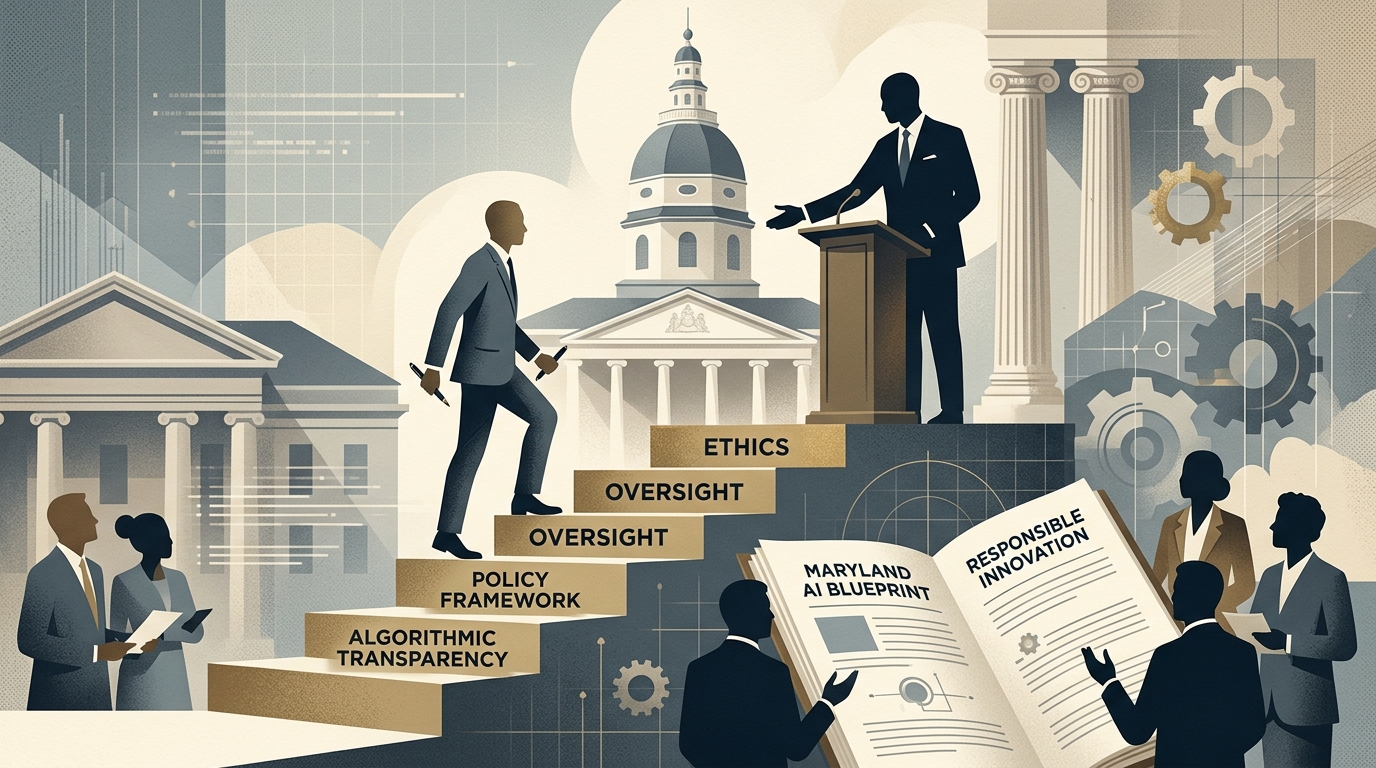
While the U.S. Congress struggles to reach a unified legislative framework for AI, states like Maryland, California, and New York are taking the lead. This "laboratory of democracy" approach allows for experimentation with different governance models. Appointing a senior advisor dedicated solely to responsible AI shows that the state is treating the issue with the seriousness it deserves. If Maryland's experiment succeeds, it could serve as a blueprint for a national strategy.
"Artificial intelligence is not a future threat or promise; it is the present reality of governance. We must harness it with wisdom," Governor Moore stated during the announcement.
In conclusion, Michael Boyce's success will be measured by his ability to translate abstract ethical principles into actionable policies. In a world moving at the speed of silicon, ensuring a human-centric approach is perhaps the most difficult yet necessary mission of our time. Maryland is positioning itself on the right side of history, recognizing that technological progress is hollow if not accompanied by social responsibility.