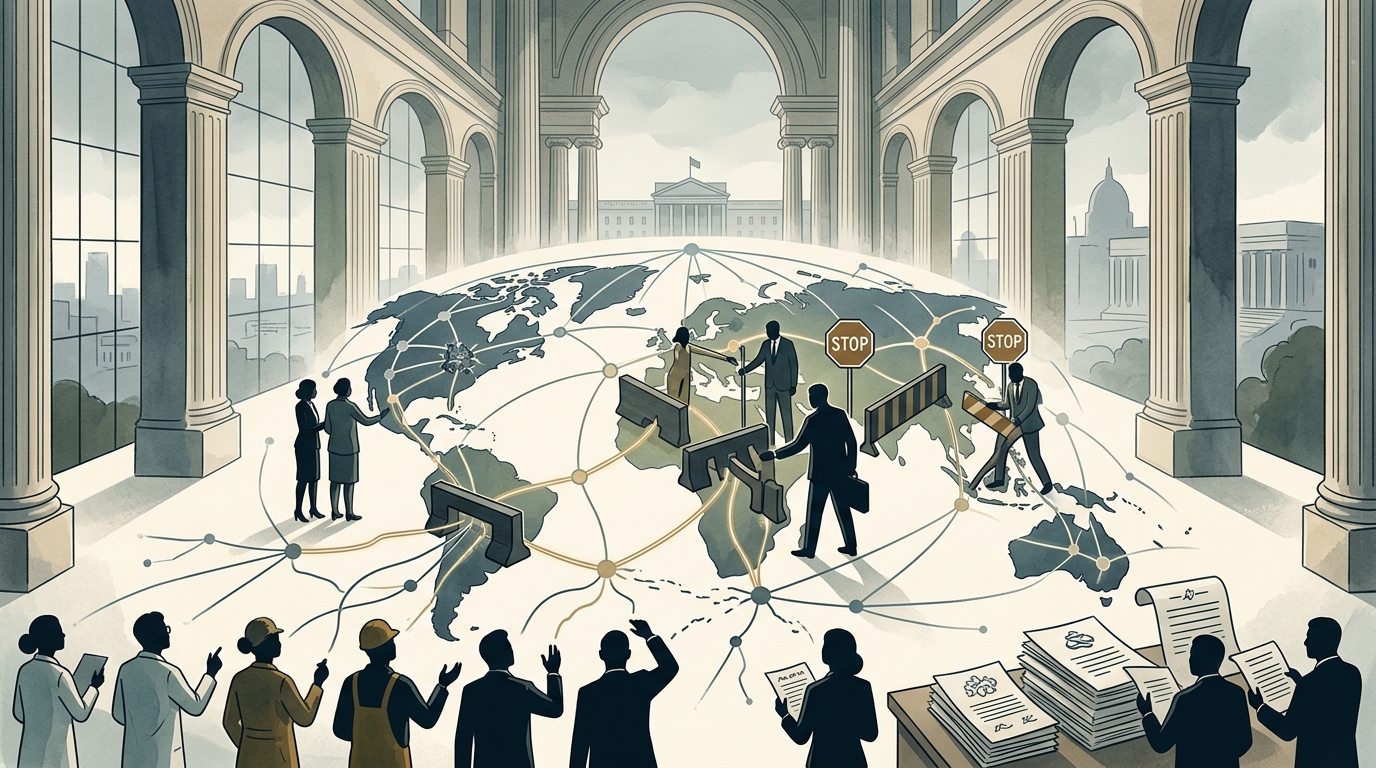
In an era where Artificial Intelligence (AI) is transitioning from a futuristic promise to a daily economic reality, Jensen Huang, the visionary leader of NVIDIA, has issued a stark warning to policymakers worldwide. During recent engagements, Huang emphasized that imposing strict restrictions on AI applications is not merely a hurdle for individual companies, but an existential threat to the overall innovation ecosystem.
The Philosophy of 'Open' Innovation
Huang argues that the power of AI lies in its ability to permeate every industry, from medicine to heavy manufacturing. When governments impose blanket restrictions, they risk creating a 'digital divide' that favors only those with the resources to bypass or comply with labyrinthine regulations. According to him, AI should be treated as a new utility, akin to electricity or the internet, where access must be as free as possible for creativity to flourish.
"Artificial intelligence is the greatest power multiplier in the history of technology. Restricting access to it is like restricting access to knowledge itself," he stated emphatically.
An Ecosystem at Risk
Huang’s concern stems from the interconnected nature of modern technology. NVIDIA does not just produce chips; it serves as the central hub of a network that includes software developers, cloud providers, and startups. If end-user applications are curtailed due to rigid regulatory frameworks—such as the EU AI Act or US export controls—the demand for the underlying infrastructure will wane, leading to a global slowdown in research and development (R&D).
- Loss of Competitiveness: Regions with heavy restrictions risk losing talent and capital to more 'hospitable' jurisdictions.
- Fragmentation: The creation of disparate AI standards across continents will make global collaboration nearly impossible.
- Compliance Costs: Small businesses may be priced out of the market, leaving the field exclusively to tech giants.
Geopolitical Implications and Sovereign AI
Huang also touched upon the concept of 'Sovereign AI.' Every country, he argues, must have the capability to develop its own AI models that reflect its culture, language, and values. Restrictions on applications often function as tools of geopolitical leverage, which could lead to a new 'technological cold war.' NVIDIA, being at the heart of US export restrictions to China, is well aware of how politics can distort the market.
The Case for Smart Regulation
Despite his warnings, Huang is not anti-regulation. Instead, he advocates for an approach that focuses on the safety of outcomes rather than the control of tools. Regulation should target the use of AI in critical sectors (such as autonomous driving or medical diagnosis) rather than the development of the algorithms themselves. This way, public safety is ensured without sacrificing progress.
In conclusion, Jensen Huang’s plea is a reminder that technology does not develop in a vacuum. The future of AI depends on a delicate balance between protecting citizens and providing freedom to creators. If the scales tip too far toward restriction, the price will be not only economic but also cultural, as it will deprive humanity of tools that could solve some of the most pressing problems of our century.