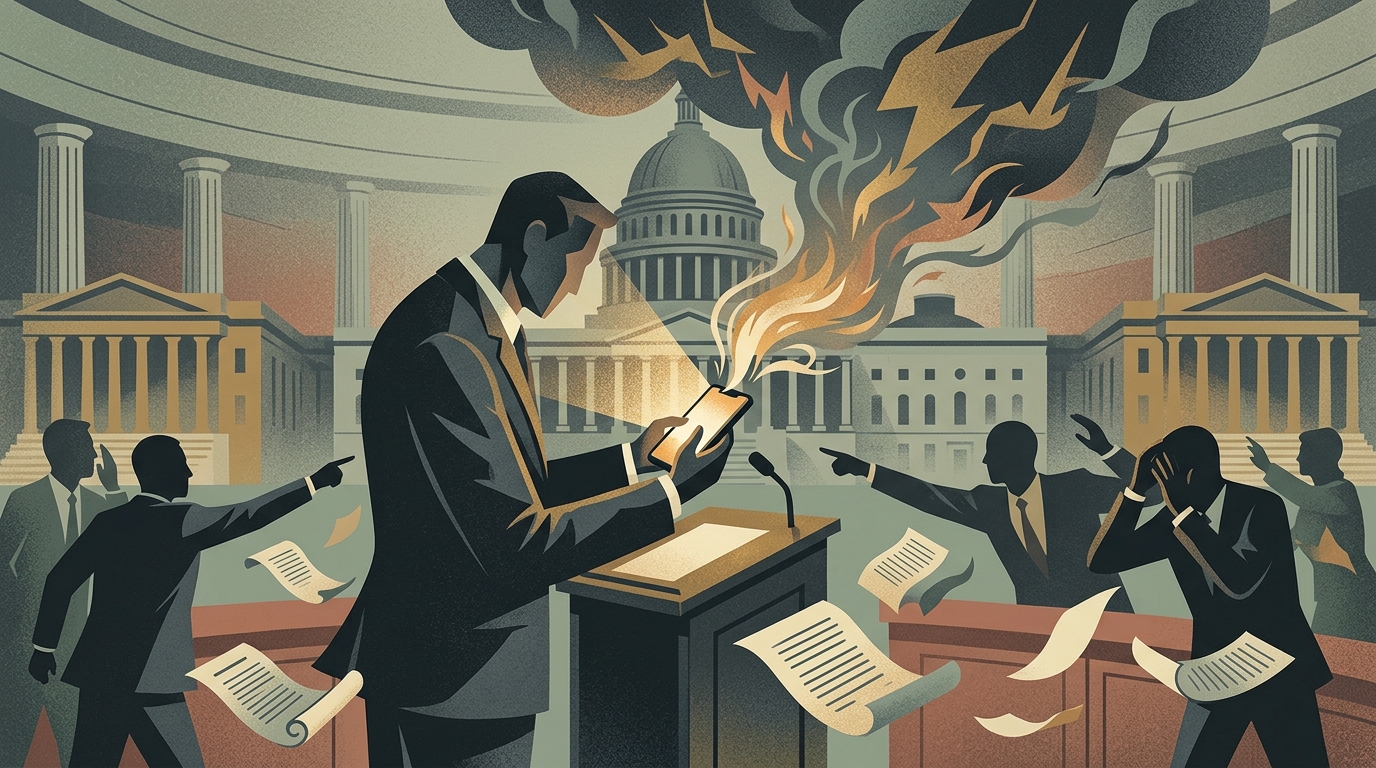
The history of American politics over the last decade could be written through the clashes of two men: Donald Trump and James Comey. Today, in April 2026, this confrontation takes on a new, unexpected dimension, moving from courtrooms and Washington offices to the digital world of Instagram. The former FBI chief finds himself once again in the crosshairs of Trump supporters, facing accusations that a recent post constitutes an implicit threat against the former (and current) president.
The Anatomy of a Post and Its Interpretations
It all began when Comey posted a photo of a misty forest with the caption: "Justice is like the weather. It may be delayed, but the storm is inevitable." In any other context, this might be seen as a simple philosophical reflection. However, in the hyper-polarized atmosphere of today's America, these words were interpreted by the Trump camp as a "coded message" to members of the so-called "Deep State" regarding an imminent move against the president.
Comey's critics argue that the use of the word "storm" is no accident, echoing conspiracy theories and political terms that have been heavily used in recent years. The reaction was instantaneous, with Republican lawmakers calling for an investigation by the Department of Justice, citing "intimidation" and "incitement to violence."
The Legal Dimension: When Does a Post Become a 'Threat'?
The question that arises is whether such a post can legally establish a charge of making a threat. Under U.S. law and the First Amendment, freedom of speech protects even harsh criticism. To be considered a "true threat," it must be proven that the speaker intended to place the target in fear of bodily harm or that a reasonable person would perceive the words as a serious expression of intent to commit violence.
- The ambiguity of the language works in Comey's favor, as "justice" is an abstract concept.
- The historical rivalry between the two men provides context but is insufficient for conviction without specific evidence.
- The use of metaphors (like the weather) is a classic tool of political rhetoric.
However, the pressure on authorities is immense. In an era where AI and social media can amplify a message to billions of users in seconds, the line between "political commentary" and "digital threat" is becoming increasingly blurred.
The Political Legacy of James Comey
Comey is not just any social media user. He is the man who in 2016 influenced the election outcome with his announcements regarding Hillary Clinton's emails and the man fired by Trump in 2017, triggering the Mueller investigation. Every move he makes is scrutinized under a microscope. To his supporters, he is a guardian of institutions undergoing persecution. To his enemies, he is a "political careerist" who used the FBI for a personal agenda.
"History will judge Comey not only for his actions at the FBI but also for how he chose to remain relevant in an era where truth is under question," says a CNN analyst.
This new dispute highlights the failure of American institutions to heal the wounds of the past. Instead of a serious dialogue about national security and justice, the public sphere is consumed by interpreting Instagram posts, degrading the level of political debate into a perpetual "witch hunt" from both sides.
Conclusion: The Digital Arena of Politics
As we head into the second half of 2026, the Comey case is a harbinger of what is to come. The use of technology and social networks as tools of psychological warfare is now the norm. Whether it is a real threat or a misunderstood metaphor, what is certain is that polarization in the US has reached a point where words are no longer just means of communication, but weapons in an endless conflict for power and the dominance of a particular "truth."