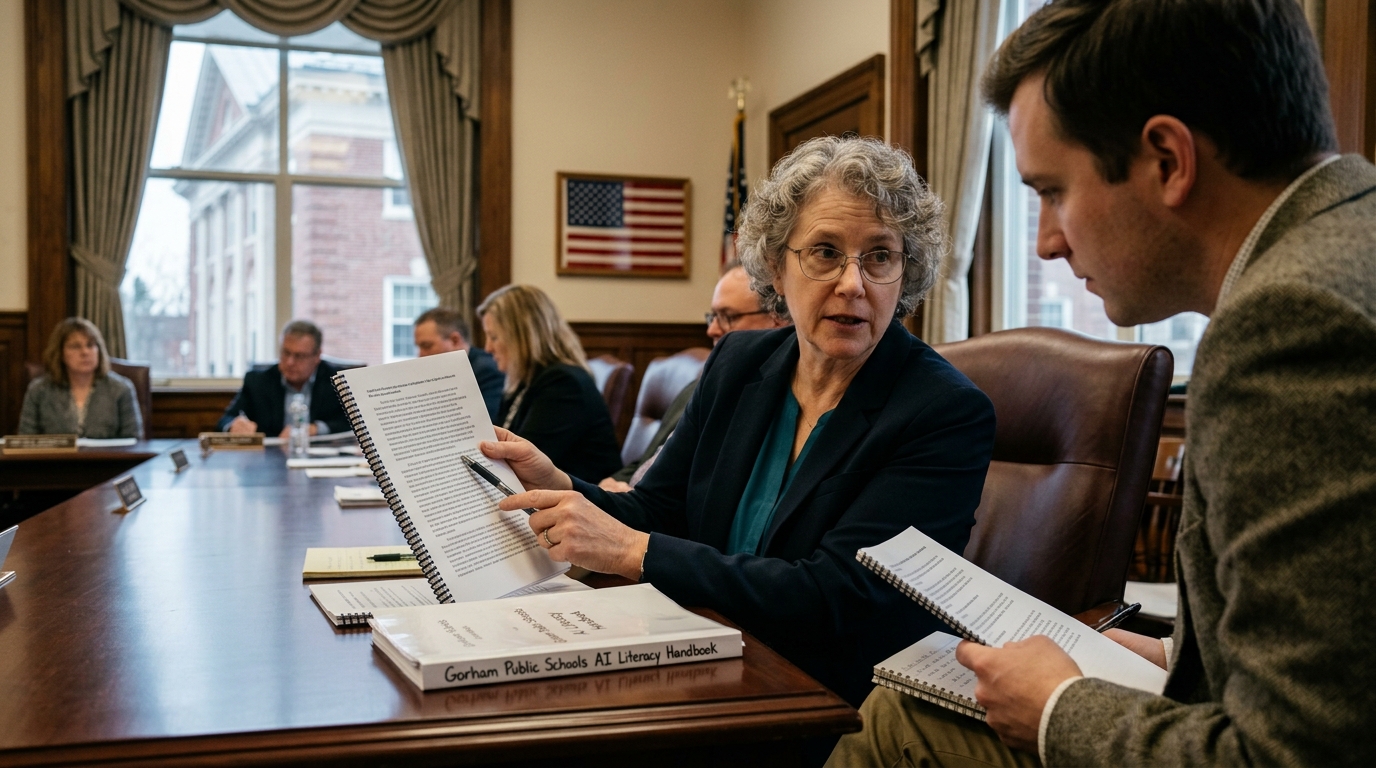
In an era where the global educational community is struggling to balance technological advancement with academic integrity, Gorham Public Schools in Maine, USA, has taken a step that is already being hailed as a beacon for the future of public education. Instead of following the beaten path of blanket bans, district authorities have released a comprehensive Artificial Intelligence (AI) handbook, aiming to educate students, teachers, and parents on the responsible use of algorithms.
The Shift from Suppression to Integration
The emergence of tools like ChatGPT initially sparked panic in classrooms. Many educational organizations rushed to block access to these tools, fearing an "epidemic" of plagiarism. However, Gorham is choosing a different approach: digital literacy. The new handbook is not just a list of rules, but a pedagogical framework that recognizes AI as an essential 21st-century skill.
According to district leadership, the goal is to help students understand not just how to use AI, but when it is ethically and educationally appropriate to do so. The handbook introduces clear gradations for technology use in assignments, distinguishing between "assistive use" (such as brainstorming or grammar correction) and "replacement of thought," which remains strictly prohibited.
Pillars of the Handbook: Ethics, Transparency, and Critical Thinking
The Gorham handbook is built on three central pillars designed to shield students from the pitfalls of technology. The first is transparency. Students are required to explicitly declare the use of AI in their assignments, describing exactly how the tool assisted them. This practice aims to foster a culture of honesty, turning AI from a "hidden assistant" into a recognized partner in learning.
The second pillar concerns critical analysis. The handbook includes sections on AI "hallucinations" and the inherent biases of algorithms. Students are taught not to accept machine-generated answers as absolute truth but to cross-reference them with reliable sources. The third pillar is academic integrity. Gorham educators emphasize that AI should not be used to produce entire texts but as a "personal tutor" that can explain difficult concepts or suggest organizational structures for thought.
Challenges and the Future of Educational Policy
Despite the enthusiasm, implementing such a guide is not without its challenges. The "digital divide" remains a significant concern: students with better access to advanced, paid AI models may have an advantage over their peers. Furthermore, the constant evolution of technology means that the handbook must be a "living document," subject to continuous updates.
"We cannot prepare students for the future using tools and methods of the past. Artificial Intelligence is here, and our responsibility is to make it an ally in knowledge," district officials stated.
Gorham's initiative is expected to serve as a model for other districts, not only in the US but internationally. In countries where the discussion on AI in education is still in its infancy, the Gorham example highlights the need for a national strategy focusing on teacher training and the development of critical thinking, rather than simple bans on mobile phones or websites.
- AI as a tool for enhancement, not replacement.
- Teacher training in identifying AI-generated content.
- Collaboration with parents to set boundaries for home use.
In conclusion, Gorham Public Schools proves that technology in the classroom is not a threat, but an opportunity to redefine what "learning" means. Focusing on the process rather than just the final product is perhaps the most valuable lesson AI can offer today's students.