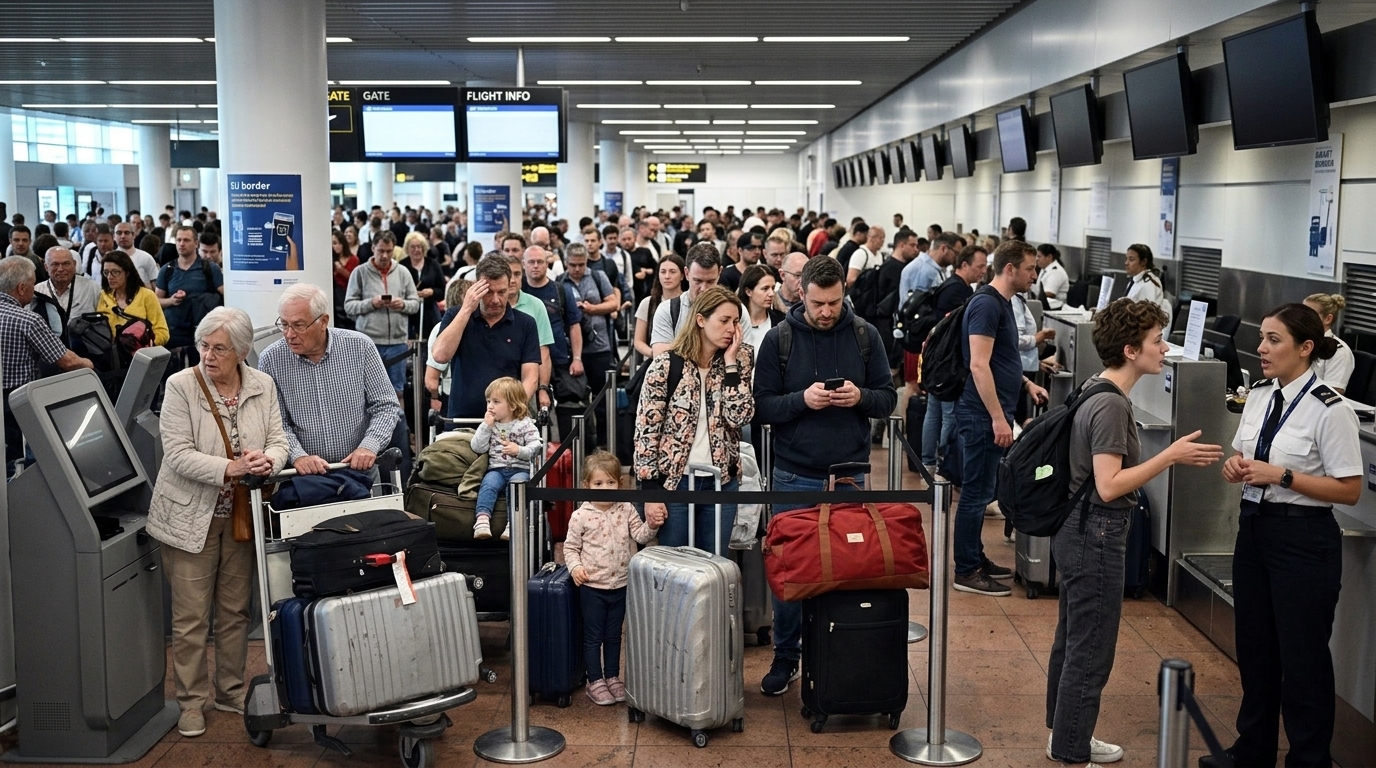
The promise was clear: a Fortress Europe equipped with the latest technology, where digital interfaces would replace archaic passport stamps. However, the reality described by the Financial Times and echoed by Fortune Greece reveals a starkly different picture. The European Union's new Entry/Exit System (EES), designed to digitally register travelers from non-EU countries, has triggered an unprecedented wave of delays, technical glitches, and operational chaos at the continent's major airports and border crossings.
Digital Bureaucracy and the Biometric Wall
The EES is not merely a software update; it is a radical overhaul of how the Schengen Area manages its borders. Every traveler from a third country (now including Britons post-Brexit) is required to provide biometric data—fingerprints and facial scans—upon their first entry. While the theory maintained that the process would take seconds, practice shows that processing time per passenger has increased exponentially.
According to reports from major European hubs like Charles de Gaulle in Paris and Schiphol in Amsterdam, the infrastructure was not prepared to handle the sheer volume of data. 'Smart' gates frequently fail to recognize biometric features under low light or high traffic conditions, forcing travelers to resort to manual checks, which in turn collapse under the weight of the queues. The result is lines stretching for hundreds of meters and passengers missing connecting flights.
The Blow to Tourism and Pressure on Airlines
Airlines and airport operators are on high alert. The International Air Transport Association (IATA) has repeatedly warned that the rushed implementation of the system without an adequate trial period could severely impact tourism in Europe. For countries like Greece, Spain, and Italy, where tourism is the backbone of the economy, these delays are not just a nuisance but an economic threat.
Of particular concern is the situation at the Port of Dover and London's Eurostar station. The unique nature of the UK-France border, where checks are conducted on British soil, has created the perfect setting for the 'Kent chaos.' Local authorities warn of waits that could reach 14 hours during peak periods, as capturing biometric data from passengers inside cars and buses proves technically difficult and time-consuming.
A Failure of Central Planning?
The question now being urgently asked is whether the European Commission underestimated the complexity of the project. The EES relies on a central database managed by the eu-LISA agency. Critics argue that interoperability between national systems and the central database remains problematic. Furthermore, the lack of border personnel exacerbates the situation, as the technology, instead of freeing up resources, requires more people to manage the system's failures.
The EU maintains that the system is essential for combating terrorism and illegal migration, as it will automatically identify 'overstayers.' However, the price of this security seems to be the freedom of movement and the reliability of European transport hubs. As 2026 progresses, pressure for corrective action is mounting, with some member states calling for a temporary suspension or 'softening' of checks during periods of extreme congestion.
Conclusions and Outlook
The border crisis highlights a broader pathology of the digital transition in Europe: the gap between legislative ambitions in Brussels and technical readiness on the ground. If the 'smart' system does not manage to become 'functional' soon, Europe risks sending a message of introversion and dysfunction to the rest of the world. For the traveler of 2026, technology is no longer a convenience but another hurdle in an already complex global landscape.