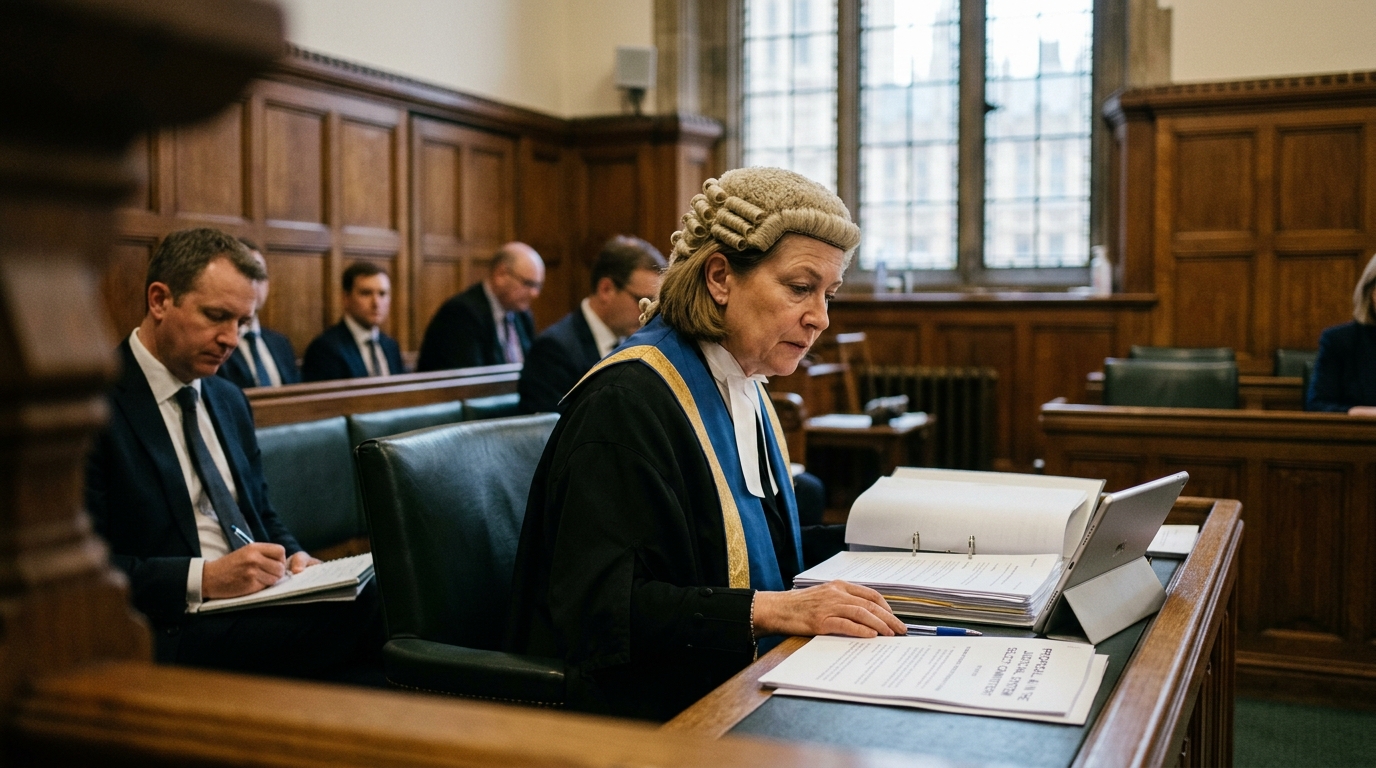
The image of a British judge, complete with traditional wig and gown, consulting ChatGPT might seem like a scene from a science fiction novel, but it has become the new reality within the corridors of the Royal Courts of Justice. The recent admission by Lord Justice Birss, one of the Court of Appeal's leading legal minds, that he utilized generative AI to draft a portion of a judgment was not merely an isolated anecdote. It was the precursor to an institutional revolution, later codified by the issuance of the first official guidelines for AI use by the judiciary in the United Kingdom.
The Transformation of Legal Practice
Justice, an institution that traditionally moves at a glacial pace and relies on centuries of precedent, is facing an urgent need for digital transformation. The 'first victory' for Artificial Intelligence (AI) in the courtroom is not about replacing human judgment, but about augmenting the capabilities of judges in managing vast amounts of information. The new guidelines permit judges to use Large Language Models (LLMs) for summarizing extensive texts, drafting administrative orders, and organizing case files.
However, the British judiciary has set stringent boundaries. The use of AI for substantive legal research is effectively prohibited, as the risk of 'hallucinations'—where the model fabricates non-existent legal cases or precedents—remains dangerously high. Lord Justice Birss’s case is illustrative: he used the tool to summarize an area of law he was already intimately familiar with, verifying the accuracy of the output before integrating it into his ruling. This 'human-in-the-loop' approach serves as the system's primary safeguard.
Risks and the Ethics of Algorithms
Despite the enthusiastic reception from certain sectors, the introduction of AI into the judicial process raises profound questions regarding transparency and equity. If a judge uses an algorithm to process data, how can a litigant be certain that latent biases—inherent in the model's training data—are not seeping into the verdict? Jurisprudence is built on reasoned justification and moral clarity, elements that generative AI, as a statistical word-prediction engine, entirely lacks.
- Transparency: Should judges be required to disclose when AI was used? Current guidelines do not mandate this, sparking criticism from human rights advocacy groups.
- Data Security: Entering confidential information into public models like ChatGPT poses significant risks to the privacy of judicial proceedings.
- Access to Justice: There is a growing concern that AI might facilitate a two-tier justice system, where speed is prioritized over the depth of legal reasoning.
"Artificial Intelligence is an extraordinary assistant but a treacherous master. In the halls of justice, the burden of decision must remain exclusively human."
The International Context and the U.S. Warning
The British move comes at a time when the global legal community is watching developments with bated breath. In the United States, the case of Mata v. Avianca served as a definitive cautionary tale, where attorneys used ChatGPT to find legal precedents, only to submit a list of entirely fictional cases to the court. The British authorities appear to have learned from this debacle, opting for a more conservative yet steady path of integration.
This 'first victory' is therefore not the triumph of the machine over the man, but the recognition that technology can make the legal system more sustainable. At a time when courts worldwide are buckling under the weight of backlogs, AI promises to liberate valuable time for judges, allowing them to focus on the essence of judgment rather than the drudgery of bureaucracy. The challenge for the coming years will be to preserve the 'human touch' in a world that is digitizing at a breakneck pace.