In the manicured streets of Ahwatukee, an upscale master-planned community in Phoenix, Arizona, the age-old tradition of a neighbor grumbling about an overgrown lawn has been replaced by something far more clinical and relentless: the algorithm. The recent controversy surrounding the use of Artificial Intelligence (AI) by Homeowners Associations (HOAs) to enforce community standards is not merely a local dispute; it is a harbinger of how technology can reshape the social fabric of local governance.
The Digital Patrol: Automating the Infraction
For decades, the enforcement of HOA covenants, conditions, and restrictions (CC&Rs) relied on periodic drive-bys by board members or property management staff. It was a process prone to human error, inconsistency, and, occasionally, human empathy. Enter the era of PropTech. Companies are now offering software that utilizes high-definition cameras mounted on vehicles that scan every home as the car moves at normal traffic speeds. AI models then process these images in real-time, identifying everything from weeds and chipped paint to trash cans left on the curb for too long.
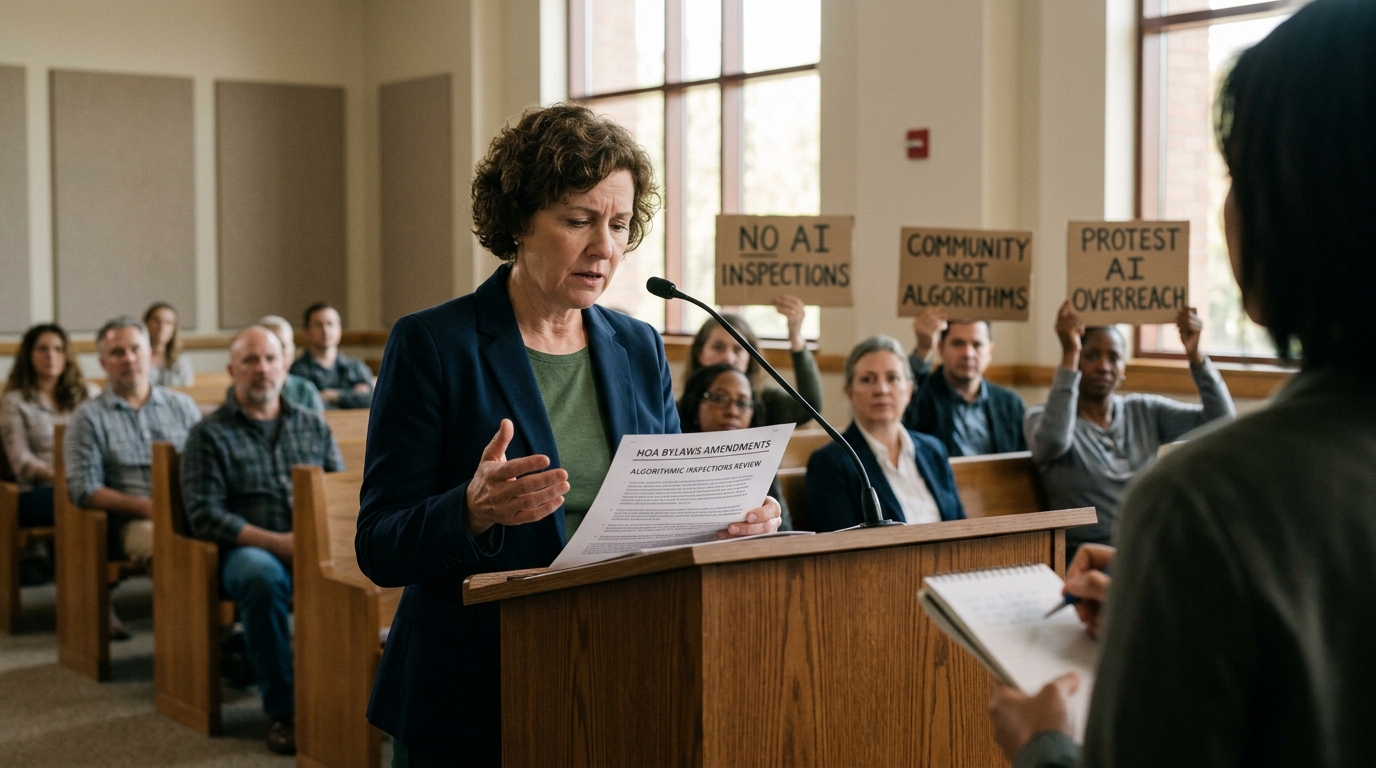
In Ahwatukee, residents began receiving violation notices accompanied by timestamped, AI-captured photos of their properties. The backlash was immediate. Many homeowners feel they are living under constant surveillance, describing the system as a "digital panopticon" where every minor aesthetic flaw is logged and penalized without the nuance of a human conversation. The efficiency of the machine has outpaced the community's tolerance for oversight.
The Clash of Privacy and Efficiency
The core argument in favor of AI inspections is "fairness through objectivity." HOA boards and property management firms argue that AI eliminates the bias inherent in human inspections. A machine doesn't target a homeowner because of a personal grudge; it simply identifies a violation based on pre-set parameters. Furthermore, the efficiency is undeniable: a task that once took days of manual labor can now be completed in hours with higher accuracy.
However, legal scholars and privacy advocates are raising alarms. While streets are public, the systematic, high-frequency automated scanning of private property without explicit consent sits in a legal grey area. In Arizona, as in much of the United States, HOA laws have not kept pace with technological advancements. This allows private associations to exercise powers that mimic state-level surveillance but without the constitutional protections—such as the Fourth Amendment—that limit government overreach.
The Social Cost of the "Perfect" Neighborhood
Beyond the legalities lies a deeper sociological concern. A neighborhood is more than a collection of assets to be protected; it is a living ecosystem. Strict, algorithmic enforcement strips away the "social lubricant" of neighborly grace. When a resident faces a hardship—perhaps a medical emergency or a family crisis—that leads to a neglected yard, a human inspector might offer a warning or a helping hand. An algorithm, however, issues a fine the moment a pixel deviates from the norm.
This "cold" governance leads to profound alienation. Residents in Ahwatukee report feeling increasingly hostile toward their HOA, viewing it not as a representative body but as a punitive machine optimized for revenue generation through fines. By turning community management into a data optimization exercise, the human element is reduced to a variable that must be forced into compliance. The result is a sterile environment where the fear of the next automated fine outweighs the sense of belonging.
A Call for Regulatory Oversight
The Ahwatukee controversy has reached the ears of state legislators. There is a growing movement to regulate how HOAs can deploy surveillance technology. Proposed measures include requiring full transparency regarding algorithmic parameters and mandating human review of all AI-generated flags before a fine can be issued. The future of suburban life depends on finding a balance between the desire for orderly aesthetics and the fundamental right to privacy and human dignity. If we allow AI to become the ultimate arbiter of our domestic lives, we risk creating "perfect" neighborhoods that are fundamentally uninhabitable for the human spirit.