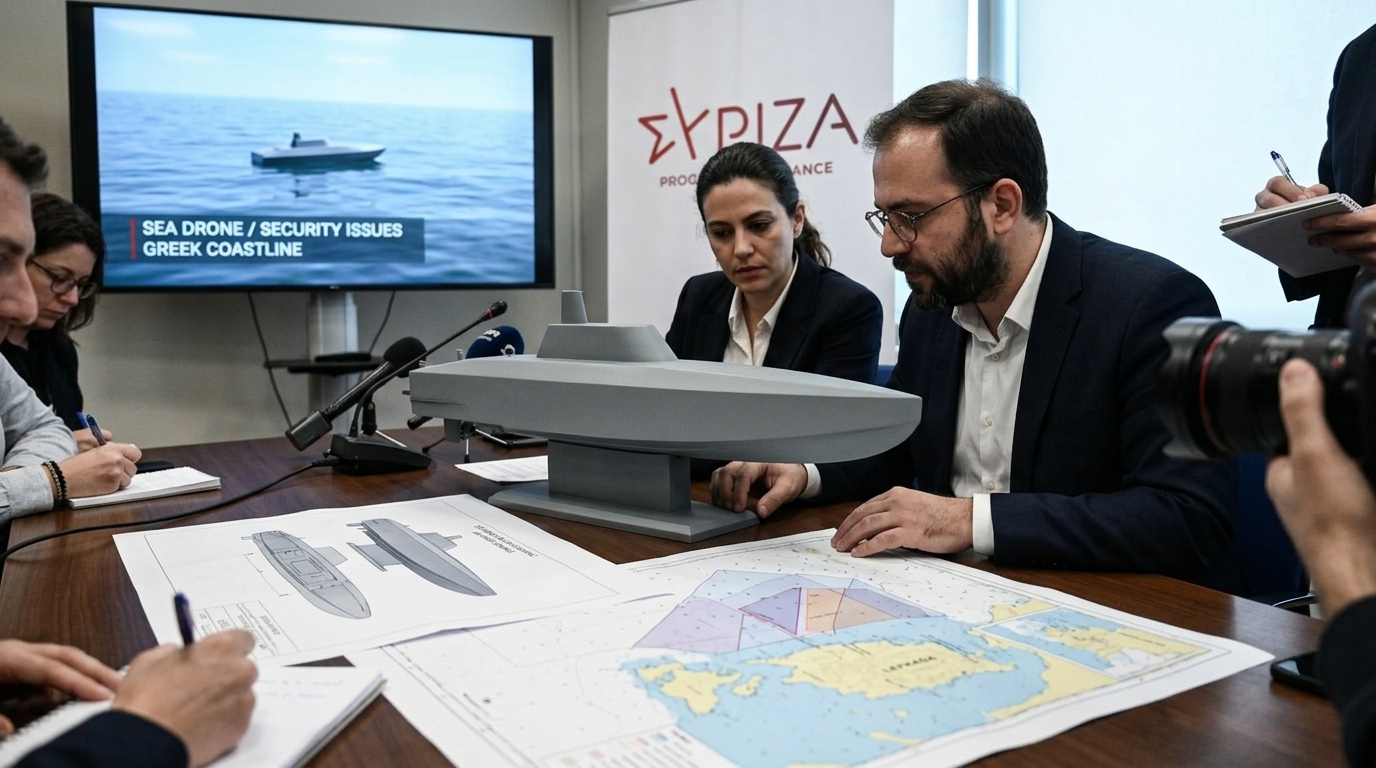
The news of a maritime drone (Unmanned Surface Vehicle - USV) found on a beach in Lefkada, carrying a large quantity of explosives and with its engine still running, is not merely a police or military incident. It serves as a loud reminder that autonomous systems technology has already transformed the security landscape in the Mediterranean, often outpacing the traditional surveillance capabilities of state mechanisms. SYRIZA, in an official statement, pointed directly to the core of the issue, asking: "In the end, who controls what happens in the Greek seas?"
The incident, which took place in the Agios Ioannis area, triggered an immediate mobilization of the Coast Guard and Army special forces. However, the fact that the vessel was spotted by citizens rather than advanced radar or maritime surveillance systems raises serious questions about the effectiveness of existing infrastructure for protecting national and European borders.
The Political Conflict and the Issue of National Sovereignty
SYRIZA's intervention was not limited to a simple reporting of the event. The main opposition used the incident to launch a sharp critique of government policy regarding border security. According to the statement, the presence of an armed autonomous vessel in a tourist area, without prior detection by the competent authorities, suggests a "massive security gap." SYRIZA is demanding answers on whether the surveillance systems purchased with billions of euros from Greek taxpayers are capable of detecting low-signature threats like drones.
The question of maritime control carries particular weight during a period of intense geopolitical shifts. The use of USVs in conflicts such as the war in Ukraine has shown that small, inexpensive, and autonomous vessels can cause disproportionately large damage to traditional naval forces. The appearance of such a medium in the Ionian Sea, far from the usual tension fronts of the Aegean, indicates that threats are now asymmetric and unpredictable.
The Technological Dimension: Why are Sea Drones "Invisible"?
To understand the security gap, we must examine the nature of USVs themselves. Sea drones are often designed with a low profile, protruding minimally above the water's surface. This makes their detection by traditional radar extremely difficult, as their signal is confused with sea clutter. Furthermore, many of these vessels use radar-absorbent materials or shapes that minimize their radar cross-section.
In the Lefkada case, the fact that the engine was running suggests the vessel was on an active mission or had recently lost control. Artificial Intelligence now plays a central role in the navigation of these systems, allowing them to follow predefined GPS routes or even recognize targets via optical sensors without the need for constant communication with the operator, which would betray their position through electronic interference.
The Need for a New AI-Driven Surveillance Strategy
The incident highlights the urgent need for integrating advanced AI systems into the Greek Coast Guard and Navy. Traditional surveillance by human radar operators is no longer sufficient. Machine learning algorithms are required to analyze real-time data from multiple sources (infrared cameras, sonar, high-definition radar) and distinguish a drone from a common fishing boat or wave patterns.
Furthermore, Greece must invest in "anti-drone" systems for the maritime environment. These include jammers, signal interception systems, and autonomous interceptor vessels. Maritime security is no longer just a matter of the number of ships, but a matter of technological superiority and data processing capability. As security analysts point out, if an explosive-laden drone can reach a Lefkada beach undetected, then critical infrastructure such as ports and undersea cables are in constant danger.
Conclusion: A Lesson for the Future
The political controversy sparked by SYRIZA is expected, but the essence of the problem transcends party lines. Greece, as a preeminently maritime nation with a vast coastline, must lead in the development and implementation of protection technologies against autonomous threats. The drone in Lefkada was a warning. The response cannot be merely political; it must be deeply technological and strategic, ensuring that "smart" surveillance fills the gaps left behind by the era of traditional means.