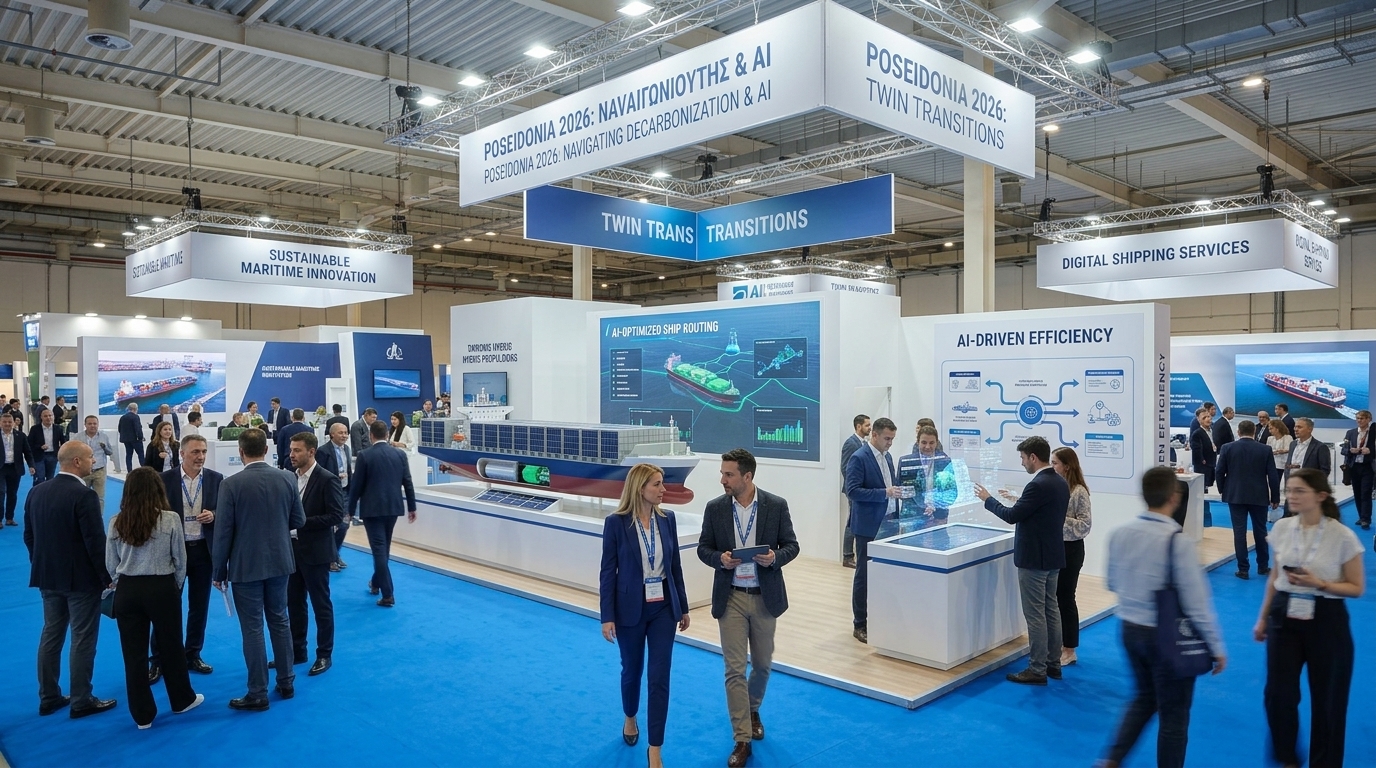
The curtain has fallen on Poseidonia 2026, leaving behind a sense of a historic turning point for global shipping. Within the halls of the Metropolitan Expo, the heart of world trade beat stronger than ever, with participation exceeding all previous records, confirming that Athens remains the undisputed capital of ocean-going shipping. However, this year's event was not merely a celebration of shipowning; it was the battlefield and collaboration ground for the two greatest challenges of the century: decarbonization and the digital transformation of the industry.
The Green Transition and the Fuel Gambit
The central theme dominating the discussions of industry leaders was compliance with the strict International Maritime Organization (IMO) targets for 2030 and 2050. The Greek shipping community, which controls over 20% of global deadweight tonnage, led the way with dozens of agreements for new vessel constructions utilizing alternative fuels. Ammonia, methanol, and hydrogen are no longer theoretical scenarios but concrete investment choices.
According to analysts, 2026 is a milestone year, as FuelEU Maritime regulations have begun to pressure companies for immediate reductions in greenhouse gas emissions. In the panels at Poseidonia, it became clear that the transition is not just a technical issue but an economic one. Strategic agreements signed between Greek groups and international energy giants to secure the green fuel supply chain underscore the need for a holistic approach. Shipping cannot act alone; it requires the support of energy producers and port infrastructures.
Artificial Intelligence: From Theory to Practice
If the green transition is the soul of this year's Poseidonia, Artificial Intelligence (AI) is its brain. For the first time, we witnessed the full integration of AI systems not only in fleet management but in the very fabric of navigation. "Smart shipping" was showcased through applications that predict maintenance needs (predictive maintenance), optimize routes in real-time to save fuel, and enhance crew safety.
- Autonomous decision-support systems that reduce human error.
- Blockchain platforms for transparency in chartering and payments.
- Digital twins of ships allowing performance simulation in extreme conditions.
The discussion on cybersecurity was also more intense than ever. As ships become floating data centers, protecting them from malicious attacks is emerging as a national priority for flag states. Greek shipowners, traditionally cautious about abrupt technological changes, now seem to be embracing innovation, recognizing that future competitiveness will be judged by bits as much as by steel.
Geopolitical Instability and Greece's Role
Poseidonia 2026 took place against a backdrop of intense geopolitical uncertainty. Ongoing unrest in the Red Sea, climate-change-induced restrictions in the Panama Canal, and trade wars between West and East are reshaping traditional maritime routes. In this context, Greek shipping acts as a stabilizing factor for global food and energy security.
"Shipping is the connective tissue of our world. In times of crisis, the ability of Greek seafarers and shipowners to adapt is what keeps markets alive," stated a leading representative of the Union of Greek Shipowners.
The event also highlighted the need for a renewal of the maritime profession. The shortage of specialized personnel capable of handling new technologies is a "ticking bomb" at the foundations of growth. Initiatives to attract young people to the sea and investment in education were at the heart of the discussions, with Greece aiming to become a high-tech maritime training hub for all of Europe.
Conclusions for the Future
In conclusion, Poseidonia 2026 was not just a trade fair but a statement of power and vision. Greek shipping proved it does not fear change but seeks it. The connection of tradition with cutting-edge technology creates a new business model that is sustainable, digital, and global. The rendezvous was renewed for 2028, with the expectation that many of the "green" and "smart" ships seen this year as blueprints will then be crossing the oceans.