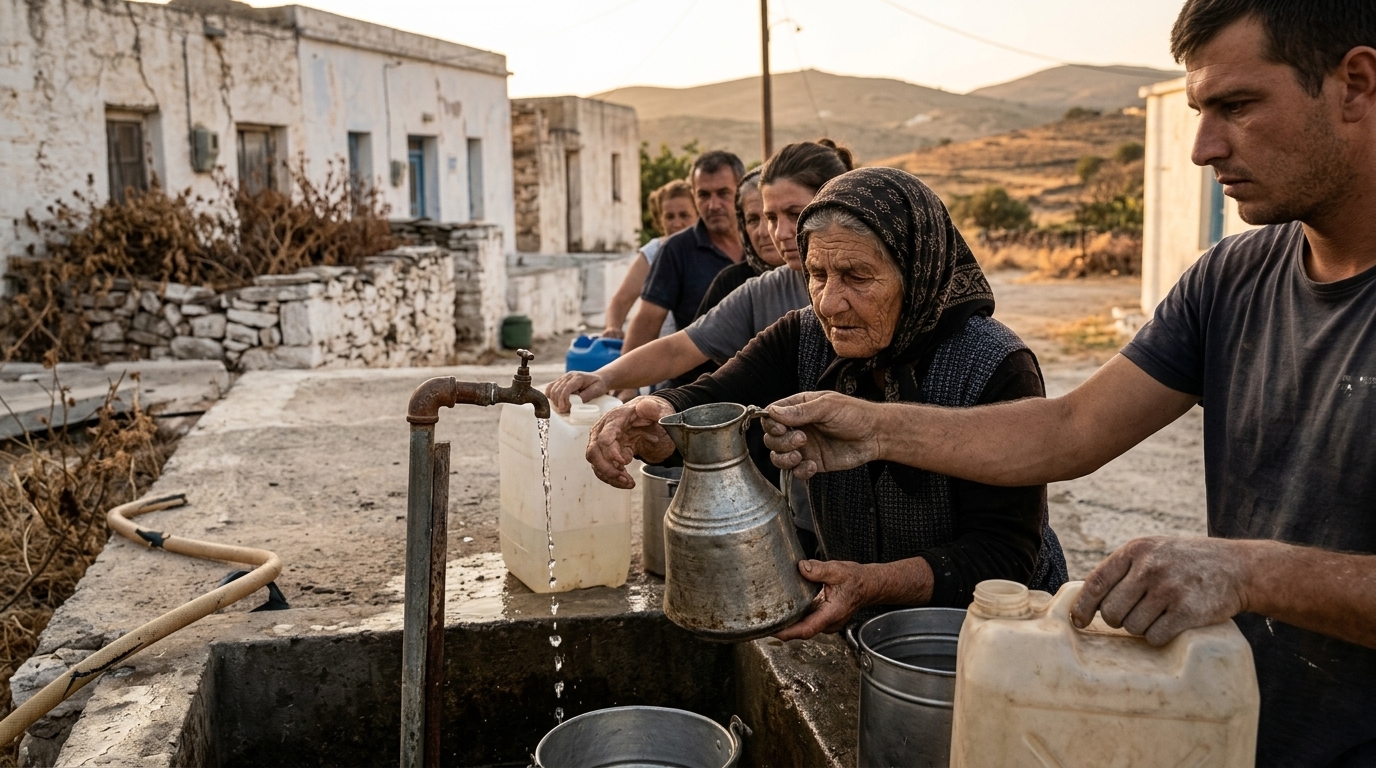
Greece stands at a critical crossroads. As the summer of 2026 confirms the ominous predictions of prolonged drought, the management of "blue gold" is emerging as a top national priority. The new national water strategy, spearheaded by the government, is not merely an administrative reform; it is an effort for survival against a climate reality that no longer forgives waste and fragmentation.
The Architecture of Reform: From Fragmentation to Consolidation
For decades, water management in the Greek provinces relied on Municipal Water and Sewerage Companies (DEYAs). Despite the commendable efforts of some, this model has been deemed unsustainable. With accumulated debts of hundreds of millions of euros to energy providers and an inability to implement large-scale infrastructure projects, DEYAs are heading toward a forced but necessary restructuring. The new bill provides for the merger of approximately 60 local providers with the industry's two giants, EYDAP (Athens) and EYATH (Thessaloniki), as well as the creation of robust regional entities.
The logic behind this move is the achievement of economies of scale. A large organization has the capacity to better negotiate its energy costs, more easily absorb Recovery Fund grants, and utilize advanced telemetry systems to detect leaks. Today, the percentage of "non-revenue water"—water lost due to aging networks—reaches 60% in some areas. This hemorrhage of resources is something the country can no longer afford.
Investment and Technological Modernization: The €41 Million Plan and Beyond
The second pillar of the strategy concerns infrastructure. With an initial project package exceeding €41 million, the government focuses on three axes: desalination, water reuse, and "smart" networks. In the Aegean islands, where water scarcity is now a permanent state, desalination plants are transforming from emergency solutions into core infrastructure, with an emphasis on using renewable energy sources to reduce operating costs.
At the same time, the introduction of Artificial Intelligence in water management is a game-changer. Sensors placed in main pipelines can predict failures before they occur, while smart meters allow consumers to monitor their consumption in real-time. The strategy also includes the utilization of treated wastewater for crop irrigation, a practice already successfully implemented in Israel and Cyprus, freeing up precious quantities of potable water for household needs.
The Role of RAAEY and the Political Stakes
Perhaps the most controversial aspect of the reform is the transfer of water oversight to the Regulatory Authority for Waste, Energy, and Water (RAAEY). This move sparked intense reactions, with many speaking of a "backdoor" to privatization. The government, however, insists that oversight by an independent authority is the only guarantee for transparency in pricing and ensuring water quality.
"Water is a public good, but its management must be conducted in terms of efficiency. We cannot have 150 different pricing policies and collapsing networks,"
sources from the Ministry of Environment and Energy state. The challenge is finding the golden ratio: ensuring access for all citizens to cheap and clean water, while simultaneously securing the resources for maintenance and expansion of infrastructure. The restructuring of providers will test the resilience of local government, which sees a significant portion of its powers transferred to the center, but the reality of the climate crisis leaves no room for localism.
Conclusions for the Future
The success of the national water strategy will be judged over the next decade. Mergers and funds are not enough. A change in culture is required, both from the state and the citizen. Agriculture, which consumes 80% of water in Greece, must be modernized with drip irrigation systems, while the tourism sector must adopt more sustainable practices. Water is ceasing to be an inexhaustible resource and is becoming the most critical indicator of our national resilience.