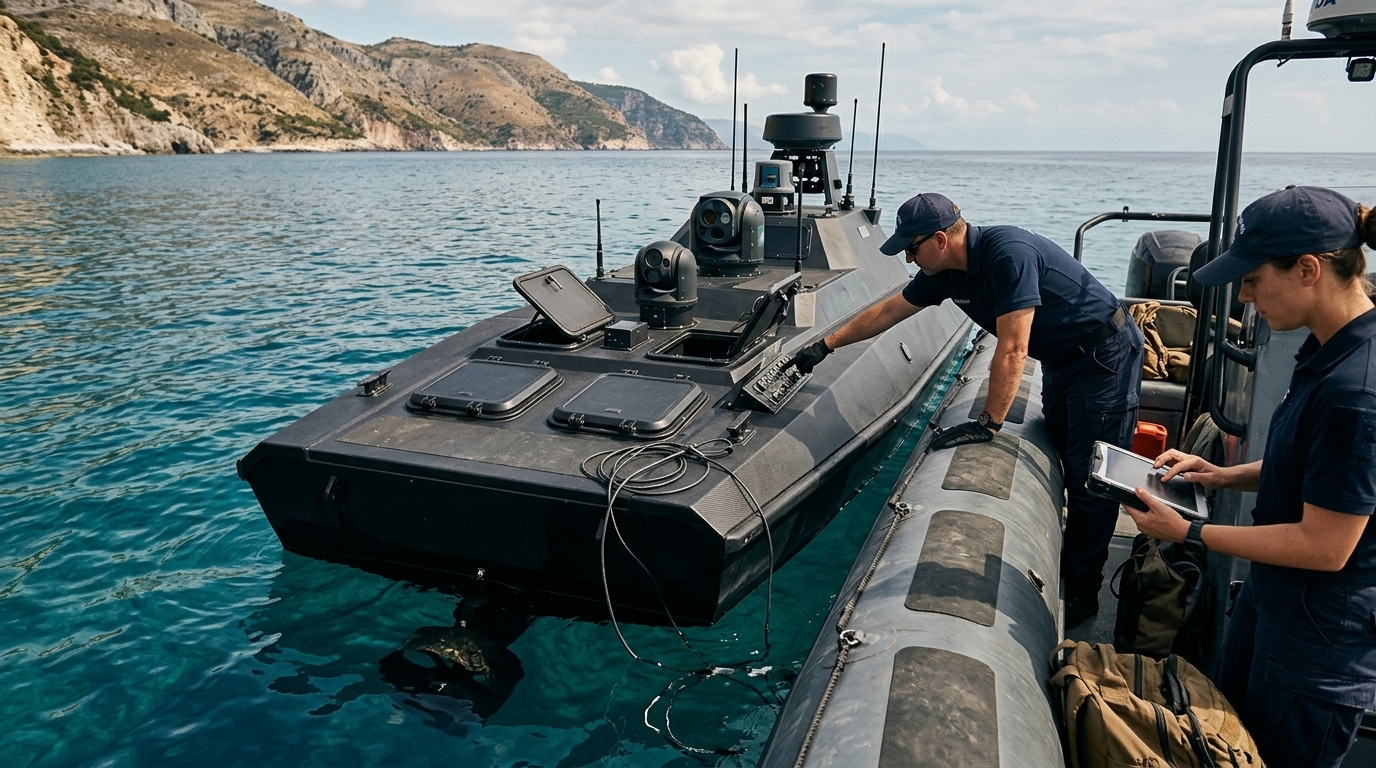
In one of the most idyllic yet rugged spots of the Ionian Sea, Cape Doukato in Lefkada, the tranquility of the local fishing community was shattered by a discovery reminiscent of a spy thriller. Local fishermen, exploring an inaccessible sea cave, came face-to-face with a black, sleek, and clearly military-grade Unmanned Surface Vehicle (USV). The most unsettling detail? The vessel's engine was running, suggesting either a recent abandonment or an active mission on standby.
The Chronicle of an Unexpected Encounter
The incident, which took place near the legendary "Kavos tis Kyras"—where tradition holds that the poet Sappho leapt to her death—highlights the abrupt collision of the ancient landscape with 21st-century technology. The fishermen immediately alerted the Coast Guard, which in turn mobilized the Hellenic Navy. The vessel, constructed from composite materials (carbon fiber) for a low radar signature (stealth), bore no national insignia, a common practice in "grey zone" operations.
The presence of the vessel with its engine running implies that the USV possessed sophisticated power management systems and was likely in a "geofencing" phase, awaiting commands via satellite link. The choice of a cave as a hideout indicates advanced planning, as the rock formations provide natural cover from satellite observation and thermal sensors.
The Geopolitical Dimension and the Ionian Theater
The Ionian Sea, though traditionally considered quieter than the Aegean, is a strategic corridor for NATO and access to the Adriatic. The appearance of such a craft cannot be considered accidental. Analytical experts are examining three main scenarios:
- Allied Exercise Scenario: The vessel could belong to a NATO force participating in electronic warfare or surveillance exercises that suffered a malfunction in its remote control system.
- Foreign Espionage: The area around Lefkada and Aktion hosts critical infrastructure. A USV could be used to map undersea cables or monitor naval movements.
- Private Sector Tech Testing: Many defense industries test their systems in real-world conditions, although abandoning such expensive equipment is rare.
The use of USVs has radically changed the landscape of warfare in Ukraine and the Red Sea. Their appearance on Greek shores underscores that the Mediterranean is becoming a testing ground for the new generation of autonomous weapons.
Technical Characteristics and Surveillance Challenges
Modern USVs, like the one found, are equipped with high-definition cameras, Lidar sensors, and artificial intelligence for obstacle avoidance. The fact that it remained undetected until accidentally spotted by civilians exposes gaps in coastal surveillance systems. Despite investments in radar, small, low-profile vessels remain extremely difficult to track, especially when operating close to coastlines.
"Sea drone technology is evolving faster than our ability to intercept them. What we saw in Lefkada is just the tip of the iceberg," says a source from the defense technology sector.
The analysis of the vessel's software and components by Navy laboratories is expected to shed light on its origin. If the craft carries Western-made components, it does not rule out its use by third-party nations, as the components market is now globalized.
Conclusions and the Path Forward
The Lefkada mystery is not just local news. It is a warning about the need to bolster national security with equivalent means. Greece, with its vast coastline, is exceptionally vulnerable to these kinds of "invisible" penetrations. Safeguarding maritime borders now requires not just ships and personnel, but a network of autonomous sensors and anti-drone systems capable of detecting even the quietest USV hidden in an Ionian cave.