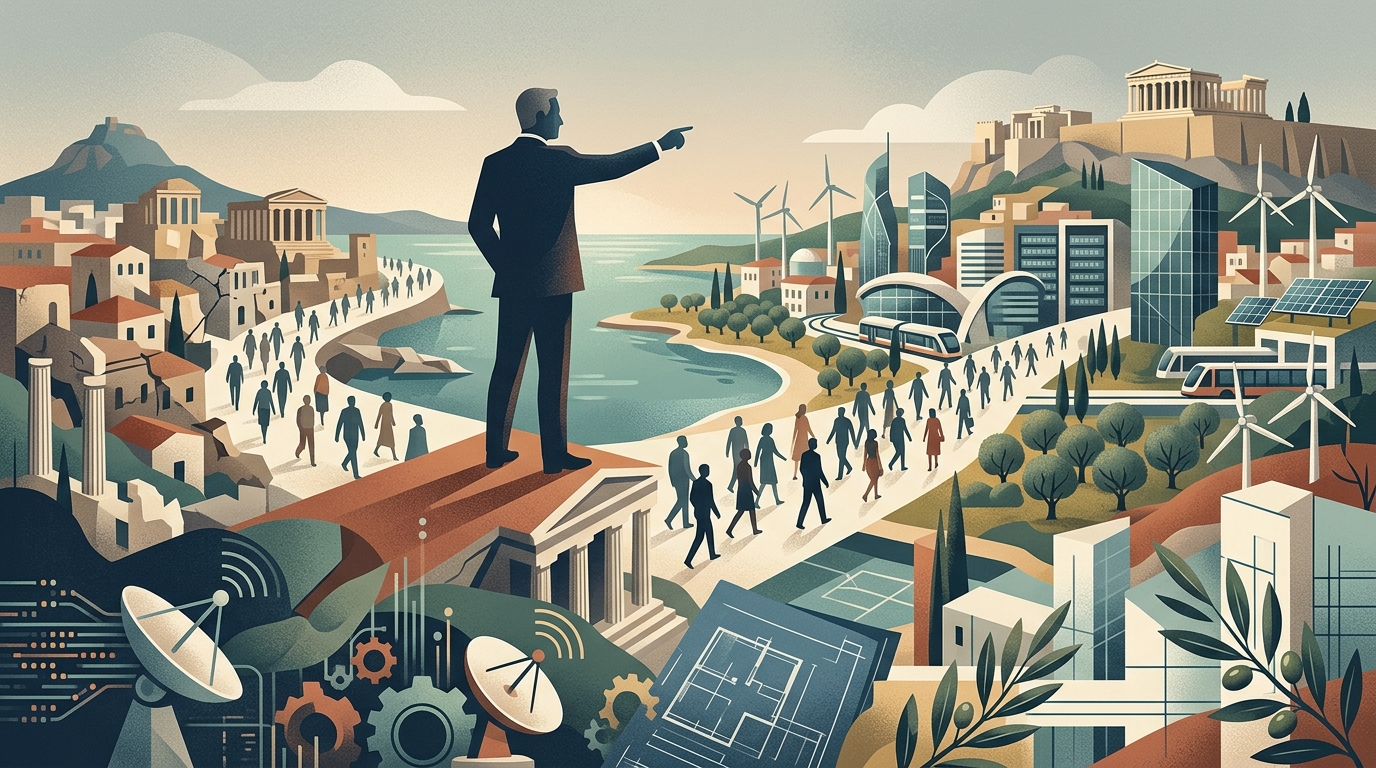
As we navigate the summer of 2026, the Greek political landscape is entering a phase of intense preparation and strategic realignment. Prime Minister Kyriakos Mitsotakis, having served the majority of his second term, faces a challenge that goes beyond mere day-to-day governance: the need to reconnect with a critical mass of voters—approximately one million citizens—who either chose abstention or shifted toward smaller political formations in recent European elections and subsequent polling.
The Enigma of the 'Lost' Million
The analysis from Maximos Mansion is clear: New Democracy's dominance in the political center is no longer a given. The 'million lost votes' do not represent a homogeneous group. They are a blend of disillusioned middle-class citizens squeezed by the cost of living, young people seeking prospects beyond subsidies, and traditional conservatives who feel the government has drifted from its ideological roots. The strategy for re-engagement is no longer based on the fear of 'returning to chaos' but on the demonstration of tangible efficiency.
The government acknowledges that 'reform fatigue' is a reality. After years of continuous crises—pandemic, energy, inflation—the electorate demands palpable results in disposable income and the quality of public services. The Mitsotakis plan for the coming months focuses on the 'politics of small wins' intended to convince citizens that the state is working in their favor.
The Three Slogans of a New Era
To communicate its vision, the government is deploying three central slogans that will form the backbone of its electoral campaign: Stability, Modernization, Justice.
- Stability: In a world of geopolitical uncertainty, Greece is projected as a 'pillar of security' in the Eastern Mediterranean. Stability concerns not only foreign policy but also the fiscal discipline that prevents a return to the dark days of the debt crisis.
- Modernization: The digital transformation of the state remains the spearhead of the government's agenda. The expansion of gov.gr, the digitization of justice, and the overhaul of the National Health System (ESY) are the fields where the government seeks to be judged.
- Justice: This is where the attempt to answer criticism regarding social inequality lies. 'Social justice' translates into targeted tax cuts for the middle class and strict market monitoring to combat profiteering.
Agenda 2030: Strategic Depth
'Agenda 2030' is not merely an electoral pamphlet but a roadmap for Greece in the next decade. Kyriakos Mitsotakis aims to present a coherent plan that transcends the electoral cycle. Key pillars include the green transition, the country's energy autonomy through renewable energy sources, and the upgrading of public education with the establishment of non-state universities—a reform that sparked intense reactions but is considered emblematic for the government camp.
"We are not just asking for a new term; we are asking for a mandate to complete the country's transformation,"
sources close to the Prime Minister state. The challenge is to convince citizens that macroeconomic indicators—such as the investment grade rating and growth exceeding the Eurozone average—will eventually translate into better wages and a fairer welfare state.
Political Risks and the Electoral Gamble
Despite the careful planning, the road to the ballot box is fraught with obstacles. The opposition, though fragmented, is banking on the natural wear and tear of a long incumbency. The cost-of-living crisis remains the government's 'Achilles' heel,' as supermarket prices do not follow the downward trend of headline inflation. Furthermore, issues regarding the rule of law and public safety continue to cause friction with the image of a 'modern European nation' promoted by the government.
The bet for Kyriakos Mitsotakis is whether he can convince the 'lost million' that the alternative proposal is either non-existent or dangerous. Returning to a parliamentary majority depends on the government's ability to show empathy and correct past mistakes, avoiding the trap of hubris that often accompanies long-term power.