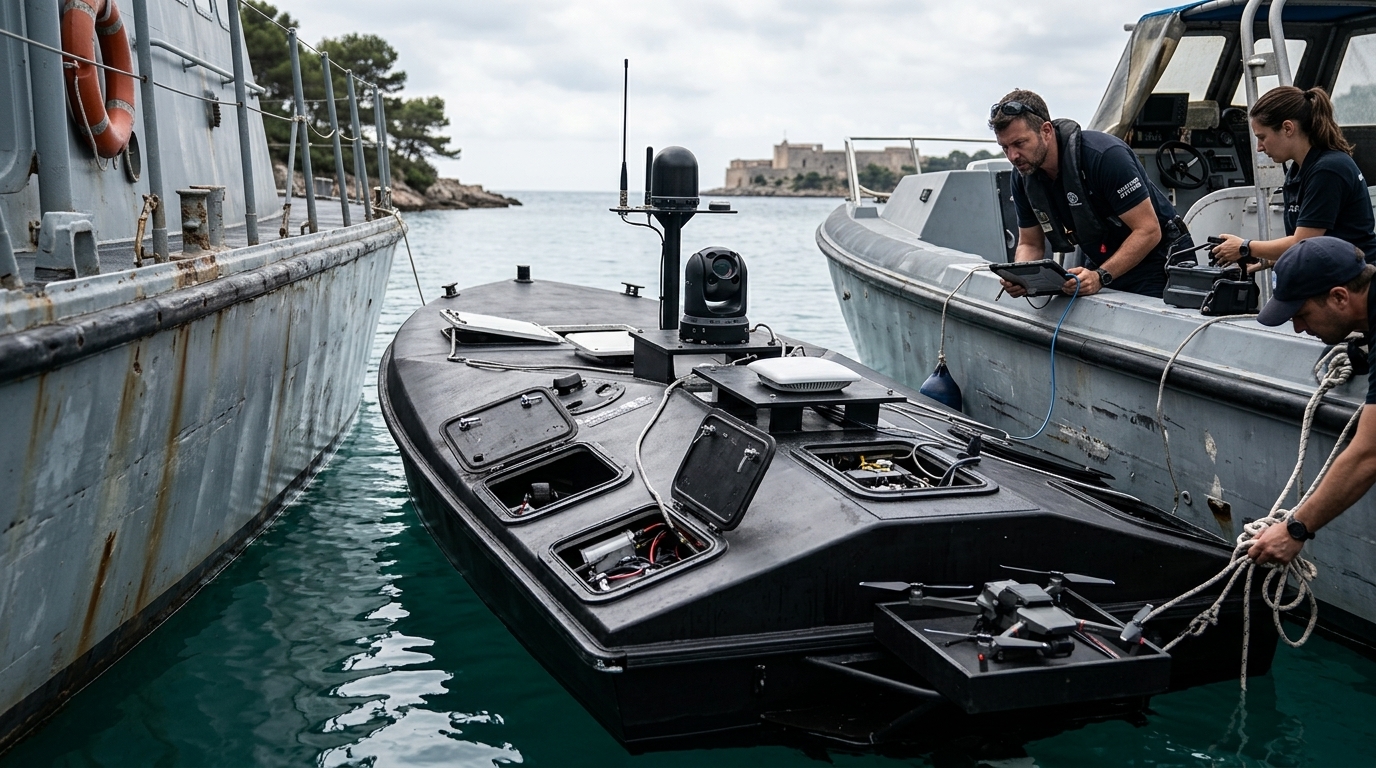
The news hit like a shockwave through the calm waters of the Ionian Sea. A sea drone—an Unmanned Surface Vehicle (USV)—packed with 300 kilograms of explosives was discovered by local fishermen off the coast of Lefkada, triggering an immediate mobilization of the Hellenic Navy and the Coast Guard. This incident is not merely a localized security event; it is a profound warning of a shifting security paradigm in the Mediterranean basin.
The Anatomy of an Asymmetric Threat
Maritime drones have become the hallmark of modern conflict, from the Black Sea to the Red Sea. However, the presence of such a weapon system in the Ionian Sea—a region far removed from the active frontlines of the Ukraine war or Houthi insurgencies—raises critical questions. Initial expert analyses suggest the craft found in Lefkada features characteristics of low-cost, high-impact technology capable of delivering a catastrophic blow to commercial shipping or critical infrastructure.
A 300kg explosive payload is massive. To put it in perspective, such a charge is sufficient to sink a medium-sized vessel or cause irreparable damage to an offshore drilling platform. The fact that the drone was discovered accidentally by civilians highlights the difficulty traditional surveillance mechanisms face in detecting small, semi-submersible targets with low radar signatures.
The Libyan Connection and the German Perspective
The German press, notably outlets like Handelsblatt, was quick to link the discovery to broader instability in North Africa. Libya, a country that remains a security 'black box,' is considered the most likely point of origin or transit for such systems. The convergence of migration routes with the trafficking of high-tech weaponry is a nightmare scenario that European intelligence agencies have been struggling to prevent for years.
Analysts point out that the same corridors used for human smuggling from the Libyan coast toward Crete and the Ionian Sea can easily be exploited for 'lethal cargo.' Concerns are heightened by the reality that USV technology has transitioned from state-exclusive weaponry to accessible tools for non-state actors, paramilitary groups, or even organized crime syndicates.
Challenges for Greek Maritime Security
For Greece, the Lefkada incident mandates a radical reassessment of maritime border protection. The Hellenic Coast Guard and the Navy are now tasked with countering a threat that is often invisible to traditional means. Investments in sensor networks, surveillance drones, and electronic warfare (jamming) systems are no longer optional but essential.
- Upgrading the AIS (Automatic Identification System) to detect suspicious patterns.
- Strengthening cooperation with Frontex for deep-water surveillance south of Crete and west of the Peloponnese.
- Developing rapid-response protocols for neutralizing unmanned vessels in high-traffic or tourist areas.
The unanswered question remains the intended destination of this specific drone. Was it an 'orphan' craft that lost its way due to technical failure? Was it part of a live-environment test? Or was it an element of a larger plot thwarted by sheer luck? While the Anti-Terrorism Unit and National Intelligence Service (EYP) continue their investigation, one thing is certain: the 'blue peace' of the Ionian has taken on a new, darker dimension.