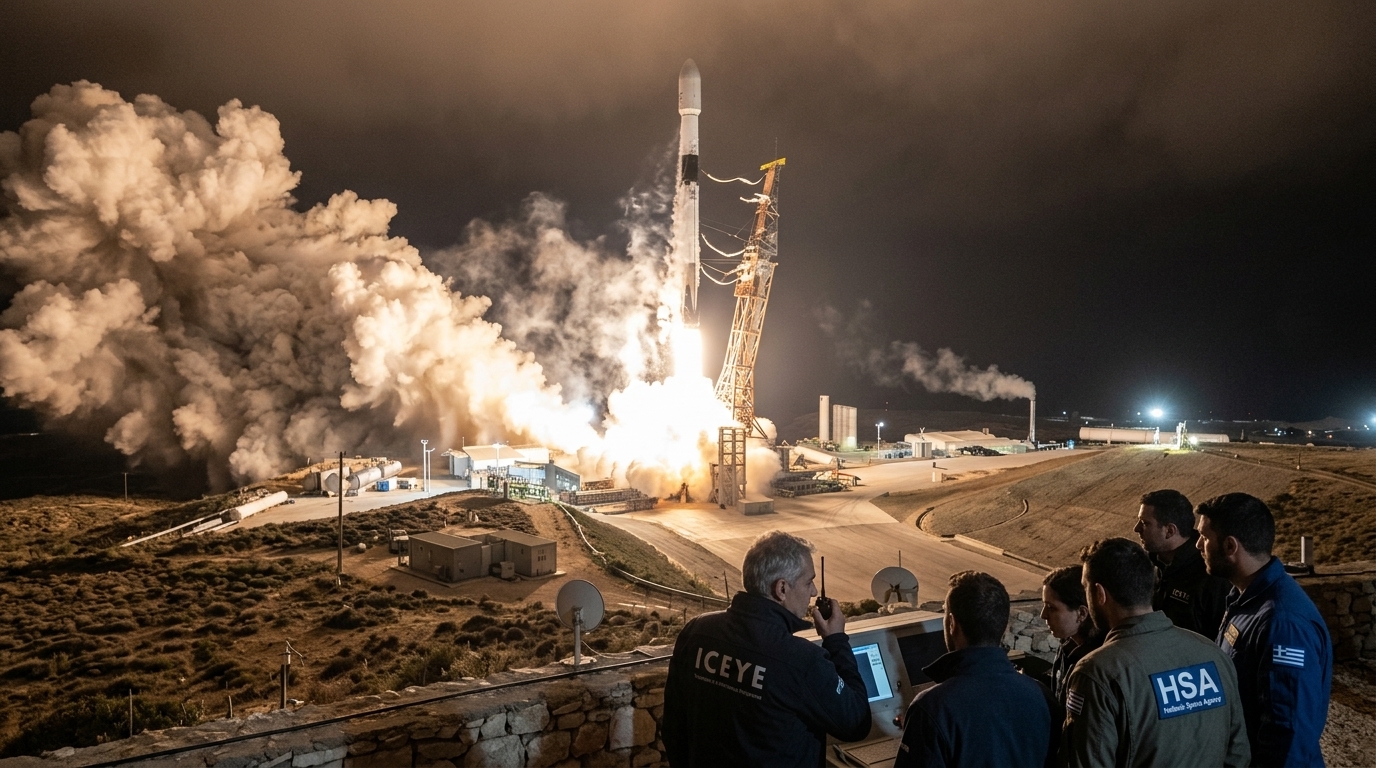
Greece, a nation traditionally anchored in maritime prowess and tourism, is now casting its gaze toward the stars—specifically, toward Low Earth Orbit (LEO). The recent announcement that ICEYE, the global leader in Synthetic Aperture Radar (SAR) technology, has chosen Athens to establish its largest global production and R&D facility is more than just a business win. It is the culmination of a national strategy aimed at positioning Greece as a central player in the burgeoning "New Space" economy.
The Strategic Weight of the National Microsatellite Program
ICEYE’s investment in Greece did not occur in a vacuum. It is the tangible result of the National Microsatellite Program, an ambitious initiative exceeding €200 million, funded by the Recovery and Resilience Facility (RRF) and implemented through the European Space Agency (ESA). This program is not merely about purchasing satellite data; it is about building a domestic value chain from the ground up.
With the launch of Hyperion GR-1, Greece gains its own dedicated "eyes" in space, capable of seeing through clouds, smoke, and total darkness. ICEYE’s SAR technology allows for near real-time earth observation, a capability of vital importance for a country frequently battling natural disasters such as wildfires and floods. The ability to receive high-resolution imagery every few hours fundamentally transforms how Civil Protection agencies manage crises and deploy resources.
Why ICEYE Chose Greece: Talent and Geography
The decision by a Finnish-headquartered company with a global footprint to move its center of gravity to Greece prompts an obvious question: why here? The answer is multifaceted. Firstly, Greece’s geographic position at the southeastern edge of Europe makes it a strategic hub for EU border security and Mediterranean surveillance. Secondly, the high caliber of Greek scientific talent—much of which has been working abroad—provides a ready pool for a meaningful "Brain Regain."
The new Athens facility will not be a mere assembly line. It will house R&D departments focused on designing the next generation of SAR sensors. This ensures that intellectual property and high-level technical expertise are generated on Greek soil, bolstering the existing ecosystem of Greek space startups and SMEs associated with the Hellenic Association of Space Industries (HASI).
Challenges and the Future of the Space Economy
Despite the current optimism, the trajectory is not without hurdles. The space industry demands long-term stability, consistent planning, and sustained funding that extends beyond the current RRF window. Greece must ensure that bureaucratic friction does not stifle innovation and that the public-private partnership model remains agile and efficient.
Furthermore, cybersecurity remains a paramount concern. Satellite infrastructure is increasingly targeted in hybrid warfare scenarios. Protecting the data produced by the Hyperion constellation and ensuring the integrity of communications with ground stations will be the next major challenge for the Ministry of Digital Governance. If Greece can maintain this momentum, the ICEYE facility will be remembered as the moment the country transitioned from a passive consumer of technology to a proactive architect of the 21st-century technological frontier.
- The investment is expected to create hundreds of high-skill jobs in engineering and physics.
- SAR technology provides unparalleled advantages for maritime border surveillance.
- Collaboration with ESA ensures adherence to the highest European aerospace standards.
- The project serves as a blueprint for utilizing RRF funds for high-tech industrialization.