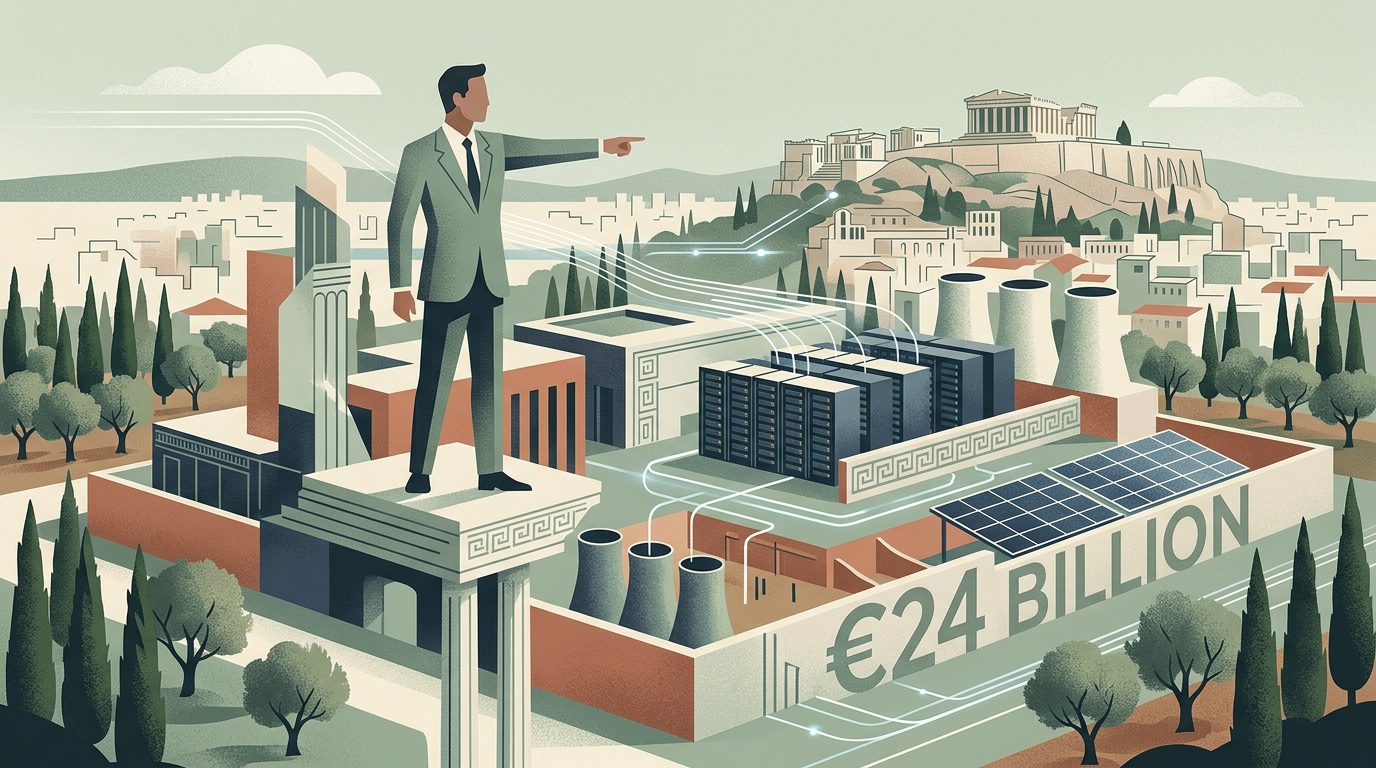
The history of the Public Power Corporation (PPC) has always been intertwined with Greece's economic development. However, under the leadership of Georgos Stassis, the organization is not merely seeking survival in the new era; it is pursuing a complete redefinition. The newly unveiled business plan, totaling €24 billion through 2030, marks the transition from a traditional utility company to an integrated provider of energy and digital services across Southeast Europe.
The Digital Pillar: The Kozani Data Center
At the heart of this transformation lies the creation of one of the largest data centers in Europe, to be located in Kozani. The choice of location is strategic. Western Macedonia, the country's traditional "energy heart," possesses the necessary grid infrastructure and access to vast amounts of power—essential elements for high-performance computing facilities. This project, to be implemented in collaboration with international partners, serves as the most potent symbol of the "Just Transition" from lignite to the digital economy.
The Kozani data center will not just be a storage facility. It is designed to be an Artificial Intelligence Hub, leveraging direct interconnection with PPC’s renewable energy sources. In an age where demand for computing power is skyrocketing due to Generative AI, the ability to provide "green" data offers PPC a unique competitive advantage in the European market.
A €24 Billion Investment Plan: The 2030 Strategy
The figure of €24 billion is staggering, but its allocation reveals a clear focus. PPC is strategically investing in decarbonization, aiming to shut down all lignite units and replace them with solar, wind farms, and energy storage systems. The acquisition of Enel Romania was the first major step toward Balkan expansion, creating an energy corridor stretching from Greece to the Black Sea.
- Renewable Energy Sources: Over 50% of investments are directed toward green energy, targeting an installed capacity exceeding 12GW.
- Grid Modernization: The digitalization of HEDNO (the distribution network) is critical for integrating renewables and deploying smart meters.
- New Services: From e-mobility (PPC Blue) to telecommunications via fiber optics, the company is entering every aspect of the consumer's daily life.
Geopolitical Dimensions and Energy Security
Georgos Stassis has repeatedly emphasized that the new PPC acts as a guarantor of energy security in the wider region. The interconnectivity of grids between Greece, Bulgaria, and Romania allows for optimal load management and long-term price reduction for the end consumer. The creation of the data center reinforces this role, as Greece transforms into a critical hub for the transfer of not only energy but also information.
"We are not just building an energy company. We are building the digital and energy backbone of Southeast Europe," a senior group executive noted during a recent investor presentation.
Significant challenges remain. Energy price volatility, bureaucratic hurdles in licensing new projects, and international competition in the data center sector require rapid reflexes. However, PPC’s capital adequacy and the confidence shown by international markets, as reflected in recent bond issuances, indicate that Stassis’s vision has the foundations to be realized.
Conclusion: Beyond Electricity
The PPC of 2026 bears no resemblance to the sluggish organization of the past. With its sights set on technology and sustainability, it aims to prove that a former state-owned enterprise can lead in the 4th Industrial Revolution. The Kozani data center will be the ultimate test: if Greece can successfully combine its sun and wind with data processing, the country will have finally secured its place on the global digital map.