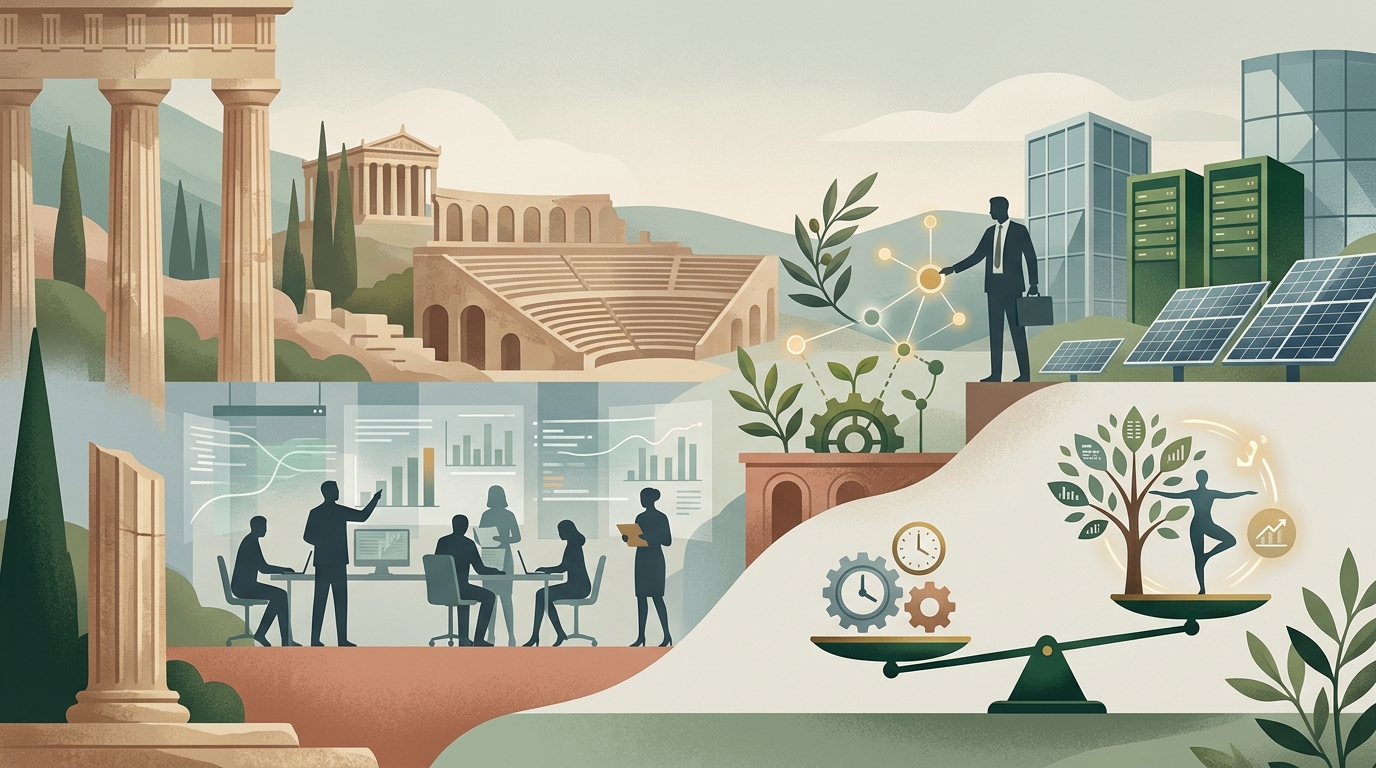
Within the framework of the 11th Delphi Economic Forum, the discussion on the future of work took on a new, deeper dimension through the remarks of George Lamprinos, Chairman and CEO of GEP. Participating in the panel titled "The Future of Work: Redefining the Human-Centric Workplace," Mr. Lamprinos posed the central dilemma of our time: how can businesses remain competitive without sacrificing their most valuable capital—the human being.
The concept of "Sustainable Performance" emerged as the keyword of his speech. According to the head of GEP, the traditional approach to productivity, which focuses exclusively on numbers and short-term profits, is now obsolete and dangerous. In today's world of multiple crises and rapid technological evolution, a company's performance is only sustainable when supported by an environment that promotes the health, safety, and psychological balance of its employees.
The Human at the Heart of Strategy
Mr. Lamprinos emphasized that the shift towards a human-centric model is not just an ethical choice but an imperative business necessity. "The bet for the next day is to create workplaces where the human does not feel like just a link in the production chain, but its driving force," he noted characteristically. This requires a radical overhaul of corporate cultures, where risk prevention and care for well-being are integrated into the core strategy rather than being a peripheral HR department function.
In this new environment, GEP, as the largest provider of occupational health and safety services in Greece, plays a decisive role. Mr. Lamprinos explained that safety is no longer limited to wearing a helmet or avoiding workplace accidents. It extends to mental health, managing workplace stress, and creating a climate of trust and inclusion.
Technology as an Ally, Not a Replacement
A significant aspect of the discussion at Delphi concerned the impact of Artificial Intelligence (AI) and automation. The CEO of GEP appeared optimistic, stressing that technology can relieve workers of dangerous or repetitive tasks, allowing them to focus on more creative and meaningful duties. However, he warned that the technological transition must occur under terms of "human oversight." Technology must serve safety and health, providing real-time data for risk prevention, but final decision-making and empathy remain exclusively human traits.
ESG and Corporate Responsibility
Mr. Lamprinos linked sustainable performance to ESG (Environment, Social, Governance) criteria, noting that the social dimension (the "S") necessarily passes through the health and safety of employees. Investors and society now demand that companies demonstrate in practice that they respect human rights and the well-being of their staff. GEP, through its services, helps businesses turn these obligations into a competitive advantage by reducing absenteeism and increasing employee loyalty.
Concluding his remarks, George Lamprinos called upon the business world to view investment in people not as a cost, but as the most efficient investment for the future. In an era where finding and retaining talent is the greatest challenge for Greek enterprises, "Sustainable Performance" is the only path to long-term success.