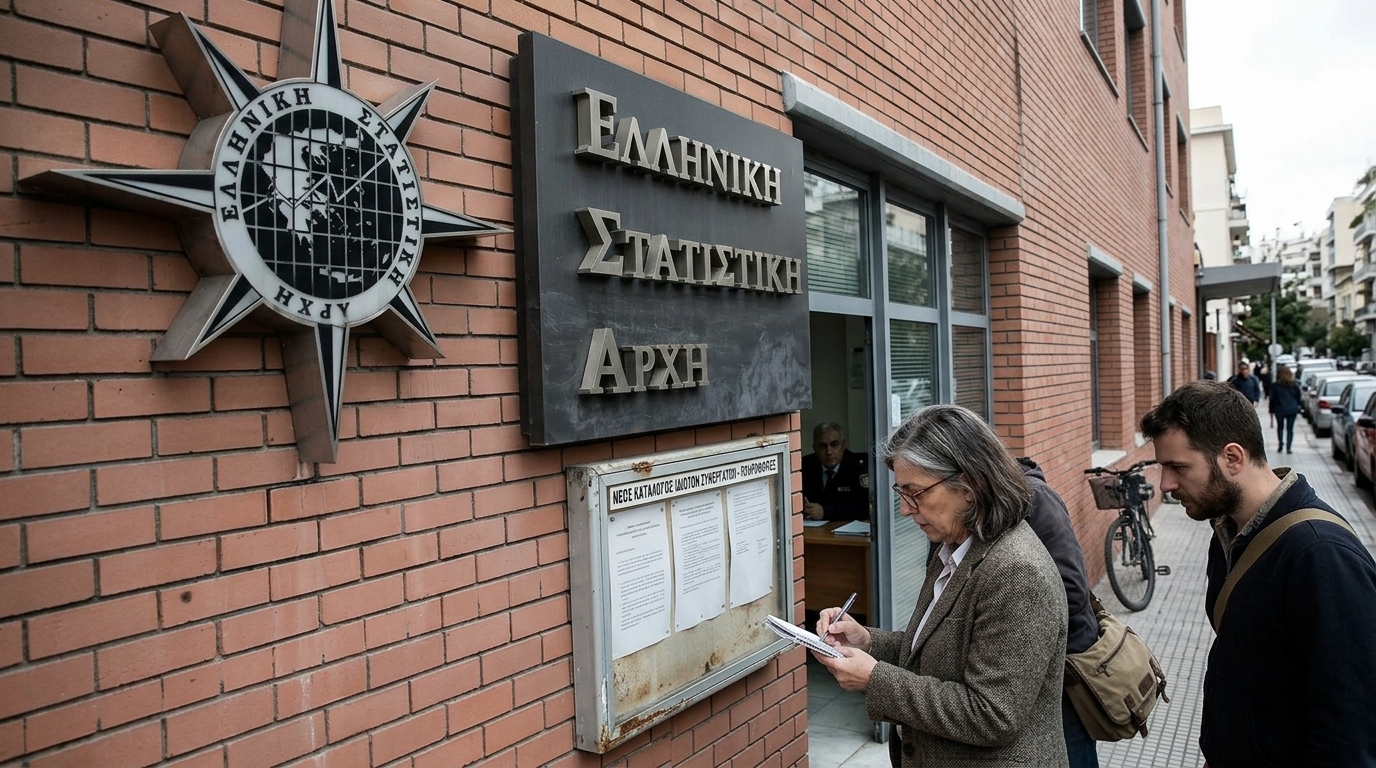
The Hellenic Statistical Authority (ELSTAT) has announced the opening of applications for the new Registry of Private Collaborators for the period spanning May to December 2026. This is a critical initiative aimed at strengthening the primary data collection mechanism, which serves as the foundation for public policy design and the extraction of vital economic and social indicators. In an era where data accuracy is more paramount than ever, ELSTAT is seeking collaborators who will act as the "sensors" of Greek reality in the field.
Eligibility and Exclusion Criteria
The Registry is open to natural persons, Greek citizens, or citizens of EU member states, who are at least high school graduates and aged between 18 and 67. However, the call includes clear restrictions aimed at ensuring impartiality and efficiency. Specifically, employees of the public sector, Legal Entities under Public Law (NPDD), Local Government Organizations (OTA), and public enterprises are excluded, as are the permanent or contract staff of ELSTAT itself.
The selection of collaborators is not random but follows a rigorous scoring system. Criteria include educational level (with extra points for postgraduate and doctoral degrees), prior experience in previous ELSTAT surveys, foreign language proficiency, and certified computer literacy. It is evident that the Authority aims to create a pool of collaborators who combine academic training with practical field experience.
The Nature of Contracts and the "Trap" for the Unemployed
One of the most critical points of the call concerns the legal nature of the collaboration. Private Collaborators are not hired as salaried employees; instead, they sign a work-for-hire contract (service agreement). This means they are paid based on the number of questionnaires they correctly complete and the quality of the data they collect. Remuneration is determined by the type of survey—whether it involves household surveys, such as the Labor Force Survey, or business surveys.
Particular attention is required for those registered as unemployed with DYPA (formerly OAED). Participating in the Registry and undertaking a project may lead to the loss of unemployment status or the termination of unemployment benefits, as the work-for-hire contract is considered employment. ELSTAT explicitly points out that candidates should weigh the financial benefit of the collaboration against the potential impact on their social benefits.
The Technological Dimension: From Paper to Tablet
As part of the country's digital transformation, ELSTAT has moved the majority of data collection to digital platforms. Private Collaborators are now required to use specialized applications on mobile devices (tablets) to conduct interviews. This drastically reduces entry errors and accelerates the data processing timeline. Technological literacy is no longer just an advantage but a basic prerequisite for survival in the role of a researcher.
Surveys to be conducted during the May-December 2026 period include the Statistics on Income and Living Conditions (EU-SILC), the Household Budget Survey, and a series of sectoral surveys on tourism and agriculture. This data is vital for the European Union and Eurostat, as it allows for the real-time comparison of Greece with other member states.
Conclusions and Outlook
ELSTAT's call represents an opportunity for thousands of citizens to earn additional income and participate in a process of national importance. However, it also highlights the systemic issues of the labor market, where flexible employment (the gig economy) is becoming the norm even for the state itself. Interested parties are invited to submit their applications electronically on the ELSTAT website, paying close attention to the accuracy of their details, as any inaccuracy can lead to exclusion from the Registry.