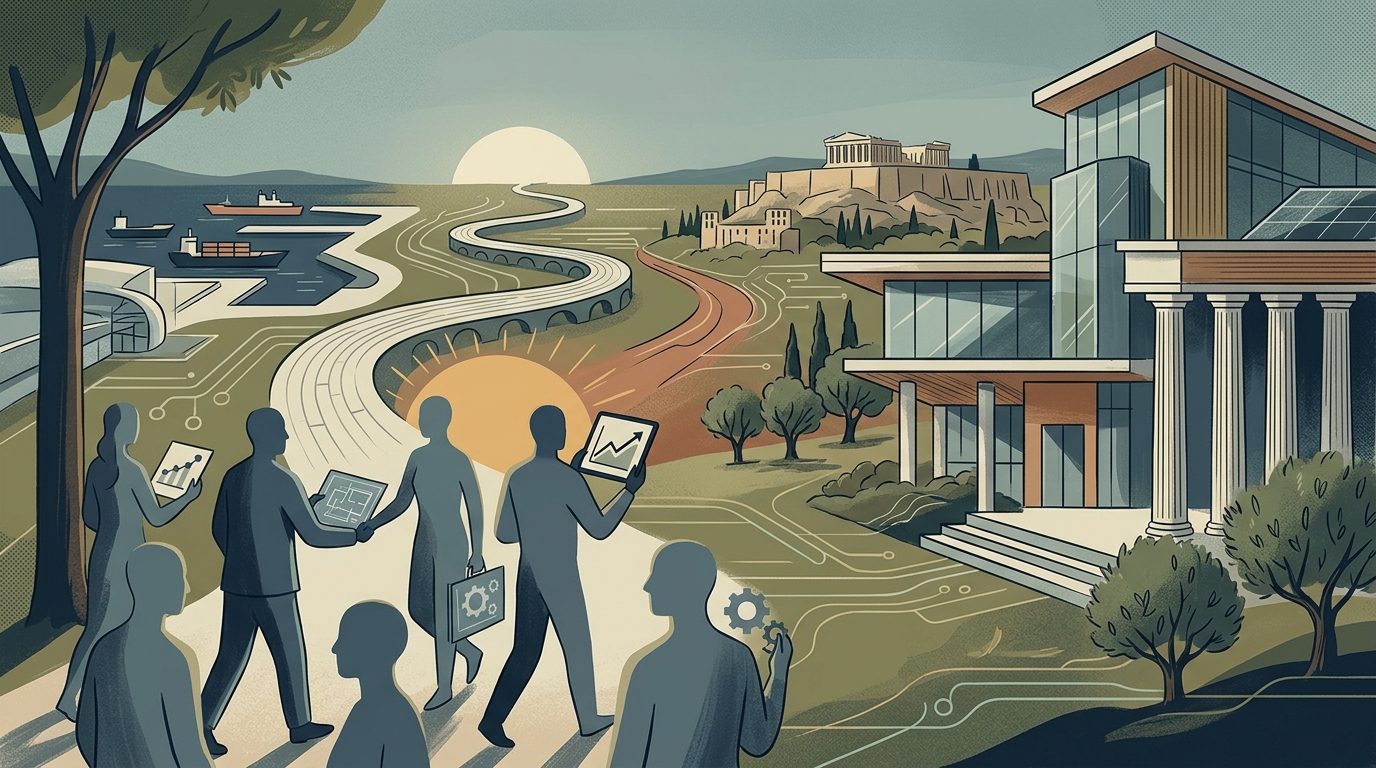
At the foot of Mount Parnassus, where the Oracle of Delphi once offered prophecies about the future, the 2026 Delphi Economic Forum attempted to decipher the most critical puzzle of the modern Greek economy: how to transform education into a driving force for production. In an era where Artificial Intelligence (AI) is no longer a future promise but a daily reality in offices and factories, the discussion about skills has taken on an existential character for businesses and employees alike.
The Paradox of the Greek Labor Market
Despite the steady decline in unemployment over recent years, Greece continues to face a sharp paradox: businesses report an inability to find suitable personnel, while thousands of graduates remain outside the market or are underemployed. Participants in the "From Education to Production" panel emphasized that the skills gap is not just about technical knowledge (hard skills), but primarily about the ability to adapt to a constantly changing environment.
According to data presented, over 60% of Greek businesses consider the lack of digital skills as the greatest obstacle to their growth. Artificial Intelligence has accelerated this need, rendering certain traditional forms of knowledge obsolete within months. The challenge is no longer just obtaining a degree, but cultivating a mindset of "lifelong learning."
The Revolutionary Convergence of Universities and Businesses
One of the most interesting proposals submitted at the Forum concerns the institutional connection of universities with production. The isolation of the academic community from market needs is now considered a luxury the country cannot afford. The creation of joint curricula was proposed, where students would spend a significant part of their education within real work environments, using AI tools and data analytics.
- Creation of "Industrial Doctorates" with direct application in Greek exporting companies.
- Integration of AI ethics and governance courses in all departments, not just technological ones.
- Development of micro-credentials that will allow workers to certify new skills in a short period.
The role of the private sector is equally critical. Large companies in Greece have already begun to operate as "educational organizations," founding their own academies to fill the gaps left by the public education system. However, the question remains: what happens to the small and medium-sized enterprises (SMEs) that form the backbone of the economy and do not have the resources for such investments?
AI as an Accelerator, Not a Threat
Contrary to the fear that prevailed in previous years regarding the mass replacement of jobs, the atmosphere in Delphi was more optimistic, albeit with strict conditions. AI is now treated as a tool for "augmentation" of human potential. The focus is shifting to "human" skills that the machine cannot (yet) replace: critical thinking, creativity, empathy, and complex problem-solving abilities.
"Education is not the filling of a pail, but the lighting of a fire," was a characteristic quote, paraphrasing Plutarch, to emphasize that 2026 education must teach young people how to learn, not what to memorize.
The bet for Greece is not to fall behind in the global competition for talent. "Brain Regain," the return of Greek scientists from abroad, directly depends on the creation of an ecosystem where skills are fairly compensated and innovation finds fertile ground. The Delphi Economic Forum concluded that investing in skills is the only sustainable social and economic policy for the next decade.