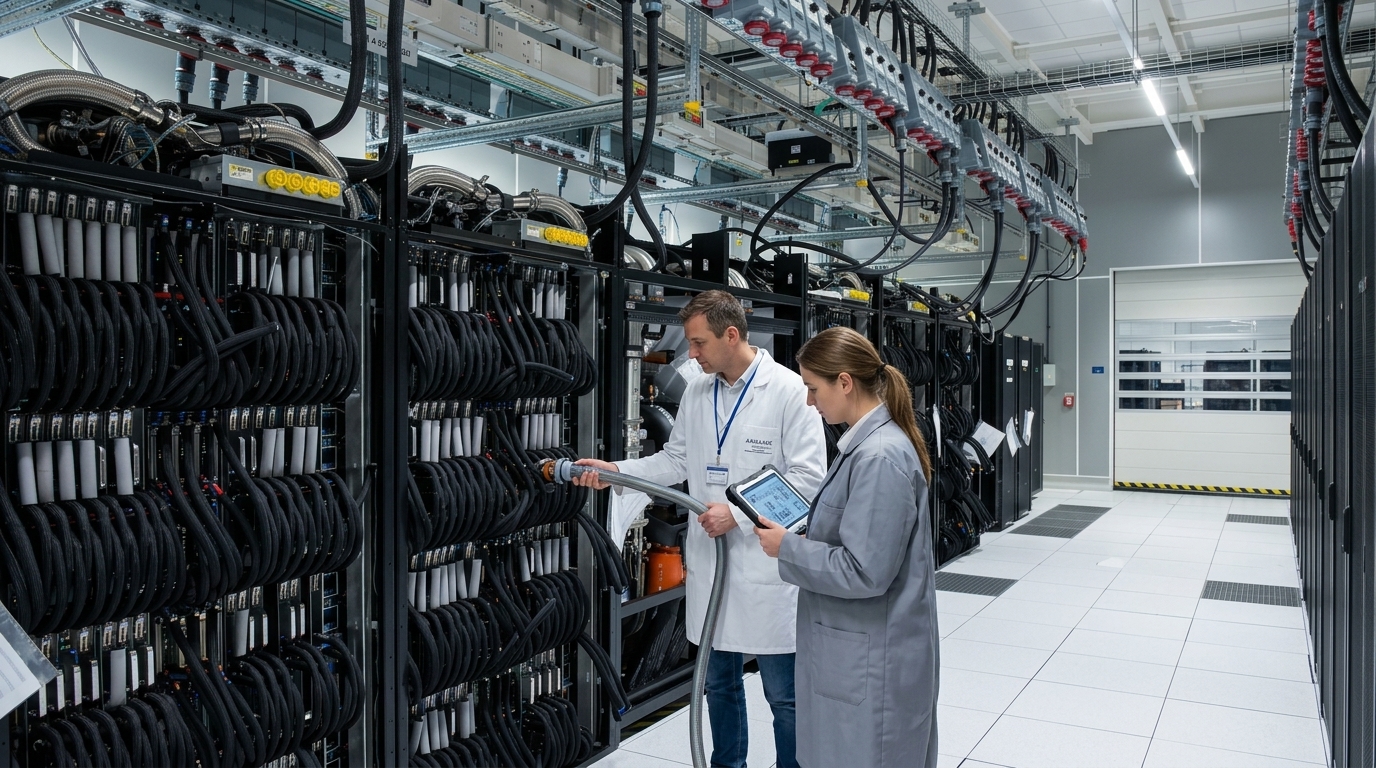
In the heart of the Lavrion Technological and Cultural Park, where Greece's industrial revolution once penned its first chapters, a new digital renaissance is currently unfolding. 'Daedalus,' Greece's first world-class supercomputer, is expected to become fully operational in the autumn of 2026, marking a pivotal moment for the country's technological sovereignty and the integration of Artificial Intelligence into the national economy.
The project, part of the broader European EuroHPC JU (European High Performance Computing Joint Undertaking) initiative, is far more than a mere hardware addition. It is a strategic infrastructure aimed at democratizing access to high-performance computing resources, which until recently were the exclusive privilege of Silicon Valley tech giants or elite foreign academic institutions.
The Architecture of Power and Green Innovation
Daedalus is not your typical server. Designed to deliver performance exceeding 30 Petaflops (30 quadrillion floating-point operations per second), the supercomputer will likely rank among the 500 most powerful systems globally (Top500). Its architecture is specifically optimized for Artificial Intelligence applications (AI-ready), featuring thousands of latest-generation graphics processing units (GPUs), which are essential for training Large Language Models (LLMs) and processing Big Data.
One of the project's most striking features is its emphasis on sustainability. The installation within the historic Electric Power Station building of the French Mining Company of Lavrion was no random choice. Daedalus's cooling system will utilize advanced liquid cooling technologies, drastically reducing its energy footprint. Furthermore, its proximity to the coastline allows for the exploration of using seawater for heat dissipation, following the standards of the most modern data centers in Scandinavia.
Democratizing AI for SMEs
What sets Daedalus apart from previous efforts is its focus on the country's productive forces. The Ministry of Digital Governance has made it clear that a significant percentage of its computing power will be allocated to Small and Medium Enterprises (SMEs) and startups. This means that a Greek biotechnology company, for instance, will be able to run simulations for new drugs in Lavrion instead of paying exorbitant fees to foreign cloud providers.
- Weather Forecasting: Localized precision for civil protection and disaster management.
- Personalized Medicine: Genomic data analysis for patients within the National Health System.
- Shipping: Optimizing vessel routes to reduce emissions and fuel consumption.
- Cultural Heritage: Digitization and 3D reconstruction of monuments using AI.
Access will be granted through open calls, with criteria favoring innovation and social impact. In this way, Greece hopes to stem the 'brain drain' of data scientists by providing them with the tools to create world-class products from their home base.
Challenges and the Implementation Stakes
Despite the optimism, the road to autumn is not without obstacles. Managing such a system requires highly specialized personnel, who are currently in short supply. Staffing the Daedalus support team is just as critical as installing the physical hardware racks. Additionally, integrating the supercomputer into the European network requires ultra-high-speed interconnects (terabit links), which must be hardened against cyberattacks.
"Daedalus is not just a machine; it is the accelerator of our national confidence in the digital age," ministry sources state.
In conclusion, the launch of Daedalus this coming autumn represents a bet on whether Greece can transform from a technology consumer into a producer. If the venture succeeds, Lavrion will have achieved something unique: connecting the mines of the 19th century with the 'data' of the 21st, proving that the history of innovation is a continuous line that simply changes form.