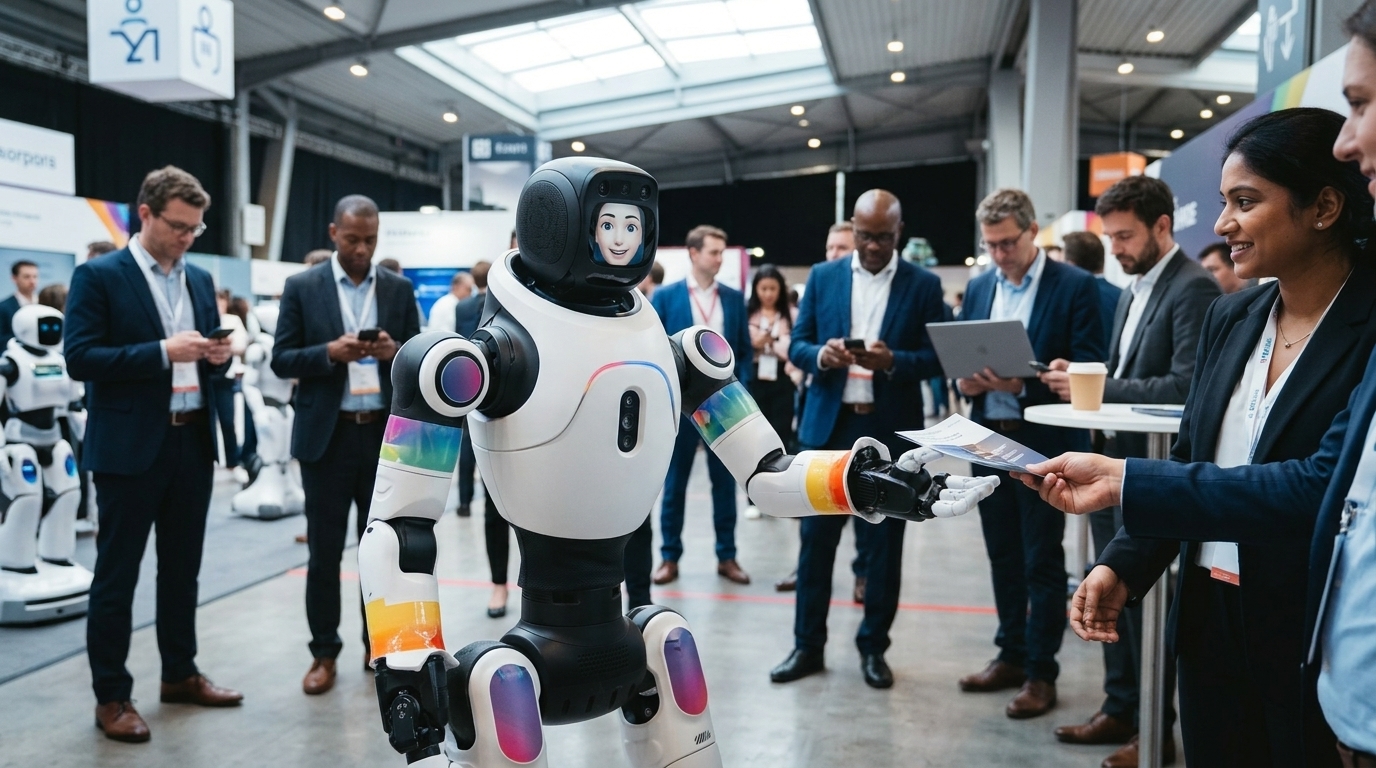
The global technological stage is witnessing a paradigm shift that few predicted would happen so swiftly. China, once known as the "world's factory," is rapidly evolving into the epicenter of the humanoid robot revolution. A recent report by Morgan Stanley has sent shockwaves through the investment community, as the banking giant doubled its forecasts for the commercialization of these machines, acknowledging that the convergence of Artificial Intelligence and advanced engineering is accelerating at a geometric pace.
Beijing's Strategic Gambit
This is not merely a technological fad; it is an existential necessity for the Chinese economy. Faced with a rapidly aging population and a shrinking workforce, the Chinese government has designated humanoid robots as a priority of national importance. The "Made in China 2025" initiative has matured into a broader strategy where robots are no longer just static tools on assembly lines, but autonomous partners in warehouses, hospitals, and retail environments.
Morgan Stanley highlights that production costs are plummeting. While a humanoid robot cost upwards of $250,000 just a few years ago, Chinese firms like Unitree and Fourier Intelligence are now targeting price points below $30,000. This cost reduction, paired with breakthroughs in "Embodied AI," allows robots to learn tasks through observation and simulation rather than rigid, traditional programming.
The Supply Chain Advantage
Why is China leading the charge? The answer lies in its vertically integrated supply chain. Much like the trajectory of Electric Vehicles (EVs), China controls the production of critical components: from servo motors and harmonic drive reducers to LiDAR sensors and high-density batteries. This ecosystem enables rapid prototyping and mass manufacturing at a scale that the West struggles to match.
"We are not just seeing an improvement in existing technology, but the birth of a new industrial category that could be as significant as the smartphone," the report states.
Morgan Stanley now predicts that by 2035, the global population of humanoid robots could exceed 10 million, with China holding the lion's share of both production and domestic consumption. Their application in heavy industry, such as automotive assembly, is already a reality. Companies like NIO and BYD are testing humanoids on their production lines for tasks that require precision but are hazardous or repetitive for human workers.
Challenges and Geopolitical Rivalry
Of course, the path forward is not without hurdles. Battery life remains a limiting factor, and the ability of robots to navigate unstructured environments—such as a cluttered home—requires further AI refinement. Furthermore, the geopolitical competition with the United States is intensifying. Tesla’s Optimus remains the primary Western contender, but China’s approach is more "collective," featuring dozens of subsidized startups collaborating with state entities.
- Cost Reduction: Targeting price points accessible to small and medium enterprises.
- AI Training: Leveraging Large Language Models (LLMs) for intuitive voice command understanding.
- Demographic Adaptation: Filling labor gaps in an aging society.
- Export Power: China aims to become the global provider of "labor-as-a-service."
In this environment, Europe and the rest of the world must decide whether to be mere consumers of these technologies or to invest in their own R&D. The speed at which Morgan Stanley revised its forecasts indicates that the time for hesitation has passed. The future of work is no longer a distant prospect; it is already walking on metallic legs through the factory floors of Shenzhen.